
The Variant Address
Two catalogues can describe exactly the same things and still fail to agree on most of their rows. That happens when one system writes a web address c...
Two catalogues can describe exactly the same things and still fail to agree on most of their rows. That happens when one system writes a web address carefully and another writes the same address casually, in several different ways at once. The pages are the same pages, with the same identifiers, yet a straightforward comparison reports most of the catalogue as missing. This article follows a measurement of that failure, spelling by spelling, and shows how much of it disappears at each step of repair.
What The Variant Address means
The Variant Address is a single web resource recorded under more than one written form of its address, where the forms differ only in presentation details — letter case in the scheme and host, an optional prefix, an explicit default port, or a trailing slash — and therefore defeat comparisons that treat the address as an opaque string. The resource has not moved and has not been duplicated. Only its label varies. Any join, deduplication pass or inventory comparison that matches addresses character by character will count the variants as different resources, understating overlap and overstating catalogue size.
The idea sits near, but is not the same as, The Two Alphabets. That concept concerned one domain name written in two alphabets, Unicode versus Punycode, where the characters belong to different writing systems and an encoding step translates between them. The Variant Address involves no second alphabet and no encoding: every character stays within the same alphabet. The scatter comes from case, from a prefix that may or may not be present, from a port number that merely restates the default, and from a final slash some writers include and others omit. Repair there requires decoding; repair here requires agreeing on one house style and rewriting every address into it.
Two inventories of the same catalogue
The measurement behind this article compared two inventories of the same 300 web resources (Source: batch 22 SD measurement results, group AM1). Source A stores canonical addresses throughout, in the form https://example.com/products/item-<id>, where each resource carries a distinct identifier. Source B covers the same 300 resources, but spreads them across five spellings, with 60 resources in each: the canonical spelling, an uppercase scheme and host, a version with a www prefix, a version with the explicit default port :443 written out, and a version ending in a trailing slash (Source: batch 22 SD measurement results, group AM1).
Nothing in source B points at the wrong place. Each spelling is a form a real system might plausibly write, copy or store; browsers tolerate the variations, and a human skimming the list would recognise one catalogue. The difficulty appears only when a machine reconciles the inventories by comparing strings, the cheapest and most common method. At that moment, presentation differences stop being cosmetic and start behaving like missing data.
What an exact join finds, and what it misses
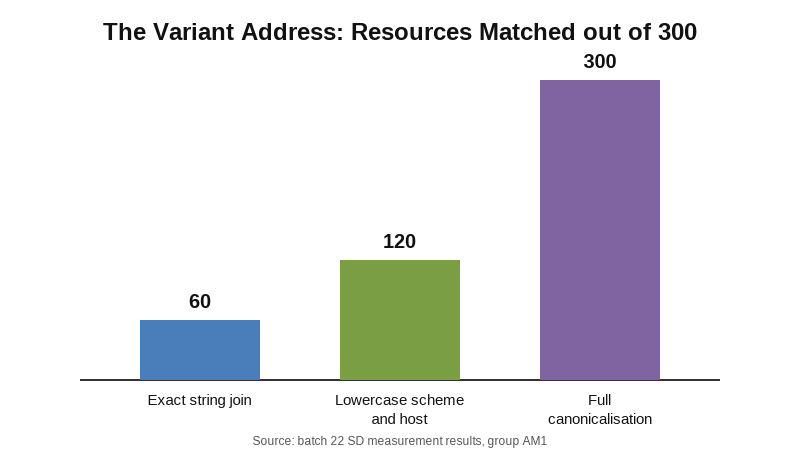
An exact string join between the two inventories matched 60 of 300 resources, with 0 false pairs (Source: batch 22 SD measurement results, group AM1). The 60 matches are precisely the block that source B happened to store in canonical form. The other 240 resources were present in both inventories the whole time, yet the join reported them as unmatched, because in each case at least one character differed between the two written forms.
The zero in the false-pairs column deserves as much attention as the low match count. An exact join never invents a pairing: every pairing it produced was correct. Its failure mode is silence rather than error, which makes it easy to miss, because a report built on exact matching looks clean and consistent. It simply describes a catalogue in which 240 real resources appear to exist in only one source, inviting false conclusions about coverage gaps or incomplete crawls.
A partial repair: fixing case alone
The first repair step tested was the smallest one: lowercasing the scheme and host portions of each address before joining. That single change matched 120 of 300 resources, again with the canonical block included, doubling the yield of the exact join (Source: batch 22 SD measurement results, group AM1). The uppercase block, all 60 resources, came back into agreement once case stopped distinguishing them.
The remaining 180 resources stayed unmatched for reasons unrelated to case. The www prefix adds characters lowercasing cannot remove, the explicit port inserts a colon and digits absent from the canonical form, and the trailing slash appends a character at the end. Each family needs its own rule, so partial repairs plateau predictably: a fix recovers exactly the family it addresses. A team that applied the case fix, watched matches double, and stopped there would still miss three fifths of the true overlap, possibly with more confidence than before.
Full canonicalisation closes the gap
Applying the complete set of rules — lowercasing scheme and host, stripping the www prefix, dropping the default port, and stripping the trailing slash — before joining matched 300 of 300 resources, with 0 false pairs (Source: batch 22 SD measurement results, group AM1). Every resource in source B found its counterpart in source A, and no resource was paired with the wrong counterpart along the way.
Two checks support the result. The absence of false pairs matters as much as the full match count, because aggressive rewriting can in principle collapse genuinely different addresses onto one string; here it did not. The measurement also carries an independent checksum: the resource identifiers sum to 1,598,159 from both sources (Source: batch 22 SD measurement results, group AM1). Matching totals confirm the inventories cover the same 300 resources, so the earlier shortfalls were artefacts of spelling, not missing content. When join and checksum agree, the repair can be trusted; when they disagree, the rewriting rules are the first place to investigate.
How the measurement was assembled and how to repair variant addresses
The measurement is a deterministic synthetic measurement with self-written parsing rules, not a commercial product test. Two inventories of 300 resources were constructed deliberately: one in a single canonical spelling, the other divided evenly across five spellings, 60 resources each, so that the true overlap was known in advance to be complete. Each matching strategy — exact string comparison, case-normalised comparison, and full canonicalisation — was then applied to the same pair of inventories, and matches and false pairs were counted against the known ground truth. Because the construction is deterministic, anyone applying the same rules to the same inventories obtains the same counts, and the identifier checksum of 1,598,159 from both sources provides a construction check that no resource was lost or duplicated while the inventories were built (Source: batch 22 SD measurement results, group AM1).
For real catalogues, the repair sequence mirrors the measurement. Canonicalise before comparing, never after a failed join has shaped decisions. Agree the canonical form first: lowercase scheme and host, one www decision applied everywhere, default ports omitted, one trailing-slash convention. Apply the rewriting deterministically to every source, including the one believed clean, because a canonical source can drift. Keep the original strings alongside the canonical form so any rule can be audited or reversed. Finally, verify with an independent total, such as an identifier sum, rather than trusting the join count alone: a full join and an agreeing checksum are two different kinds of evidence pointing the same way.
Questions, answered
Why did the exact join match only 60 of the 300 resources? Because only 60 resources in source B were stored in exactly the canonical spelling used by source A. The other 240 differed by case, a www prefix, an explicit default port or a trailing slash, and an exact string comparison treats any single differing character as a different address. The result was 60 of 300 matched with 0 false pairs (Source: batch 22 SD measurement results, group AM1).
Does full canonicalisation risk merging addresses that are genuinely different? It can in principle, which is why false pairs were counted throughout the measurement. In this case the full rule set — lowercase, strip www, drop the default port, strip the trailing slash — matched 300 of 300 with 0 false pairs (Source: batch 22 SD measurement results, group AM1), and the identifier checksum of 1,598,159 from both sources independently confirmed that the inventories covered the same resources.
Summary
The Variant Address shows how a catalogue can disagree with itself without anything being missing. Five spellings reduced an exact join to 60 matches out of 300, a case fix recovered one family to reach 120, and full canonicalisation restored all 300 with no false pairs. The resources never changed; only their written forms did. Teams should therefore canonicalise before joining, apply the rules to every source, and confirm the outcome with an independent checksum.
Sources
- Batch 22 SD measurement results, group AM1.