
The Two Thousands: A Thousand, a Thousand and Twenty-Four, and a Label That Lies
Storage arithmetic harbours a quiet ambiguity: the word kilo means a thousand, except when it means a thousand and twenty-four. A capacity labelled KB...
Storage arithmetic harbours a quiet ambiguity: the word kilo means a thousand, except when it means a thousand and twenty-four. A capacity labelled KB may have been computed by multiplying by 1000, and the same digits labelled KiB by multiplying by 1024, and a reader that applies one multiplier to every label will be wrong about much of any mixed file. This article measures that error on a constructed set of byte counts, and then something worse: a block of rows whose labels do not tell the truth at all.
What The Two Thousands means
The Two Thousands is the condition in which byte counts are expressed under two rival calibres, the decimal multiplier 1000 behind the KB label and the binary multiplier 1024 behind the KiB label, so that any single-calibre reading systematically misjudges the rest. Each source in the measurement held 300 records carrying 300 distinct byte counts (Source: batch 21 SD measurement results, group AL6).
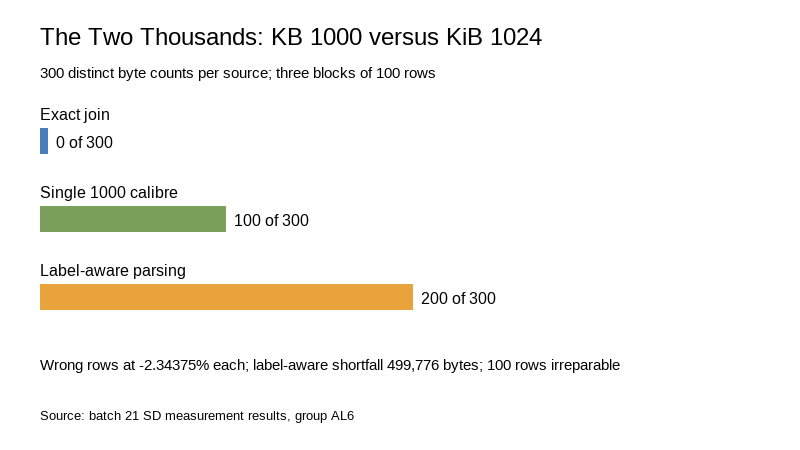
> Census: 300 records per source; an exact join matched 0 of 300, a single 1000-calibre parse matched 100 of 300 with a misjudgement rate of 66.67%, and a label-aware parse matched 200 of 300 with a misjudgement rate of 33.33%, leaving 100 rows whose labels are themselves distorted and which no text-layer rule can repair (Source: batch 21 SD measurement results, group AL6)
The Two Thousands differs from its nearest neighbour, The Percent Scale, first in size and then in kind. In The Percent Scale, one rendering of a ratio was read on another rendering's scale and the received value was out by a factor of one hundred. The calibre error here amounts to only a few percent in relative terms — precisely, every wrongly read row is low by a constant relative error of -2.34375% (Source: batch 21 SD measurement results, group AL6) — small enough to pass unnoticed for years. And in The Percent Scale the text at least contained the truth for a reader who knew the scale, while here 100 rows carry labels that lie about their own calibre, so the text layer holds no truth to recover. The Percent Scale is a reading error; The Two Thousands is a reading error compounded by a labelling failure that reading alone cannot fix.
Three blocks, and an exact join that matches nothing
The second source divided its 300 rows evenly across three blocks of 100: values labelled KB and genuinely computed at the 1000 calibre, values labelled KiB and genuinely computed at the 1024 calibre, and values labelled KB but actually computed at the 1024 calibre, the mislabelled block (Source: batch 21 SD measurement results, group AL6). Joining the stored strings exactly matched 0 of 300 rows and failed on all 300 (Source: batch 21 SD measurement results, group AL6), because the first source stores bare integers and every row in the second source carries a unit label, so no pair of strings can be equal.
The quantities behind the labels were drawn as multiples of 0.25 within the range from 1.25 to 400, with the three blocks' quantity ranges kept disjoint so that no block's values could coincide with another's by construction (Source: batch 21 SD measurement results, group AL6). That care matters later: when the label-aware parse produces a false merge, it is a genuine accident of arithmetic.
One calibre for everything: a constant, quiet underestimate
The first repair parsed every value at the 1000 calibre, whatever the label said. It matched 100 of 300 rows, the genuinely decimal block, and misjudged the rest, a misjudgement rate of 66.67% across 200 wrong rows (Source: batch 21 SD measurement results, group AL6). Every wrong row is low by exactly the same relative error of -2.34375%, the gap between the two calibres expressed as a proportion (Source: batch 21 SD measurement results, group AL6). In absolute terms it errs by a mean of 4,829.07 bytes per wrong row, up to a maximum of 9,570 bytes (Source: batch 21 SD measurement results, group AL6). A constant relative bias does not average away as files grow; it scales with them, and only a check against an outside truth, such as the unlabelled byte counts in the first source, exposes it.
Reading the labels honestly still leaves a hundred rows wrong
The second repair believed the labels, multiplying KB values by 1000 and KiB values by 1024. It matched 200 of 300 rows and still failed on 100, a misjudgement rate of 33.33% (Source: batch 21 SD measurement results, group AL6). The survivors are the mislabelled block. Those 100 rows are distorted in the label itself, not merely scattered in form, and no rule that reads only the text can repair them. This article therefore reports no full-parse recovery for this group, because none exists: the honest ledger entry is 200 of 300, with 100 rows irrecoverable without information from outside the file.
The damage is quantifiable. Summed, the first source holds 63,138,314 bytes, while the label-aware parse of the second source totals 62,638,538 bytes, a shortfall of 499,776 bytes that the label-aware reading silently loses (Source: batch 21 SD measurement results, group AL6). Within that block the mean absolute error is 4,997.76 bytes per row, reaching a maximum of 9,444 bytes, at the same constant relative error of -2.34375% (Source: batch 21 SD measurement results, group AL6). The label-aware level also produced 1 false-merge pair: one mislabelled row, read at the 1000 calibre its label claims, lands exactly on another record's true byte count (Source: batch 21 SD measurement results, group AL6).
Constructing a file where a third of the labels lie
From seed 42, the generator drew 300 distinct byte counts, stored them as bare integers in one source, and expressed them in the other under three labelling regimes in equal blocks, keeping the blocks' quantity ranges apart (Source: batch 21 SD measurement results, group AL6). Three readings were applied: exact text, the single 1000 calibre, and the label-aware pair of calibres. The work is a deterministic synthetic measurement whose parsing rules were written by hand for the purpose in the standard library; it audits no commercial product, and the mislabelled block is a constructed worst case, not an estimate of real-world mislabelling.
Questions, answered
Why did the exact join match nothing at all? Because every value in the second source carries a unit label and the first source stores bare integers, so no pair of strings can be equal. The exact join matched 0 of 300 rows and failed on all 300 (Source: batch 21 SD measurement results, group AL6).
How large is the error from reading everything at the 1000 calibre? Uniform and systematic: each of the 200 wrong rows is low by a constant relative error of -2.34375%, and the misjudgement rate at that level is 66.67% (Source: batch 21 SD measurement results, group AL6).
Why can the label-aware repair not finish the job? Because 100 rows are labelled KB but were computed at the 1024 calibre, so the label itself is distorted. The label-aware parse matched 200 of 300 rows with a misjudgement rate of 33.33%, and still fell 499,776 bytes short of the true total of 63,138,314 bytes (Source: batch 21 SD measurement results, group AL6).
Did any repair in this group avoid false merges entirely? No. The label-aware parse produced 1 false-merge pair, when a mislabelled row read at its claimed calibre coincided exactly with another record's true byte count (Source: batch 21 SD measurement results, group AL6).
Summary
The Two Thousands sets two multipliers behind near-identical labels and lets each reading strategy inherit a characteristic failure: an exact join matched 0 of 300 rows, a single 1000-calibre parse matched 100 of 300 with a constant -2.34375% underestimate on every wrong row, and a label-aware parse matched 200 of 300 while still losing 499,776 bytes to the mislabelled block (Source: batch 21 SD measurement results, group AL6). Against The Percent Scale, whose hundredfold confusion at least leaves the truth inside the text, the bias here is far smaller, quiet enough to survive for years, and in its worst block the truth is not in the text at all.
Sources
- Batch 21 SD measurement results, group AL6: 300 records per source, 300 distinct byte counts; source B blocks 100 each across honest KB at the 1000 calibre, honest KiB at the 1024 calibre, and mislabelled KB computed at the 1024 calibre; exact join 0 matched, 300 failed; single-calibre parse 100 matched, misjudgement rate 66.67%; label-aware parse 200 matched, 100 failed, misjudgement rate 33.33%, 1 false-merge pair; every wrong row at a relative error of -2.34375%; true total 63,138,314 bytes, label-aware total 62,638,538 bytes, shortfall 499,776 bytes.
- Measurement script sd_batch21_measurements.py, group AL6: deterministic synthetic construction, seed 42, self-written parsing rules, pure standard library; not a commercial product measurement.