
The Thirteenth Digit: A Zero That Changes Nothing and Everything
Product codes are supposed to be the easy part of joining two files. A code is assigned once, printed on the packaging, and carried through ordering,...
Product codes are supposed to be the easy part of joining two files. A code is assigned once, printed on the packaging, and carried through ordering, stock, and sales systems, so it feels like a stable key that should match wherever it appears. In practice the same product can arrive wearing the same digits in different lengths, because one system stores a national form and another stores the international form built from it. The extra digit is only a zero, and a zero at the front looks like nothing at all. This measurement asks what happens when that nothing is handled carelessly, handled partly, and handled fully, and whether the check digit that guards the code survives the change of length or has to be rebuilt.
What The Thirteenth Digit means
The Thirteenth Digit is the leading zero that turns a 12-digit UPC-A code into a 13-digit EAN-13 code, lengthening the stored string without changing which product the code identifies. The product stays the same, the data digits stay the same, and the final check digit stays the same. Only the representation grows, because the longer form reserves its first position in a way that the shorter form leaves implicit. Two records can therefore disagree as strings while agreeing completely as identifiers, and a join that compares strings alone will treat one product as two.
The neighbouring concept is The Reissued Identifier, where an ISBN-10 became an ISBN-13, the prefix changed, and the check digit was recomputed for the new form. The precise difference is that here the check digit survives untouched: the same digit validates both the twelve-digit and thirteen-digit forms. That survival is not a small technical footnote. It means the longer code is not a reissue and needs no new validation logic, no conversion table for check digits, and no fresh assignment from an authority. It is the old code with a zero standing in front of it, and any process that recomputes or discards the check digit during conversion is doing work the format never asked for, while risking fresh errors in a digit that was already correct.
Four stored forms of the same codes
The measurement uses 300 distinct products identified by UPC-A codes with real mod-10 check digits computed during construction. Building the check digits properly matters, because the later claim that a prepended zero keeps the check digit valid can only be tested on codes whose check digits were valid to begin with. Source A stores the 12-digit UPC-A form for every product, giving the join a single consistent reference. Source B stores the same products in four ways: 100 as UPC-A, 100 as EAN-13 with one leading zero prepended, which is the thirteenth digit itself, 50 as a 14-digit form with two leading zeros, and 50 grouped with spaces.
That mixture mirrors how codes actually travel. One supplier sends the domestic form, another sends the international form, a warehouse system pads codes to a fixed width, and a spreadsheet or a printed list breaks a long string into readable groups. None of these habits changes the product, and none of them is careless in its own setting. The difficulty appears only when the forms meet in a join and the joining rule has to decide what counts as the same code. By separating the four forms into known groups, the measurement can show exactly which stored form each joining rule rescues and which it leaves behind, rather than reporting one blurred total.
Step by step towards a full match
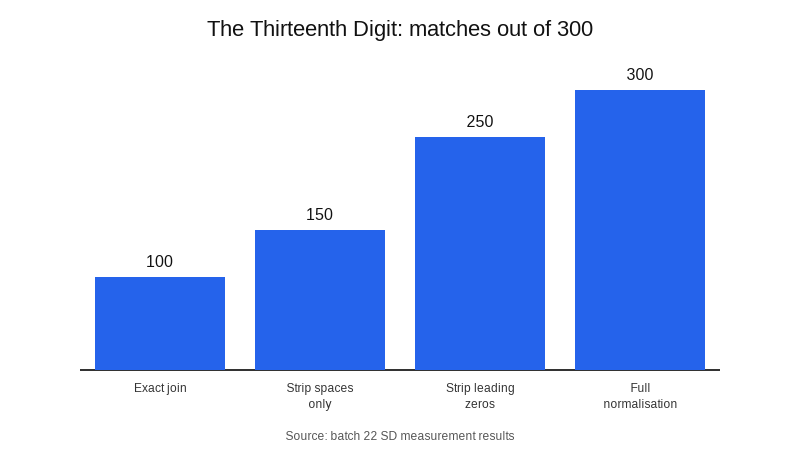
An exact join matched 100 of 300 rows. Those are the rows where source B kept the UPC-A form, so both strings agree digit for digit and character for character. Every other stored form failed, including forms that a human reader would accept at a glance. Stripping spaces only matched 150 of 300, adding the grouped rows to the exact matches while leaving both padded forms unmatched. A rule aimed at only one kind of variation predictably repairs only that kind, and the gain from each single fix is bounded by the size of the group it addresses.
Comparing after stripping leading zeros, without separator handling, matched 250 of 300. That step rescued both padded groups, the EAN-13 rows and the 14-digit rows, because removing leading zeros reduces every padded form to the stored UPC-A digits. The grouped rows still failed, because their spaces remain embedded in the string and a digit-by-digit comparison stumbles on characters that are not digits at all. Full normalisation, stripping spaces and leading zeros together, matched 300 of 300 with 0 false merges. The zero false merges deserves emphasis alongside the complete coverage. Normalisation here did not buy its matches by loosening the comparison until distinct codes blurred together. Each product still resolved to its own code, because the steps removed only characters that carry no identifying information: padding at the front and spacing between groups.
The verified property behind the result is that prepending the zero keeps the original check digit valid for 300 of 300 codes. Every constructed code was checked in both lengths, and in every case the check digit computed for the twelve-digit form also validated the thirteen-digit form. As a checksum matter, the data digits agree across both sources after normalisation, so a pipeline can validate first, normalise, and validate again without expecting the second check to fail on correctly converted rows. When a converted row does fail its check digit, that failure points to a real transcription or conversion error elsewhere in the digits, not to the added zero, and it can be routed for inspection with some confidence about where the problem is not.
How the measurement was assembled
This was a deterministic synthetic measurement, run with seed 42, so the same 300 products, the same computed check digits, and the same assignment of stored forms are produced on every run. The codes were constructed to specification, including their mod-10 check digits, rather than copied from a live product catalogue, which keeps the exercise free of real commercial data while preserving the arithmetic that makes the format work. Each joining rule, from exact comparison through the separate stripping steps to full normalisation, was implemented with self-written parsing rules in the standard library and applied uniformly to all rows. This is not a commercial product measurement: no commercial product measurement was performed, no vendor system was tested, and the results describe only what these stated rules did on this stated set of constructed codes.
Questions, answered
If the check digit stays valid, why do the codes fail to match at all? Because matching and validation answer different questions. Validation asks whether a code is internally consistent, and the prepended zero leaves that consistency intact. Matching asks whether two strings, or two normalised forms, are the same, and an exact comparison says no whenever one string carries an extra leading zero or embedded spaces, even though both strings pass their checks.
Why did stripping leading zeros help more than stripping spaces? Because more rows were affected by padding than by grouping. The padded forms together account for the EAN-13 group and the 14-digit group, while grouping affects only its own smaller group. A fix can only recover the rows whose variation it addresses, so the order in which single fixes pay off depends on the mixture in the file being cleaned.
Does full normalisation risk merging different products? In this measurement it did not, with 0 false merges across 300 products. Stripping leading zeros and spaces removes characters that do not distinguish one code from another, while every distinguishing digit remains in place. That safety is a property of this identifier's structure, and it should be verified, as it was here, rather than assumed for every code system a team meets.
Summary
The thirteenth digit is a leading zero that lengthens a product code without reissuing it, and its check digit survives the change untouched, valid for 300 of 300 codes in both lengths. Exact matching found only the 100 rows stored in identical form. Stripping spaces raised the total to 150, stripping leading zeros raised it to 250, and full normalisation matched all 300 with 0 false merges. The pattern is a practical one: list the stored forms first, pair each form with the step that repairs it, and check that each step removes only what carries no identity. Done in that order, a longer code stops looking like a different product and takes its proper place as the same product, written for a wider system.
Sources
- Batch 22 SD measurement results, group AM5, covering the 300 constructed UPC-A codes, the four stored forms in source B, the stepwise join counts, and the check digit verification reported above. (Source: batch 22 SD measurement results, group AM5)