
The Coarser Grid: Integer Fahrenheit Cannot Carry a One-Decimal Celsius Inventory
The cold-chain auditor's spreadsheet had two tabs that were supposed to agree. One listed sensor readings in Celsius to one decimal place; the other,...
The cold-chain auditor's spreadsheet had two tabs that were supposed to agree. One listed sensor readings in Celsius to one decimal place; the other, exported from an American buyer's system, listed the same readings in whole Fahrenheit degrees. Row by row the tabs mostly agreed — and then, scattered through the sheet, pairs of distinct Celsius readings, a tenth of a degree apart, had become the same Fahrenheit integer, and a few readings had quietly acquired partners they never had: the buyer's system showed two shipments at one temperature where the sensors had recorded two different ones. No sensor had failed. The conversion had done exactly what whole-degree Fahrenheit arithmetic must do, because one Fahrenheit degree spans 0.5556 Celsius degrees, and a grid that coarse cannot hold a finer one.
What The Coarser Grid means
The Coarser Grid means a target unit whose smallest written step is wider than the source inventory's resolution, so that converting into it forces distinct source values into shared cells. The nearest prior concept is The Snapped Grid. The Snapped Grid described coordinates rounded in their own unit onto a coarser decimal grid, which pulled different locations into the same grid key and falsely merged them. The Coarser Grid reaches the same merging by a different road: nothing is rounded in its own unit at all. The Celsius values are exact, the Fahrenheit integers are exact roundings of exact conversions, and the loss happens between the units, because the Fahrenheit degree is simply a wider step than the tenth-of-a-degree resolution the inventory lives at. Snapping is a choice of grid. The Coarser Grid is a property of the unit pair, and it applies even to conversions performed perfectly.
1 Stop the Bleeding: Quarantine Every Integer-Fahrenheit Field Before It Merges Anything
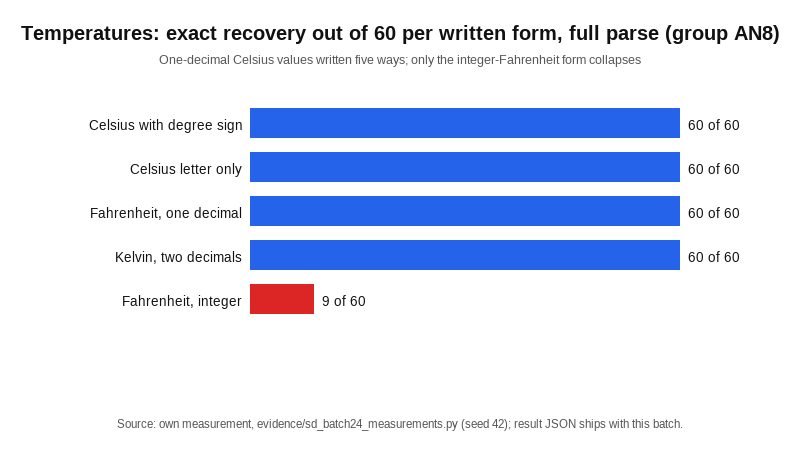
The immediate action, before any root-cause work, is to find every field, export or integration that carries temperatures as whole Fahrenheit degrees and stop it feeding merges, deduplication or compliance checks. In the measured inventory of 300 one-decimal Celsius values written five ways, the integer-Fahrenheit block is the only destructive one: under a full parse that converts Fahrenheit and Kelvin properly, the other four blocks — Celsius with a degree sign, Celsius letter only, Fahrenheit at one decimal place, and Kelvin at two decimal places — each recover 60 of 60, while the integer block recovers 9 of 60. The bleeding has a second wound: the full parse over all 300 rows produces 10 false merges, every one traceable to two Celsius values collapsing into one Fahrenheit integer and parsing back as a single value. Quarantine means those fields are read as approximate display values from now on — never as join keys — until the fix in section 3 lands.
2 Temporary Workaround: Parse Properly, and Treat the Integer Block as a Range
While the source systems are being fixed, two workarounds keep the data usable. First, parse with the units honoured rather than blindly: the same measurement shows a unit-blind parse — reading every number as Celsius whatever its suffix — recovers only 120 of 300 and creates 17 false merges, as Fahrenheit and Kelvin numbers land exactly on other rows' Celsius values. The full parse recovers 249 of 300, so conversion competence is worth 129 rows on its own. Second, treat each surviving integer-Fahrenheit value as what it mathematically is: not a temperature but an interval 0.5556 Celsius degrees wide. A reading of "94°F" is the interval that parses back around 34.4°C at its centre and covers the Celsius values from about 34.2 to 34.7 — which is precisely why the worked example in section 3 cannot be reconciled to a single value. Matching against intervals, and flagging every interval that contains two source rows as ambiguous instead of merging them, converts silent false merges into visible review items.
3 Root-Cause Fix: Carry One Decimal in Fahrenheit, or Stop Converting for Storage
The root cause is a resolution mismatch, so the fix must restore resolution, not add care. The measured numbers point at the exact repair: Fahrenheit written at one decimal place recovers 60 of 60 in the same inventory where integer Fahrenheit recovers 9 of 60, because a tenth of a Fahrenheit degree is 0.0556 Celsius degrees — ten times finer than the source grid. Kelvin at two decimals also recovers 60 of 60. So the fix, in order of preference: store and exchange temperatures in the source unit at source resolution (Celsius at one decimal), converting only for display; if Fahrenheit must be the exchange unit, mandate one decimal place in the schema and reject integer values at the boundary; and re-derive any historically merged rows from the surviving source records rather than splitting them by guesswork. Worked example, the row that proves the need: a sensor value of 34.2°C converts to 93.56°F, which integer spelling rounds to "94°F"; parsed back, 94°F is (94 - 32) x 5/9 = 34.4°C — a different row's value, delivered with total confidence. Its neighbour 34.3°C converts to 93.74°F, rounds to the same "94°F", and parses back to the same 34.4°C: two shipments, one phantom temperature, zero errors raised. Multiply that pair by the 51 integer-block rows that failed to round-trip and the scale of the historical repair is clear.
4 Verification and Closure: Re-Run the Five Forms and Count
Closure is a count, not an impression. Rebuild the test inventory — 300 Celsius values at one decimal, written in the five forms — and re-run the staged parses. The fixed pipeline should show: exact string 60 of 300; full parse 300 of 300 if integer Fahrenheit has been eliminated from the exchange, or 249 of 300 with the integer block still present and quarantined; false merges at zero once ambiguous intervals are flagged rather than merged. The checksum of the inventory, the values summed in tenths of a degree, is 74,095 and should be invariant across inventories. If the full-parse count rises but false merges persist, the fix has repaired conversion while leaving the merging logic untouched, and the item stays open. Only when the integer block is gone from storage — or fenced off from every join — does the auditor's two tabs problem actually close.
Questions on The Coarser Grid, answered
1. Why does integer Fahrenheit lose Celsius values that one-decimal Fahrenheit keeps? Because of step width. One Fahrenheit degree is 0.5556 Celsius degrees, wider than the 0.1-degree resolution of the source inventory, so neighbouring Celsius values share an integer cell. A tenth of a Fahrenheit degree is 0.0556 Celsius degrees — finer than the source grid — so the one-decimal block recovered 60 of 60 against the integer block's 9 of 60.
2. Is the problem the conversion formula? No. The formula is exact and the one-decimal Fahrenheit and Kelvin blocks round-trip perfectly. The loss is caused by writing the converted value on a grid coarser than the grid the value came from.
3. What did the unit-blind parse do in the same inventory? It recovered 120 of 300 and created 17 false merges, reading Fahrenheit and Kelvin numbers as if they were Celsius. Proper conversion recovered 249 of 300; the remaining damage sat entirely in the integer-Fahrenheit block.
4. Can merged historical rows be split again from the Fahrenheit values alone? No. An integer Fahrenheit cell contains up to six one-decimal Celsius values (34.2 through 34.7 in the "94°F" case, of which those present in a given inventory merge). Splitting requires the original Celsius records; the integer alone does not say which values it swallowed.
Next action: search the exchange schemas and export definitions for every temperature field typed as a whole number of Fahrenheit degrees, and change the first one feeding a merge or a compliance check to one-decimal Celsius today — that single field is where the next phantom reading is already scheduled to appear.