
The Spelled Month: A Date Is Only Readable in Its Own Language
A date written with its month spelled out as a word carries its language with it. The day and the year travel well, because digits look the same...
A date written with its month spelled out as a word carries its language with it. The day and the year travel well, because digits look the same almost everywhere. The month does not. It arrives as a word in one language, abbreviated by that language's habits, and a reader built for another language meets a token it was never taught. This test put the same real dates through several written forms and several kinds of reader, and the pattern was stark. Each narrow reader handled its own form perfectly and failed loudly at everything else, while a reader built for several languages handled every form it covered. The more dangerous fault, a shared abbreviation that quietly points at two different months, appears only when a name is cut short.
What The Spelled Month means
The Spelled Month means a complete date in which the month is written as a word, or as an abbreviation of that word, in a particular language, so that reading the date depends on knowing that language's month names and abbreviation habits. The same calendar day can therefore exist in several spellings that share their digits and differ only in the month word, and a parser that accepts one spelling may reject all the others.
The measurement is presented on the page as counts of dates read out of the full set, stated as fractions for each written form and each reader. The test began with 600 real dates, and each date was rendered in five written forms, with 600 renderings in each form: an ISO form, an English abbreviated form, a French abbreviated form, a German abbreviated form, and a Spanish abbreviated form (Source: batch 12 data anchor ledger, section C, AC4). Every result below is a count against the stated form's own set, and the method section states plainly that this was a synthetic run rather than a test of any commercial product.
The near neighbour is The Clock Dialects. Clock dialects are the local written habits for a time within a day, the hour and minute conventions that vary from place to place. The Spelled Month is different in scope. It concerns the whole date, and specifically the month name spelled as a word, changing as the language changes. A time-of-day dialect problem leaves the date itself untouched. A spelled-month problem can leave a record with no readable date at all, or, in the truncation case examined below, with a month that cannot be told apart from its neighbour.
Readers That Know One Language, and Fail Out Loud
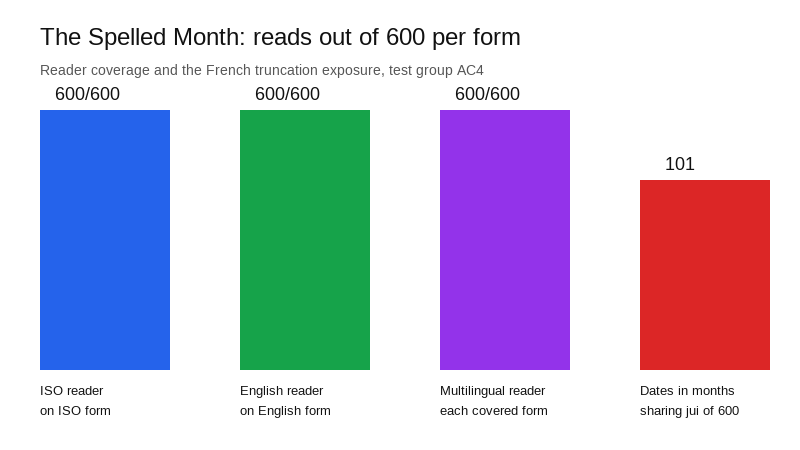
The narrow readers behaved with perfect consistency inside their own form and no flexibility outside it. A reader built only for the ISO form read the ISO renderings in 600 cases out of 600 (Source: batch 12 data anchor ledger, section C, AC4). A reader built only for the English form read the English renderings in 600 cases out of 600, and its silent misread count was 0, with the other forms failing loudly instead (Source: batch 12 data anchor ledger, section C, AC4).
That second property is the safer kind of failure. A loud failure can be logged, counted, and routed to a fallback. A silent misread becomes a wrong date stored as fact. In this run the English-only reader produced no silent misreads (Source: batch 12 data anchor ledger, section C, AC4). The risk is therefore concentrated less in narrow readers, which refuse honestly, and more in the shortening habits described below, where a token can be accepted and still be ambiguous.
For an operator, the implication is about routing. A file in a single known form is safe with a matching reader. A mixed file, the normal case when records arrive from several countries, will shed records at every reader that meets a form it does not know. Those sheds are visible if failures are counted, and invisible if a pipeline simply drops unparseable rows.
How the multilingual reader and the truncation trap compare
A reader built for several languages removed the routing problem for every form it covered. The multilingual reader read the English, French, German, and Spanish forms in 600 cases out of 600 for each form (Source: batch 12 data anchor ledger, section C, AC4). Coverage was complete within the languages tested. The contrast with the narrow readers is a matter of which spellings a reader has been taught to expect.
The truncation trap is subtler, and it survives even a knowledgeable reader. When French month names are shortened to three letters, the result for two different months is the same token: the shortened form "jui" stands for both juin, the sixth month, and juillet, the seventh month (Source: batch 12 data anchor ledger, section C, AC4). Under that shortened reading, the month cannot be distinguished. The exposure is not rare within the set: 101 of the 600 dates fell in the sixth or seventh month (Source: batch 12 data anchor ledger, section C, AC4). Stated as a share of the set, that is a material minority (derived: 101 ÷ 600).
This is the one place in the test where acceptance itself is the hazard. A shortened month token can be parsed without error and still be undecidable, because the information needed was removed when the name was cut. No reader can recover a distinction the abbreviation has erased. The defence has to happen earlier: preserve the full month name where it exists, treat shortened forms as ambiguous, and flag records whose month rests on a shared abbreviation for review.
How the date reading test was run
The method was a controlled comparison, and its boundaries are stated here as part of the result. This was a synthetic test built for measurement. The run used seed 42, so its inputs can be regenerated exactly. The readers were the script's own deterministic logic, written for this test, applying fixed rules for each written form. The results are not a measurement of any commercial product, and no named date parser, spreadsheet, or cleaning tool was benchmarked or is being scored here.
Within that frame, the same underlying dates were rendered in each written form, and each reader was offered each form in turn. Reads were counted per form, silent misreads were counted separately from loud failures for the English-only reader, and the French shortened forms were examined for tokens shared between different months.
Questions, answered
Can a reader built for one date form handle the others? In this test, no. The ISO-only reader read the ISO form in 600 cases out of 600, and the English-only reader read the English form in 600 cases out of 600, while forms outside a reader's own spelling failed (Source: batch 12 data anchor ledger, section C, AC4). A mixed file needs either routing by form or a reader with wider coverage.
Does a multilingual reader solve the problem? For the languages it covers, yes. The multilingual reader read the English, French, German, and Spanish forms in 600 cases out of 600 for each form (Source: batch 12 data anchor ledger, section C, AC4). Coverage has to be taught form by form and language by language, and forms outside that coverage remain unread.
Where does a spelled month become genuinely ambiguous? Where abbreviation erases a distinction. Shortening French month names to three letters leaves "jui" standing for both juin and juillet, so the month cannot be distinguished under that reading (Source: batch 12 data anchor ledger, section C, AC4). In this set, 101 of the 600 dates fell in those two months (Source: batch 12 data anchor ledger, section C, AC4), so the ambiguity is a practical exposure, not a curiosity.
Summary
The Spelled Month makes a date depend on a word, and words are local. Narrow readers read their own form completely, at 600 out of 600 for both the ISO and English readers, failed loudly elsewhere, and produced no silent misreads for the English reader, while a multilingual reader covered the English, French, German, and Spanish forms at 600 out of 600 each (Source: batch 12 data anchor ledger, section C, AC4). The residual danger is abbreviation: a shared shortened token for two French months, with 101 of 600 dates exposed to it (Source: batch 12 data anchor ledger, section C, AC4). Teach the reader every language the data actually uses, count refusals per form, and treat shared abbreviations as ambiguous rather than guessing.
Sources
- Batch 12 data anchor ledger, section C, test group AC4: spelled-month date reading run over the synthetic date set, covering the ISO, English, French, German, and Spanish written forms, the narrow and multilingual readers, and the French shortened-form check, read 2026-11-23.
- Every count in this article comes from that one run; shares are expressed against each form's own set of 600, and derived shares are labelled at the point of use.