
The Mismatched Ruler: One Speed, Four Written Steps, and the Conversion That Decides Survival
Start with the survival rates, because they are the whole story in one line. In a measured inventory of 300 speeds recorded in kilometres per hour to...
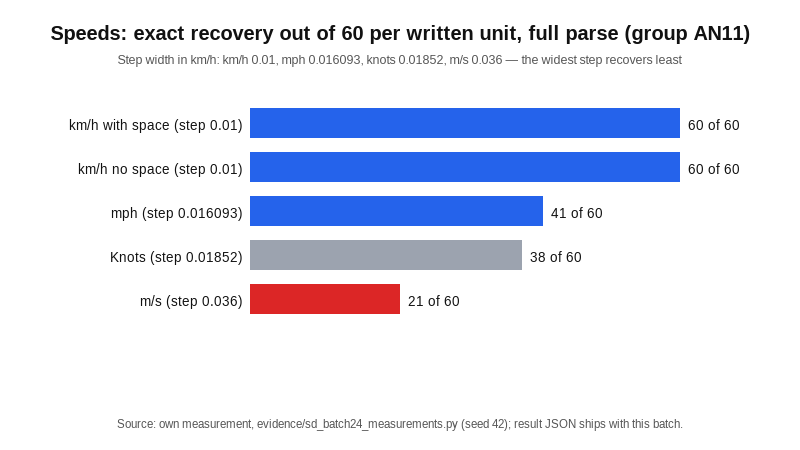
Start with the survival rates, because they are the whole story in one line. In a measured inventory of 300 speeds recorded in kilometres per hour to two decimal places, a full parse that converts every foreign unit properly recovers all 120 rows written in km/h — and then, unit by unit, 41 of 60 rows written in mph, 38 of 60 written in knots, and just 21 of 60 written in metres per second. Same values, same two-decimal care, same correct conversion factors. The only difference between the units is the width of their smallest written step when it is laid against the km/h grid: 0.016093 km/h for a hundredth of a mph, 0.01852 for a hundredth of a knot, and 0.036 for a hundredth of a metre per second. The widest ruler loses the most values. It is not a metaphor; it is the arithmetic of grids that do not align.
What The Mismatched Ruler means
The Mismatched Ruler means a family of units for one quantity whose smallest written steps have different widths in the canonical unit, so that round-trip survival through a conversion is decided by the step width of the unit chosen for writing. The nearest prior concept is The Meeting Point. The Meeting Point described two temperature scales whose numerical readings change with the scale and coincide at exactly one value, -40 — a curiosity about where two rulers cross. The Mismatched Ruler is not about a crossing point. Its four rulers for speed share no useful coincidence; what decides everything is that each ruler's finest mark falls in a different place on the canonical grid, and a value survives conversion only when its converted spelling happens to land back on a canonical line. The Meeting Point is where two scales agree. The Mismatched Ruler is why four scales, all honest, disagree about which values can come home.
The Template: A Conversion Record That Keeps the Step Width Visible
The remedy this procedure installs is a conversion record — a template filled in for every speed that enters the inventory from a foreign unit, so the step width is examined before the value is trusted. The template has six fields.
Field 1 — Value as written. The string exactly as received, unit suffix included: for example, "45.51 m/s". Never strip the unit at intake; the suffix is the only evidence of which ruler made the measurement.
Field 2 — Declared unit. mph, m/s, kn, or km/h, copied from the string's suffix. If the suffix is missing, the record stops here and the value is quarantined; a unit-less speed has the same defect as any silent unit.
Field 3 — Step width in canonical units. The width of the source unit's smallest written step, expressed in km/h: 0.016093 for two-decimal mph, 0.036 for two-decimal m/s, 0.01852 for two-decimal knots, 0.01 for km/h itself. This field is filled from a standing table, not computed per record.
Field 4 — Converted value. The value in km/h at two decimals, computed with the exact factors: mph x 1.609344, m/s x 3.6, knots x 1.852.
Field 5 — Round-trip check. Convert Field 4 back into the declared unit at the same written precision and compare with Field 1. Equal means the value survived; unequal means the record carries a converted value that its own source spelling cannot reproduce.
Field 6 — Disposition. One of: accepted (round-trip equal), accepted-with-drift (round-trip unequal, drift recorded in Field 5's margin), or quarantined (unit undeclared). The drift figure, not a warning flag, is what downstream users see.
Field-by-Field Guidance: Where Each Field Goes Wrong
Field 1 fails by tidiness: an operator who "cleans" the string on arrival destroys the evidence the rest of the template needs. Field 3 is the field everyone wants to skip, and it is the predictive one: if the step width exceeds the canonical grid width of 0.01 km/h — as all three foreign units' steps do — some values will fail Field 5, and the failure rate can be estimated before a single record is processed (the wider the step relative to the grid, the lower the survival: in the measurement, survival fell from 41 of 60 at a step of 0.016093 to 21 of 60 at 0.036). Field 4 fails by rounded factors: using 1.6 for mph or 3.6 is exact for m/s but 1.609344 must not be shortened, since a shortened factor manufactures drift that Field 5 will then blame on the ruler. Field 5 fails by being run at the wrong precision — the back-conversion must use the source's written decimals, two, or the check certifies a precision the source never had. Field 6 fails by euphemism: "accepted-with-drift" must carry the actual drift, because a drift of 0.02 km/h is nothing to a logistics dashboard and everything to a calibration log.
A Filled Example: 163.82 km/h Through Three Rulers
Take the inventory's example speed, 163.82 km/h, as it arrives in each foreign spelling. As mph: written "101.79 mph"; Field 3 records the step 0.016093; Field 4 converts 101.79 x 1.609344 = 163.82; Field 5 converts back and matches; disposition, accepted. As knots: written "88.46 kn"; step 0.01852; Field 4 gives 88.46 x 1.852 = 163.83; Field 5's back-conversion lands on the written value but the canonical value has drifted by 0.01; disposition, accepted-with-drift 0.01. As metres per second: written "45.51 m/s"; step 0.036, the widest ruler in the set; Field 4 gives 45.51 x 3.6 = 163.84; drift 0.02; disposition, accepted-with-drift 0.02. One true speed, three records, three dispositions — and the template's point is that the differences were predictable from Field 3 alone, before any conversion ran. Across the full inventory the same pattern holds in aggregate: the staged parses recover 60 of 300 by exact string, 120 of 300 when spacing decoration is ignored, and 220 of 300 under the full parse, with 2 false merges appearing where a drifted value landed exactly on another row's canonical value — the failure Field 6 exists to make visible.
Common Filling Mistakes
Four mistakes recur wherever this template is adopted. Mistake one: filling Field 3 from the unit's name instead of its written precision — knots at two decimals and knots at three decimals are different rulers with different step widths, and the template prices the spelling, not the unit in the abstract. Mistake two: recording the converted value at more decimals than the canonical grid, which makes drift look smaller than the inventory can actually hold; the inventory's grid is two decimals, and Field 4 must live on it. Mistake three: treating a passed round-trip as proof the value is exact — 41 mph rows passed, and they passed because their values happened to sit on both grids, not because mph conversion is lossless. Mistake four: dropping the quarantined rows from the count. The inventory's checksum — its speeds summed in hundredths of a km/h, 4,852,460 — reconciles only when quarantined and drifted rows are counted alongside the clean ones.
Questions on The Mismatched Ruler, answered
1. Why does m/s lose more values than mph when both are written to two decimals? Because the written step differs. A hundredth of a metre per second is 0.036 km/h wide — 3.6 times the canonical grid width of 0.01 — while a hundredth of a mph is 0.016093 km/h wide. Most converted m/s values land between canonical lines and cannot round-trip; more mph values happen to land on them. The measured recoveries were 21 of 60 for m/s and 41 of 60 for mph.
2. Would writing m/s to three decimals fix it? It would shrink the step to 0.0036 km/h, finer than the canonical grid, and most values would then round-trip. The ruler is the written precision, not the unit: any unit written finely enough survives, and any unit written coarsely enough loses values.
3. Are the 2 false merges in the full parse a parsing bug? No. They are drifted conversions landing exactly on another row's canonical value — the predictable tail of the same step-width effect, and the reason converted rows carry their drift in the record.
Closing checklist for any converted inventory: record the value as written, suffix included; declare the unit from the suffix, never from the magnitude; write the source step width in canonical units on the record; convert with unshortened factors; run the round-trip check at the source's own precision; and carry the drift figure, not a flag, into the merged inventory.