
Silent Misbooking: The Import That Succeeded 900 Times and Booked 76% in the Wrong Currency
Nothing failed. That is the finding. Nine hundred amount values went through a deliberately naive import — detect the number, strip whatever symbol clings...
Nothing failed. That is the finding. Nine hundred amount values went through a deliberately naive import — detect the number, strip whatever symbol clings to it, record the figure as dollars — and the import reported total success: every value parsed, no errors, no exceptions, no rejected rows. Buried in that clean run, 684 of the 900 amounts had been booked in the wrong currency. The symbols had been seen, correctly identified, and then thrown away, and the amounts they belonged to were euros, pounds and yen recorded as if they were dollars. A parse error would have been kinder. An error gets looked at.
The run, in numbers
The file mixed 900 amounts: 720 carrying an explicit currency symbol — split evenly, 180 each, across dollars, euros, pounds and yen (derived from the run's counts) — and 180 carrying none. The naive parser's first stage was flawless — it detected the symbol on 720 of 720 symbol-bearing values, a 100% detection rate. Its second stage was also flawless, mechanically: it stripped the symbols and parsed all 900 values without a single failure. The damage happened entirely in the third, implicit step, where the stripped figure was booked in the system's home currency. Of the 720 symbol-bearing values, 540 — exactly 75.0% — were in euros, pounds or yen, 180 in each, and every one of them was booked as dollars. The dollar-denominated values survived by accident of geography. Adding the ambiguous unsymbolled values that the parser also booked without question, the run's total of silently misbooked or unresolvable amounts reached 684 of 900, 76.0% (Source: SmartDataAI import test U4, run 2026-11-23; the script and result JSON are filed in this batch's evidence pack).
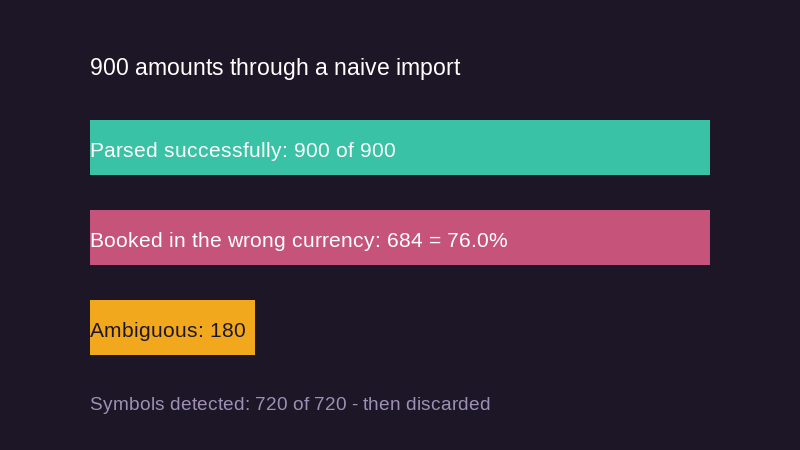
The remaining 180 values, 20.0% of the file, carried no symbol at all, and the test scores them separately — not as misbooked, since their true currency is genuinely unknowable from the value alone, but as ambiguous: booked, again, as dollars, by a rule that never announced itself. Between the certainly-wrong 540 and the unknowably-booked 180 sits the whole problem. A parser that throws errors on ambiguous input is annoying and safe. A parser that succeeds on everything is pleasant and dangerous, because its output file carries no trace of the decisions it made. Every figure in the resulting ledger is well-formed. Most of them are wrong.
Decompose the 684 and a bleaker figure falls out: the share of the file that was booked correctly. The correctly-booked values are exactly the ones whose true currency was dollars — 180 symbol-bearing dollar amounts that survived because the default happened to match them, plus the 36 unsymbolled values that were truly dollars. That is 216 of 900, a correct-booking rate of 24.0% (derived from the run's counts), achieved by a pipeline whose own success metric read 100%. The two numbers describe the same run. One of them was on the dashboard. It is also worth noticing where correctness came from: not one correctly-booked value owed its correctness to the parser. Every survivor survived by coincidence between its true currency and the parser's assumption, which means the pipeline's accuracy was a property of the file's currency mix, not of the pipeline. Feed it a file with no dollars in it at all and the same flawless run books nothing correctly.
The magnitudes deserve a word. A euro booked as a dollar is a small lie, a few percent. A yen amount booked as dollars is a catastrophe wearing a valid number's clothes — the figures differ by two orders of magnitude, and the imported value will pass every range check that was calibrated on the home currency's plausible amounts only if nobody set one. The test counts misbookings, not their sizes, but the construction included yen precisely because symbol-stripping does not merely mislabel value; at the extremes it manufactures it.
What Silent Misbooking means
Silent Misbooking means an import outcome in which values parse successfully into the wrong unit — here, the wrong currency — because the unit marker was detected and discarded rather than carried into the record. It is distinguished from a parse failure by its invisibility: the run reports success, the values are numeric and well-formed, and the error exists only as a disagreement between the booked unit and the true one. The measure is the share of values whose booked currency differs from their constructed currency, counted over a run whose parse success rate was, pointedly, 100%. Where a parse failure rate asks "how much data broke?", Silent Misbooking asks the more dangerous question: "how much data lied?" The bitterness of the measure is that the cure is nearly free. The parser already held the correct currency in its hand at detection time — it had identified the symbol on 720 of 720 symbol-bearing values — and needed only to write that symbol into a currency column instead of discarding it. Silent Misbooking is therefore never a detection problem. It is a one-column omission, repeated nine hundred times, at industrial scale and total silence.
Questions, answered
If the parser detected the symbols, why did it still misbook? Because detection and bookkeeping were separate steps, and only the first was implemented. The parser recognised the euro, pound and yen signs on all 720 symbol-bearing values — then stripped them and booked the bare figures as dollars. The information needed to book correctly existed at parse time and was deliberately thrown away by the strip step.
Are the 180 unsymbolled values counted as errors? They are counted twice over, for two different facts. As ambiguity, they are 20.0% of the file — values no honest import should assign a currency to without a flag. As outcomes, 144 of the 180 were in fact non-dollar amounts, so the default booking made them misbookings as well; only the 36 that were truly dollars came through unscathed.
How this was measured
The amounts were synthesised by the test script — 900 values with constructed currencies, 720 with symbols and 180 without — under a fixed seed of 42, and the parser under examination is the script's own naive strip-and-book logic, deterministic and reproduced in the filed evidence. The counts describe this constructed file and this stated parser; the exercise benchmarks no commercial product, and its proportions are presented as construction, not as a survey of real ledgers.
Summary
A naive currency import parsed 900 of 900 values successfully and booked 76.0% of them in the wrong currency: 540 euro, pound and yen amounts recorded as dollars despite their symbols being detected perfectly, and 144 unsymbolled amounts whose true currencies — euros, pounds, yen and yuan — a silent default overrode, in a file where a full 20.0% of values carried no symbol at all. Silent Misbooking is the failure mode that success metrics cannot see — a clean run, a well-formed ledger, and three quarters of it denominated in a currency its values never claimed to be.
Sources
- SmartDataAI import test U4 (mixed currency symbols), executed 2026-11-23 — measurement script and result JSON filed in the evidence pack accompanying this batch.
- Construction and scoring rules — 900 constructed amounts, symbol detection, strip-and-book parsing, ambiguity counted apart from misbooking — are stated in the measurement section above.