
The Sign Flip: A Fallback Reader Turns 450 Negative Amounts Positive
A rejected value is an honest problem. It sits in an error report, somebody looks at it, and the underlying record gets fixed or consciously set...
A rejected value is an honest problem. It sits in an error report, somebody looks at it, and the underlying record gets fixed or consciously set aside. A misread value is a dishonest one. It passes every count, fills every column, and quietly states the opposite of the truth. In this test, a strict amount parser failed on two thirds of a file — and that failure, by itself, would have been survivable. What made the file dangerous was the fallback behind the parser: a permissive reader that kept only the digits and discarded everything else, including the signs. Applied to the failures, that fallback did not rescue the data. It reversed it, converting hundreds of negative amounts into positive ones and leaving a file that looked complete while its totals pointed the wrong way.
What The Sign Flip means
The Sign Flip means the error in which an amount that fails strict parsing is recovered by a fallback that reads only its digits, so that a negative amount re-enters the data as a positive amount of the same size. The value survives, the magnitude survives, and only the direction is lost — which, for money, is the one property that cannot be lost without consequence. A flipped amount does not merely omit information. It asserts the opposite: a payment becomes a receipt, a loss becomes a gain, a balance owed becomes a balance held.
Four ways to write a negative, one way to read it
The test file held 900 amount strings. Of those, 600 were truly negative amounts, written in four forms of 150 each: the standard form with a leading minus sign; the accounting form wrapped in parentheses; the form with a trailing minus sign; and the form carrying a credit suffix (Source: SmartDataAI import test V5, run 2026-11-23; script and result JSON filed with this batch's evidence pack). The remaining 300 strings were truly positive: 150 written as a plain amount and 150 carrying a debit suffix (Source: SmartDataAI import test V5, run 2026-11-23; script and result JSON filed with this batch's evidence pack). Every string was a legitimate, unambiguous way of writing its amount; none of them was malformed, truncated or internally contradictory.
Against that file stood a strict parser whose grammar was deliberately narrow: an optional leading minus sign, followed by digits and a decimal part. That parser succeeded on 300 of 900 strings, which is 33.3% (Source: SmartDataAI import test V5, run 2026-11-23; script and result JSON filed with this batch's evidence pack). The 300 successes were exactly the strings written in the two forms its grammar covered — the standard negative form and the plain positive form. Everything expressed through parentheses, a trailing minus, a credit suffix or a debit suffix failed, even though a human reader would have understood every one of them at a glance.
The composition of the 600 failures is where the story turns. Of those 600 failed strings, 450 were truly negative amounts, which is 75.0% of all the negative amounts in the file (derived from the group counts). Only one of the four negative forms — the standard leading-minus form — had survived strict parsing. The other three negative forms, 150 strings each, made up the bulk of the failure pile. A failure pile is never a random sample of a file, and this one was heavily loaded with exactly the values whose sign a careless recovery would destroy.
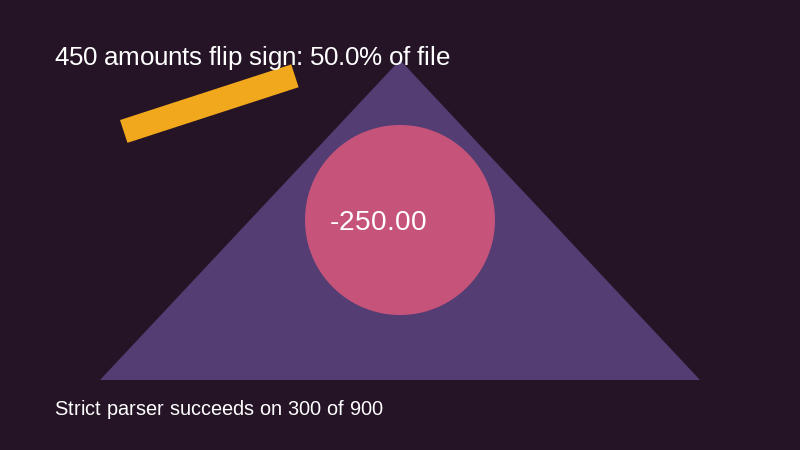
That recovery is the second act of the test. A digit-only fallback — the kind that strips every character that is not a digit or a decimal point and reads what remains — was considered for the failed strings. Under that fallback, all 450 truly negative failures would be read as positive amounts, because parentheses, trailing minus signs and credit suffixes are precisely the characters such a fallback throws away. Those 450 flipped amounts amount to 50.0% of the entire file (derived). Half the file, in other words, would carry the wrong sign while passing as successfully imported data.
The effect on totals deserves its own arithmetic. When a negative amount is flipped to positive, a column total does not err by the amount of that record; it errs by twice the amount, because the total loses a subtraction it should have had and gains an addition it should never have had. Across 450 flipped records, that doubling compounds silently. A report built on such a file does not merely understate or overstate by a little. It moves in the wrong direction with confidence, and the larger the flipped share — here, half the file — the more authoritative the wrong total looks, because it was computed from a complete-looking dataset with no gaps to arouse suspicion.
None of the four negative forms in the test is exotic. Parenthesised negatives are a long-standing accounting convention. Trailing minus signs appear in exports from older financial systems. Credit and debit suffixes are how ledgers have labelled direction for generations. A parser that covers only the leading-minus form is not being careful; it is being parochial, recognising the dialect of one system and treating the dialects of others first as errors and then, through its fallback, as positives. The Sign Flip is therefore best understood as a two-step design failure: a grammar too narrow for the forms real files actually use, compounded by a recovery rule that values completeness over direction.
How this was measured
The amount strings in this test were invented by a script, not taken from any real ledger or export: the script wrote out known amounts in known forms, so the true sign of every string was fixed by construction before any parser ran. The script used a fixed seed of 42, which makes the file identical on every run. The strict parser and the digit-only fallback were both the script's own deterministic parsing logic, applying fixed character rules with no randomness and no outside data. This is not a measurement of any commercial product, accounting package or import tool, and no such product was tested. The counts are constructed quantities, declared as such: 900 constructed strings, with group sizes of 150 per written form, and the derived shares — the proportion of negatives among the failures, and the proportion of the whole file that a digit-only fallback would flip — are arithmetic on those constructed counts, labelled derived wherever they appear (Source: SmartDataAI import test V5, run 2026-11-23; script and result JSON filed with this batch's evidence pack).
Questions, answered
Which amount forms did the strict parser fail on? Every form outside its narrow grammar. It succeeded on the standard negative form and the plain positive form — 300 strings in total — and failed on the parenthesised form, the trailing-minus form, the credit-suffix form and the debit-suffix form, 150 strings each. All six forms were legitimate ways of writing their amounts.
Why is a flipped sign worse than a rejected value? A rejected value announces itself: it is missing, it appears in an error count, and a total computed without it is understood to be partial. A flipped value announces nothing. It enters totals as its own opposite, moving a sum by twice its amount in the wrong direction, and it survives row counts and casual sampling because its magnitude looks entirely plausible.
How much of the file would the digit-only fallback have flipped? 450 amounts — every truly negative string the strict parser had failed on. That is 75.0% of all the negative amounts in the file (derived), and 50.0% of the file as a whole (derived). The fallback would have converted three of the four negative written forms into positives, wholesale, while leaving the file looking complete.
Summary
The Sign Flip is the conversion of unparseable negatives into positives by a fallback that reads digits and discards sign markers. In this test a strict parser succeeded on only 300 of 900 amount strings, and 450 of its 600 failures were truly negative amounts written in parenthesised, trailing-minus or credit-suffix form. A digit-only fallback would have flipped all 450 — half the file — turning a visible, bounded failure into an invisible, doubled error in every total. The failure was never the real danger. The rescue was.
Sources
- SmartDataAI import test V5 (negative amount formats), run 2026-11-23; script and result JSON filed with this batch's evidence pack.
- Construction note: the amount strings, the strict parser and the digit-only fallback were all written by the test script (seed fixed at 42); the measurement section explains the construction in full.