
The Shifted Comma: Same Digits, Different Place to Pause
Every digit can stay exactly where it belongs while the number still changes its face. Take a long amount, keep the digit sequence untouched, and...
Every digit can stay exactly where it belongs while the number still changes its face. Take a long amount, keep the digit sequence untouched, and move only the commas that group the digits for reading. To one reader the result is the familiar shape of a large number. To another reader, trained on a different grouping habit, the first version looks wrong and the second looks natural. To software that compares text character by character, the two versions are simply different strings, even though the value they carry is identical. That positional difference is what this article examines.
What The Shifted Comma means
The Shifted Comma is the relocation of grouping commas inside a number, without any change to the digits themselves or to the numeric value, when a different grouping convention is applied. The run behind this article presents its scope directly: it works with 600 amounts of 6 to 9 digits, spanning 100,000 to 999,999,999 (Source: evidence/sd_batch12_results.json, group AC2). In that presentation, the Western grouping places commas so that digits are grouped in threes, while the Indian grouping is described by the rule that the last 3 digits form a group and every 2 digits before them form a group (Source: evidence/sd_batch12_results.json, group AC2). The worked example given in the results makes the contrast concrete: the same amount appears as 469,015,703 in Western grouping and as 46,90,15,703 in Indian grouping (Source: evidence/sd_batch12_results.json, group AC2). Read the digits in order in both forms and the sequence never changes. Only the pauses move.
The nearest neighbour is The Quoted Comma. That concept belongs to delimited text, where a comma inside quotation marks must be distinguished from a comma that separates one field from the next, and the whole problem exists because the comma is doing two jobs in one file format. The Shifted Comma has no quotation marks, no fields, and no delimiter dispute at all. Its commas live entirely inside a single number, and the dispute is not about what separates values but about where a reader expects the visual grouping inside one value to fall. The fixes differ accordingly. Quoting and escaping solve the first problem. Normalising grouping, or comparing values after the commas are removed, solves the second. Applying the first fix to the second problem would leave the shifted commas exactly where they were.
Two spellings for every amount
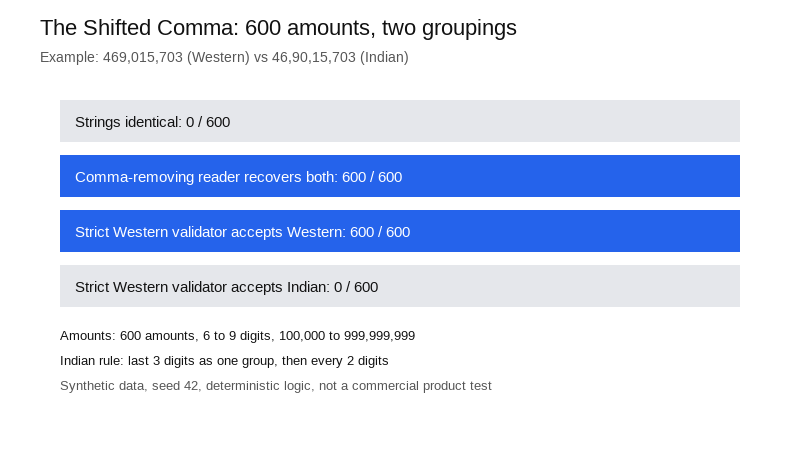
The first measurement is the simplest, and its result is total. When the Western and Indian spellings of each amount were compared as strings, they were identical in 0 of the 600 cases (Source: evidence/sd_batch12_results.json, group AC2). Not a single amount in the set survived the change of convention with its text unchanged. That outcome follows from the sizes involved. For a short number the two conventions can coincide, because there are not enough digits before the final group for their different grouping rhythms to diverge. The amounts in this run, at 6 to 9 digits, are all long enough for the rhythms to pull apart, so a system that stores amounts as formatted text and matches them as text will find no matches at all between the two conventions, even though every pair of spellings denotes the same value.
A reconciliation or deduplication step that joins on a formatted amount will behave as if the datasets describe different amounts. Nothing is wrong with the arithmetic or the digits. The failure lives in the decoration: a human sees the same money, while software comparing characters sees no overlap.
Readers that forgive, and readers that refuse
Not every kind of reader responds the same way, and the run separated two responses that are often confused. The first reader removes the commas and then interprets what remains. That reader recovered the intended amount from both spellings in 600 of the 600 cases for each style (Source: evidence/sd_batch12_results.json, group AC2). Strip the decoration away and the digit sequence, which never changed, carries the full value on its own. For data cleaning this is the forgiving path: whatever grouping convention produced the text, deleting the commas collapses both spellings to one canonical digit string, and records that looked unrelated become recognisably the same amount.
The second reader is a strict validator for Western grouping, one that checks not just the digits but the placement of the commas against the grouping-in-threes rule. It accepted the Western spellings in 600 of the 600 cases (Source: evidence/sd_batch12_results.json, group AC2). It accepted the Indian spellings in 0 of the 600 cases (Source: evidence/sd_batch12_results.json, group AC2). The results describe that rejection as loud rather than silent: the validator does not misread the Indian form as a different amount, and it does not quietly repair it. It refuses it. Loud refusal is, in many ways, the safer failure, because it surfaces the convention clash at the point of entry instead of letting two spellings of one amount drift downstream and diverge in reports. But it is still a refusal of valid amounts, written correctly under a major convention, and a system deployed across regions will meet that convention in ordinary, well-formed input rather than in malformed edge cases.
Forgiveness treats grouping as presentation and loses the ability to detect a genuinely misplaced comma. Strictness protects one rule and rejects another region's ordinary writing. Each is wrong when chosen by accident or inherited from a library default.
How the comparison was run
This was a synthetic-data run, and its method section states that without qualification. The amounts were generated for the test rather than taken from invoices, ledgers, or any commercial product, and the exercise is not a commercial product measurement. The run used seed 42, so the same generated set can be produced again and the same checks repeated on identical input. Each generated amount was written in both grouping styles following the stated rule for each style, with the Indian style grouping the last 3 digits together and every 2 digits before them. The checks then followed the script's own deterministic logic: a direct string comparison between the two spellings, a recovery check after removing commas from each spelling, and a strict Western grouping validation applied to each spelling in turn. Because the logic is deterministic and the seed is fixed, the counts reported here are exact for this set rather than estimates sampled from a larger population. That precision is also the boundary of the claim. A different range of amounts, especially one including shorter numbers where the two conventions can coincide, would produce a different string-match count, and nothing in this run pretends otherwise.
Questions, answered
Do the two spellings ever match as text? Not in this set. The Western and Indian spellings were string-identical in 0 of the 600 cases (Source: evidence/sd_batch12_results.json, group AC2), because every amount tested, from 100,000 to 999,999,999 (Source: evidence/sd_batch12_results.json, group AC2), was long enough for the two grouping rhythms to diverge.
Can the original amount still be recovered from either spelling? Yes, completely, by the forgiving route. A reader that removes the commas recovered the amount from both spellings in 600 of the 600 cases for each style (Source: evidence/sd_batch12_results.json, group AC2), while a strict Western validator accepted the Western form in 600 of the 600 cases and the Indian form in 0 of the 600 cases (Source: evidence/sd_batch12_results.json, group AC2).
Summary
The Shifted Comma shows how a number can be simultaneously unchanged and unrecognisable. The digits and the value survive a change of grouping convention perfectly; the text does not survive it at all. In a set of 600 long amounts, the two spellings never once matched as strings, a comma-stripping reader recovered every amount from either spelling, and a strict single-convention validator rejected every spelling written the other way. None of those outcomes required corrupt data or careless typing. They required only two legitimate conventions meeting in one system that had not decided which one it spoke. Deciding, explicitly, whether grouping is presentation to be stripped or a rule to be enforced is the whole lesson, and it is far cheaper to decide it in design than to discover, after a failed reconciliation, that the commas were the disagreement all along.
Sources
- Results file for test group AC2: evidence/sd_batch12_results.json (read 2026-11-23), produced from synthetic data under seed 42 by the script's own deterministic logic; no commercial product was measured.
- Batch 12 data anchor ledger, section C. Grouping rules, worked example, and recorded counts for group AC2.