
The Shallow Source: A Citation That Stops at the Front Door
A citation is a promise that a specific page supports a specific fact. The weakest page a citation can point to is the root of a site: the homepage, ...
A citation is a promise that a specific page supports a specific fact. The weakest page a citation can point to is the root of a site: the homepage, which supports the fact that the company exists and very little else. A listings file can therefore look fully sourced while most of its citations never go anywhere. That is the condition a recomputation found in the SmartDataAI listings source file for week01, a file of 50 rows in which the fact_source_url column was populated for every row (Source: SmartDataAI listings source CSV, week01, recomputed 2026-11-23). Measured by the path depth of those URLs, 34 of 50 fact sources sat at depth 0, the site root itself, a share of 68.0 percent (Source: SmartDataAI listings source CSV, week01, recomputed 2026-11-23). Only 16 of 50 citations pointed anywhere below the root at all (Source: SmartDataAI listings source CSV, week01, recomputed 2026-11-23).
What The Shallow Source means
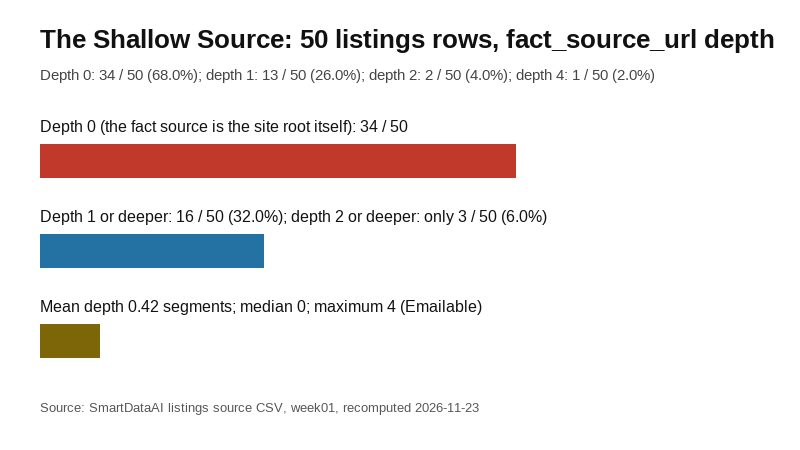
The shallow source is the condition of a cited fact source whose URL stops at or near the root of a site, so that the citation names a property rather than a page and a reader following it lands on a homepage instead of on the evidence for the row's facts. Depth, as used here, is the number of non-empty path segments in the fact_source_url; a trailing slash adds nothing, and query strings and fragments are not counted (Source: SmartDataAI listings source CSV, week01, recomputed 2026-11-23). The recomputation found depth 0 in 34 of 50 rows, depth 1 in 13, depth 2 in 2, and depth 4 in 1, with no row at depth 3 (Source: SmartDataAI listings source CSV, week01, recomputed 2026-11-23). The mean depth was 0.42 segments and the median was 0 (Source: SmartDataAI listings source CSV, week01, recomputed 2026-11-23). The concept applies to any dataset whose rows carry source citations as evidence; it does not claim a root page can never support a fact, only that a file dominated by root citations has not shown where its facts live.
The nearest neighbour is The Empty Map, and the difference is between a field that is absent and a field that is present but uninformative. In The Empty Map, the headquarters_country column of this same listings file was blank in 48 of 50 rows: the data had simply not been collected. The fact_source_url column has the opposite profile. It is filled in for all 50 rows (Source: SmartDataAI listings source CSV, week01, recomputed 2026-11-23), so completeness checks pass and the file presents itself as sourced. Yet in 34 of 50 rows the filled value is the site root (Source: SmartDataAI listings source CSV, week01, recomputed 2026-11-23), the URL equivalent of citing a building instead of a room. The Empty Map fails loudly, as a blank; the shallow source fails quietly, as a citation that resolves, loads, and proves almost nothing.
Thirty-Four Citations That End at the Root
The distribution deserves to be read as a shape, not just a headline number. Depth 0 accounts for 34 of 50 rows, 68.0 percent of the file (Source: SmartDataAI listings source CSV, week01, recomputed 2026-11-23). Depth 1 accounts for 13 of 50 rows, 26.0 percent (Source: SmartDataAI listings source CSV, week01, recomputed 2026-11-23). Depth 2 accounts for 2 of 50 rows, 4.0 percent, and depth 4 for 1 of 50 rows, 2.0 percent, with depth 3 unoccupied (Source: SmartDataAI listings source CSV, week01, recomputed 2026-11-23). Grouped the other way, 16 of 50 rows, 32.0 percent, cite any page below the root, and only 3 of 50 rows, 6.0 percent, reach depth 2 or deeper (Source: SmartDataAI listings source CSV, week01, recomputed 2026-11-23). The median depth of 0 states the same shape in one figure: the typical citation does not leave the homepage.
A cross-check inside the recomputation sharpens what depth 0 means here. Of the 34 depth-0 rows, 32 carry a fact_source_url exactly equal to the row's homepage string, and the remaining 2 sit at the root of a different host (Source: SmartDataAI listings source CSV, week01, recomputed 2026-11-23). The shallow rows are not deep pages whose paths happen to be short; they are, in 32 cases, literally the homepage repeated in the source column. All 16 rows at depth 1 or deeper, by contrast, sit on the same host as their row's homepage (Source: SmartDataAI listings source CSV, week01, recomputed 2026-11-23).
The One Citation That Went Four Levels Down
The deepest citation in the file shows what the column looks like when it does its job. The single depth-4 row, 1 of 50, belongs to Emailable and points into a documentation path ending at an email-verification-api page (Source: SmartDataAI listings source CSV, week01, recomputed 2026-11-23). A reader following that URL arrives at a page about the specific capability the row describes, where the row's facts can be checked. That is the standard the column exists to meet, and the maximum depth of 4 (Source: SmartDataAI listings source CSV, week01, recomputed 2026-11-23) proves the format never prevented it.
Depth is, of course, a proxy. A depth-1 page can be the right evidence for a row, and a deep page can still be the wrong one. What depth measures cheaply is the specificity of the citation: whether the collector recorded the page where a fact was seen, or recorded the site and moved on. A mean depth of 0.42 segments across 50 rows (Source: SmartDataAI listings source CSV, week01, recomputed 2026-11-23) says the file's evidence trail points at companies rather than at claims. Where 34 of 50 URLs lead to homepages (Source: SmartDataAI listings source CSV, week01, recomputed 2026-11-23), an audit stalls at the exact step the source column was meant to make easy.
How The Depths Were Recomputed
This piece rests on a recomputation of a named source file, not on a synthetic measurement, so its method section states the file, the definition, and the date. The source is the SmartDataAI listings source CSV for week01, a file of 50 data rows in which every row carries a non-empty fact_source_url; the file's SHA-256 is 8b95dca96e996047d33a45cfae6860ad1998ebe3feac246df62f3d6d8f0fe8f9 (Source: SmartDataAI listings source CSV, week01, recomputed 2026-11-23). The recomputation was performed on 2026-11-23 (Source: SmartDataAI listings source CSV, week01, recomputed 2026-11-23). Depth was computed as defined above, over all 50 rows with no exclusions, and the tally produced the distribution, mean, median, and maximum stated, plus the homepage cross-check (Source: SmartDataAI listings source CSV, week01, recomputed 2026-11-23). No page content was fetched or judged; the recomputation measures where the citations point, not whether the pointed pages support the facts, and no vendor is rated by it.
Questions, answered
Does a depth-0 citation prove a row's facts are wrong?
No. It proves the citation does not show where the facts were seen. The row may be accurate, but in 34 of 50 rows the recorded source is the site root (Source: SmartDataAI listings source CSV, week01, recomputed 2026-11-23), so verification starts from a search rather than from evidence. The shallow source is a defect of the audit trail, to be reported as such, neither as fabrication nor as a clean bill of health.
What depth should a listings file aim for?
Deep enough that the cited page itself carries the row's facts, which in this file's own best case meant a depth-4 documentation page for Emailable (Source: SmartDataAI listings source CSV, week01, recomputed 2026-11-23). There is no magic threshold, but the measured distribution gives a baseline: only 3 of 50 rows reached depth 2 or more (Source: SmartDataAI listings source CSV, week01, recomputed 2026-11-23). A collection rule requiring the fact-bearing page would move the median off 0 (Source: SmartDataAI listings source CSV, week01, recomputed 2026-11-23), where it currently sits.
Summary
The shallow source is a citation that stops at the front door: present in every row, valid as a URL, and silent about where the row's facts actually live. In the recomputation of the SmartDataAI listings source CSV for week01, 34 of 50 fact sources sat at depth 0, 68.0 percent of the file; 13 sat at depth 1, 2 at depth 2, and 1, the Emailable documentation page, at depth 4; the mean depth was 0.42 and the median 0, and 32 of the 34 shallow values were the homepage string itself (Source: SmartDataAI listings source CSV, week01, recomputed 2026-11-23). Where The Empty Map is a field that was never filled, the shallow source is a field filled with the least informative true value available. Count depth, and require the page that carries the fact.
Sources
- SmartDataAI listings source CSV, week01: source file of 50 data rows, SHA-256 8b95dca96e996047d33a45cfae6860ad1998ebe3feac246df62f3d6d8f0fe8f9, recomputed 2026-11-23; all depth counts and the homepage cross-check are direct recomputations of its fact_source_url column (Source: SmartDataAI listings source CSV, week01, recomputed 2026-11-23).
- Batch 16 listings angle record, describing the depth definition and distribution used in this piece.