
The Root Address: When a Homepage URL Stops at the Front Door
A homepage address can point deep into a site, or it can stop at the entrance and name the site itself. In this listings census, every official...
A homepage address can point deep into a site, or it can stop at the entrance and name the site itself. In this listings census, every official homepage address does the second job. Each entry names a root and nothing beyond a root. That uniformity sounds dull until a data team tries to match company records and finds that this humble field is either a stable anchor or a quiet source of near-duplicates. The Root Address names the first situation: a homepage URL whose path goes nowhere, and whose only visible fork is whether the host begins with a familiar prefix or stands bare.
What The Root Address means
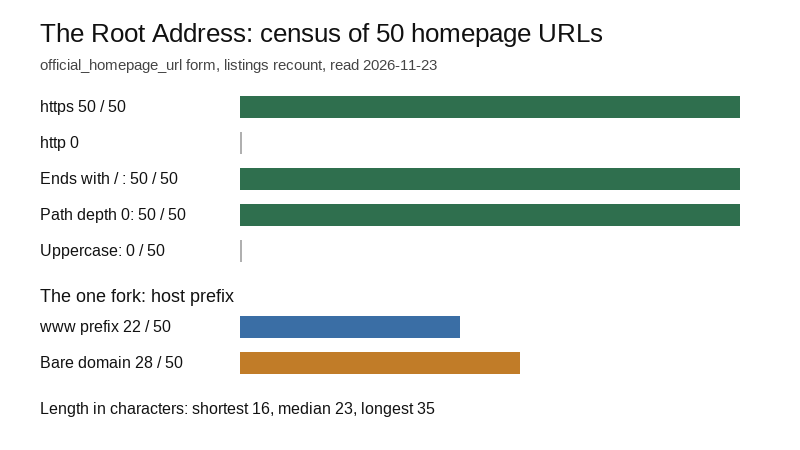
The Root Address is an official homepage URL that resolves to the root of a domain: it carries a scheme and a host, ends at that host, and adds no path segment beyond the closing slash. The field under inspection is the column named official_homepage_url in the listings file, and the census treats that column, and only that column, as its object (Source: listings recount, evidence/SD-data-listings-week01-20261111.csv, read 2026-11-23). The question is not whether an address is correct, reachable, or owned by the company beside it. The question is what shape the recorded address takes: its scheme, its closing slash, its path depth, its capitalisation, its prefix, and its length. Counted that way, the census records https for 50 of 50 entries and http for 0 entries, an ending slash for 50 of 50 entries, a path depth of 0 for 50 of 50 entries, and a deepest observed path depth of 0 (Source: listings recount, evidence/SD-data-listings-week01-20261111.csv, read 2026-11-23).
The nearest neighbour is The Home Domain. It compares an evidence URL against the domain of an official site, asking whether supporting material lives on the same domain as the homepage or somewhere else. The Root Address ignores that comparison and looks only at the spelling form of the official address itself, where the single fork is whether the prefix is written or not, split between 22 entries with the prefix and 28 entries without it (Source: listings recount, evidence/SD-data-listings-week01-20261111.csv, read 2026-11-23). A record can hold a perfect root address while its evidence sits on an unrelated domain, so a tidy homepage field must never be mistaken for proof about evidence.
A Census With No Deep Paths
The striking result is not a spread but a sameness. Every recorded address ends with a slash and sits at path depth 0, each recorded for 50 of 50 entries, with the deepest value observed also standing at 0 (Source: listings recount, evidence/SD-data-listings-week01-20261111.csv, read 2026-11-23). None of the addresses continues past the front door: the field behaves like a register of doors rather than a register of rooms.
That sameness has practical value: a path is information, but it is also variation. Records for the same company can diverge when one collector copies an address after a redirect, another copies one from a press release, and a third copies one from a search result that lands on a subpage. A root address removes much of that drift before matching begins, because the string has fewer moving parts, so a deduplication pass can spend its attention on the host itself.
The scheme and the spelling tell the same uniform story. The census records https for 50 of 50 entries, http for 0 entries, and capital letters in 0 of 50 addresses (Source: listings recount, evidence/SD-data-listings-week01-20261111.csv, read 2026-11-23). For a data steward, that uniformity simplifies validation: an entry arriving with the older scheme, or carrying a capital letter, stands out at once as an exception. A capital letter can split one company into two rows under an exact string match, so a uniformly lower-case field removes that trap and gives later collectors a house style to match.
The One Fork: A Prefix Written or Left Off
Against that background, the census contains one genuine fork. The prefix appears in 22 of 50 addresses, while the bare domain form appears in 28 of 50 addresses (Source: listings recount, evidence/SD-data-listings-week01-20261111.csv, read 2026-11-23). As shares of the census, the prefix form accounts for 44.00% (derived: 22 / 50 x 100) and the bare form for 56.00% (derived: 28 / 50 x 100). Neither form dominates enough to be called the house style, and neither is rare enough to count as an error.
That fork is what troubles exact matching. A human who sees the prefixed and bare forms of one domain usually recognises a single front door; a strict string comparison sees two different strings and keeps both. A team may treat the two host forms as equivalent for matching while preserving the recorded spelling for display, or rewrite every address to one preferred form. An undocumented mixture, by contrast, leaves later readers unable to tell whether a spelling difference signals a different company or merely a different collector habit.
Length completes the portrait. The shortest address runs to 16 characters, the longest to 35 characters, and the median sits at 23 characters (Source: listings recount, evidence/SD-data-listings-week01-20261111.csv, read 2026-11-23). The gap between longest and shortest is 19 characters (derived: 35 - 16). Because every address stops at the root, that spread comes not from paths but from the names themselves, with and without the prefix. For validation, the range acts as a soft fence rather than a hard rule: an incoming address far outside it would prompt a useful question about whether a path or a subpage address has crept into a field reserved for roots.
How the census was counted
The method begins with a single named source. The recount works from the file evidence/SD-data-listings-week01-20261111.csv, which holds 50 rows, checked on 2026-11-11 and recounted on 2026-11-23 (Source: listings recount, evidence/SD-data-listings-week01-20261111.csv, read 2026-11-23). No address was visited to test whether it loads: this is a reading of recorded strings, not a crawl.
The counting scope is the official_homepage_url column alone. For each row, the recount records the scheme, the closing slash, the depth of any path after the host, any capital letter, the host prefix, and the length in characters. Path depth counts segments after the host, so an address ending at the host with a closing slash scores 0, the score recorded for 50 of 50 rows (Source: listings recount, evidence/SD-data-listings-week01-20261111.csv, read 2026-11-23). Length is counted on the string as written, including scheme, prefix where present, and closing slash. Nothing is rewritten or merged before counting, so the bare and prefixed forms are tallied as written, at 28 and 22 respectively (Source: listings recount, evidence/SD-data-listings-week01-20261111.csv, read 2026-11-23). Shares and the length gap are the only calculated figures, each labelled with its formula.
Questions, answered
Does a root address prove that a listed homepage belongs to the company beside it? No. The Root Address describes the shape of a recorded string, not its ownership. The census shows a field written uniformly at depth 0 for 50 of 50 rows (Source: listings recount, evidence/SD-data-listings-week01-20261111.csv, read 2026-11-23), and that uniformity says nothing about whether the domain is right for the company in the row. Ownership needs its own checks. Treating a tidy form as proof would confuse the spelling of an address with the substance behind it, exactly the confusion The Home Domain exists to keep visible.
Should every address in the file be rewritten to remove the prefix, so the forms match? The census reports the mixture rather than judging it: 22 addresses carry the prefix and 28 stand bare (Source: listings recount, evidence/SD-data-listings-week01-20261111.csv, read 2026-11-23). A team matching by exact string will feel the split as duplicate risk, and may normalise for matching while keeping the recorded spelling on display. What the numbers rule out is ignoring the fork: with the prefixed share at 44.00% (derived: 22 / 50 x 100), any process assuming a single form will mishandle a large share of the rows.
Summary
The Root Address names a homepage field that stops at the front door. In this census the form is strikingly settled: https for 50 of 50 entries, a closing slash for 50 of 50 entries, path depth 0 for 50 of 50 entries, and capital letters in 0 of 50 entries (Source: listings recount, evidence/SD-data-listings-week01-20261111.csv, read 2026-11-23). Lengths run from 16 to 35 characters around a median of 23 characters, and the one open fork is the prefix, written in 22 entries and left off in 28 (Source: listings recount, evidence/SD-data-listings-week01-20261111.csv, read 2026-11-23). The concept gives data teams a compact checklist for the shape of a homepage field, and marks the boundary of what that shape can say: form can be audited from the string alone; truth about the company behind it must come from somewhere else.
Sources
- Listings recount from evidence/SD-data-listings-week01-20261111.csv, 50 rows, checked 2026-11-11, recounted 2026-11-23, read 2026-11-23.
- Batch 12 data anchor ledger, section for SD-6, for the census scope and the neighbouring concept distinction, read 2026-11-23.