
The Missing Width: When Is a Resolution Field Allowed to Say Only "1080p"?
What, exactly, does "1080p" promise? A buyer reading a device inventory sees the label on a display and reasonably believes the resolution has been re...
What, exactly, does "1080p" promise? A buyer reading a device inventory sees the label on a display and reasonably believes the resolution has been recorded. It has not. The label records the height and nothing else: in a measured inventory of 300 resolution pairs, the single string "1080p" is the correct label for ten different pairs, from (1152, 1080) to (2304, 1080), spanning widths that differ by a factor of two. The width — the dimension that decides how much fits across the screen — is simply absent from the string, and no parsing cleverness can recover information that was never written down. So the acceptance question for a resolution field is not whether the label is familiar. It is whether the field, as written, still identifies one pair.
What The Missing Width means
The Missing Width means a conventional abbreviation that encodes one component of a two-component value and discards the other, so that the written form names a family of values rather than a value. The nearest prior concept is The Compound Inch. The Compound Inch described imperial measurements written as two units in one string — feet and inches together — which a parser must split and recombine before the value can be used; there, the string carried more than one field and the work was decomposition. The Missing Width is the opposite defect: the string carries fewer fields than the value has. A compound inch can always be recovered by a parser that knows the grammar, because everything is present. A "1080p" label cannot be recovered by any parser, because the width is not hidden in the string — it is not in the string at all.
1 The Deliverables: What a Resolution Field Must Hand Over
An inventory that records resolutions is delivering four things, and the acceptance review should name them separately. Deliverable one: the width in pixels, as a number. Deliverable two: the height in pixels, as a number. Deliverable three: the orientation that follows from the pair — whether the display is landscape or portrait — which matters because the measured inventory holds both, and pairs like (1920, 900) and (900, 1920) are different deliverables with the same two numbers. Deliverable four: the pixel total, which should be derivable from the first two and serves as a consistency check, never as the record itself. A field that delivers only the height — the p-label — hands over one of the four and leaves the other three to inference. The measured inventory's ground truth is 300 distinct pairs drawn from standard widths and heights, with a pixel checksum of 669,471,096; every acceptance test below is run against that ground truth.
2 Itemised Acceptance Standards: Five Written Forms Against the Pair
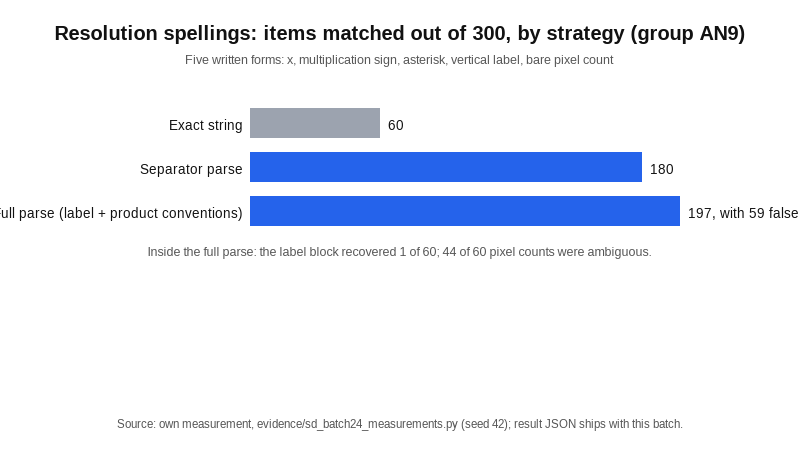
The inventory's second copy writes each pair in one of five forms, 60 pairs each, and each form gets its own standard. Form one, "1600x1080" with a lowercase x: passes — exact string matching recovers all 60, because the form is the canonical one. Form two, the multiplication sign "1600×1080", and form three, the asterisk "1600*1080": pass under a separator-aware parse, which lifts the total from 60 to 180 of 300 with zero false merges; these forms are typographically different and informationally identical. Form four, the vertical label "1080p": fails. A full parse armed with a modal-width convention — guess the most common width for the stated height — recovers 1 of 60 label rows and lands on a wrong pair for the other 59, each of which is recorded as a false merge against the pair it lands on. Form five, the bare pixel count "1728000": fails differently. Sixteen of its 60 products are unique in the inventory and recover exactly; 44 are ambiguous, because a product does not determine its factors. The example pair's own product, 1,728,000, is shared by four pairs in the inventory: (900, 1920), (1440, 1200), (1600, 1080) and (1920, 900) — including both orientations of one shape.
3 Self-Check Method: Three Questions to Ask Any Resolution Field
The self-check can be run on any inventory in minutes, without the ground-truth machinery of the full measurement. Question one: does the written form contain both numbers? Read ten rows at random; if any row's form shows only one number — a p-label or a bare product — the field fails on its face, and the only remaining question is how much of the inventory it affects. Question two: for the forms that do carry both numbers, are the separators from the known set (x, ×, *)? A separator parse recovered every such row in the measurement, so this is a cheap pass to earn. Question three: pick the most frequent label in the inventory — here "1080p" — and count how many distinct pairs in the source data carry that height. If the answer is more than one, the label is a family name, and every row written with it is unidentifiable. In the measured inventory that count is ten pairs for height 1080 alone, and across the label block the convention-based parse was wrong 59 times out of 60. A field that fails question three is not a resolution field; it is a height field wearing a resolution's name.
4 Rework Points: Bringing a Label-Based Inventory Up to Standard
Rework proceeds from the least recoverable form upward. First, the p-labels: these rows cannot be repaired from the inventory itself, because the width was never captured; they must be re-sourced from device records, purchase data or the hardware, and any row that cannot be re-sourced should be marked as height-only rather than silently assigned the modal width — the measurement shows that assignment is wrong 59 times in 60, and each wrong assignment manufactures a false pair that later joins will treat as fact. Second, the pixel counts: the 16 unique products can be promoted to pairs safely; the 44 ambiguous ones need one more datum — either dimension, or the orientation — to resolve, and a single additional field is cheaper to collect than a full re-survey. Third, the separator variants need no rework at all, only a parser that treats x, × and * as one separator. The rework order matters: fix the forms in order of information actually lost, not in order of how untidy they look. The asterisk looks worst and loses nothing; the label looks cleanest and loses the most.
Questions on The Missing Width, answered
1. Why can't a parser recover the width from "1080p"? Because the width is not encoded in the string. In the measured inventory, ten different pairs share the height 1080, and the label is identical for all of them. Parsing rearranges information; it cannot create it.
2. How well did the modal-width convention do on the label block? It recovered 1 of 60 rows. The other 59 were assigned to a wrong pair — counted as false merges — because most heights in the inventory pair with several widths and the convention can only name one.
3. Is a bare pixel count a safe way to store a resolution? No. Only 16 of 60 products in the measurement were unique to one pair; 44 were shared. The product 1,728,000 alone names four pairs, including a landscape pair and its own portrait rotation.
4. Which written forms are fully safe? The three two-number forms: lowercase x, the multiplication sign and the asterisk. A separator-aware parse recovered all 180 such rows with zero false merges.
5. What is the minimum a resolution field must contain to pass acceptance? Both pixel dimensions as numbers. Orientation and pixel total should be derivable from them; if either is stored, it must agree with the pair it is stored beside.
Decision rule: accept a resolution field only if every row states both dimensions numerically — treat any row written as a vertical label or a bare pixel count as unrecorded, route it for re-sourcing, and never let a convention-assigned width enter the inventory as if it had been measured.