
The Reissued Identifier: The Same Book, Reissued Under a Longer Number
Some identifiers are not corrected, edited, or mistyped. They are reissued. When a numbering system changes generation, every item it covers receives...
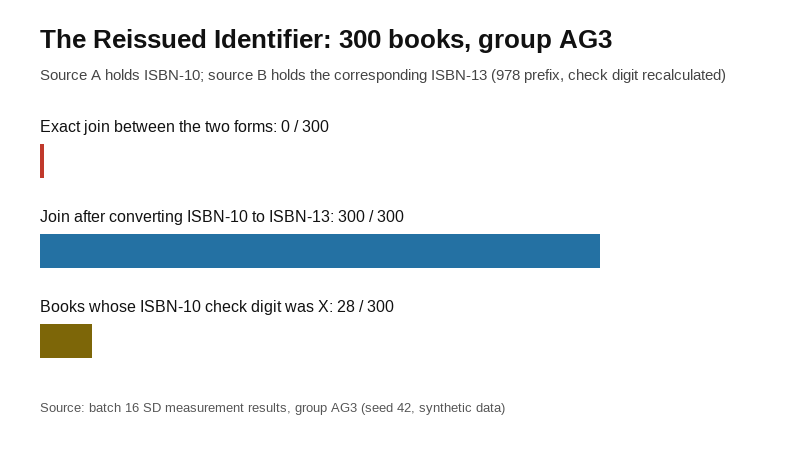
Some identifiers are not corrected, edited, or mistyped. They are reissued. When a numbering system changes generation, every item it covers receives a new official form, built from the old one by a published rule, and both forms circulate at once. A book is the cleanest case. One source stores the book's ISBN-10; another stores the corresponding ISBN-13. The two strings describe the same book, both are official, and neither contains an error. Yet in a measured set of 300 books, an exact join between the two forms matched 0 of 300 records (Source: batch 16 SD measurement results, group AG3). Only after one form was converted into the other did the join recover, matching 300 of 300 (Source: batch 16 SD measurement results, group AG3).
What The Reissued Identifier means
The reissued identifier is the condition of an entity whose identifier has been replaced by a successor form under a system-wide change, so that records carrying the old form and records carrying the new form no longer join, even though both forms are correct and current. In the measured set, source A stored each book's ISBN-10 while source B stored the corresponding ISBN-13, formed by adding the 978 prefix and recalculating the check digit (Source: batch 16 SD measurement results, group AG3). The set held 300 books (Source: batch 16 SD measurement results, group AG3). On that basis, the exact join between the two sources matched 0 of 300 records, a failure of 100 percent (Source: batch 16 SD measurement results, group AG3). The concept applies wherever a numbering scheme has changed generation and both generations remain in circulation; it does not apply to typos or local renumbering, because a reissued identifier is not a damaged old number. It is a new number, issued by rule.
The nearest neighbour is The Plus Alias, and the difference is where the variation lives. In The Plus Alias, one mailbox provider's tagging feature let a single address appear with a +news suffix inside one and the same addressing system, and a stripping rule turned out to be right for the tagging group and wrong for the legacy addresses in the same file. The variation there was a local habit inside one system, and judging it required knowing which subpopulation a record belonged to. The reissued identifier involves no habit and no subpopulation. The ISBN-10 and the ISBN-13 are two generations of one scheme, the successor derived from the predecessor by a fixed public rule, a 978 prefix plus a recomputed check digit (Source: batch 16 SD measurement results, group AG3). Every record is affected in exactly the same way, and the repair is a conversion applied to all of them.
A Join That Found Nothing at All
Most matching failures are partial: a join loses the records with typos or stray spaces. The reissued identifier loses everything, uniformly, and that uniformity is its signature. Because every ISBN-13 in source B differed from its ISBN-10 counterpart in source A, the exact join matched 0 of 300 books (Source: batch 16 SD measurement results, group AG3). There was no partial success and no residue of lucky matches, because no number survives this change unchanged; the prefix alone guarantees that every string differs.
That totality cuts both ways. A total failure is easy to diagnose once someone looks, because a join returning nothing between two files known to describe the same 300 books (Source: batch 16 SD measurement results, group AG3) is obviously broken rather than merely dirty. The danger is the interpretation placed on it before anyone looks: a catalogue team that trusts the join concludes the two sources cover entirely different books, and may manufacture duplicate holdings out of a numbering change. Downstream counts built on the joined file silently report zero overlap, and zero is a plausible-looking number that invites no questions.
Conversion Is Arithmetic, Not Interpretation
The repair distinguishes this concept from most identifier cleaning. Converting an ISBN-10 to its ISBN-13 form requires no fuzzy matching, no threshold, and no guess about intent. The rule is mechanical: take the nine significant digits, place the 978 prefix in front of them, and recalculate the check digit under the ISBN-13 scheme (Source: batch 16 SD measurement results, group AG3). Applied to source A, that conversion produced a key set that matched source B exactly, and the join recovered to 300 of 300 (Source: batch 16 SD measurement results, group AG3). The relationship between the two forms is a function, not a resemblance.
One detail shows why the conversion must be done by the rule rather than by string surgery. Among the 300 books, 28 carried an ISBN-10 whose check digit was the letter X (Source: batch 16 SD measurement results, group AG3). The X is a legitimate ISBN-10 check value, standing for ten, and it has no counterpart in the ISBN-13 form, whose check digit is always a decimal digit produced by the recalculation. A naive repair that glued the 978 prefix onto the old string, X included, would produce an invalid identifier for those 28 books (Source: batch 16 SD measurement results, group AG3), and a subtly wrong one in general, because even a numeric old check digit would almost never equal the recomputed one. The prefix is the visible part of the change; the recomputed check digit makes the new form a valid member of the successor system.
How The Two Forms Were Measured
Evidence for this piece came from a purpose-built synthetic simulation rather than from any publisher catalogue or retail system. A small deterministic script invented the books, ran under seed 42, and scored two joins. Nothing in the run touches a commercial product, and no vendor is rated anywhere in it. Book numbers were handed out in ascending order, starting at 200000000 and adding one per title, after which the script worked out each ISBN-10 check character by the scheme's own rules; that arithmetic is what left 28 titles ending in X (Source: batch 16 SD measurement results, group AG3). A companion ISBN-13 was then derived for every title through the published 978 conversion. Joining the raw key sets produced no matches at all, 0 of 300, whereas joining after conversion produced a full house, 300 of 300 (Source: batch 16 SD measurement results, group AG3).
Questions, answered
If both forms are official, which one should a database store?
Store the successor form as the join key and keep the predecessor as a recorded attribute. The measurement shows the cost of leaving the choice to each source independently: two files describing the same 300 books joined at 0 of 300 until one side was converted (Source: batch 16 SD measurement results, group AG3). A declared canonical generation, with conversion at ingest, removes the failure entirely, because the conversion is deterministic and lossless for this pair of schemes (Source: batch 16 SD measurement results, group AG3).
Why not simply strip the 978 prefix to go back to ISBN-10?
Because the ISBN-13 is not the ISBN-10 with a prefix pasted on. Its final digit was recalculated under a different scheme, so removing the prefix leaves a string whose last digit is the new check digit, not the old one, and for 28 of the 300 measured books the original check digit was the letter X, which no stripping operation can reconstruct (Source: batch 16 SD measurement results, group AG3). Conversion backward requires recomputing the ISBN-10 check digit from the nine significant digits; it is arithmetic, not deletion.
Summary
The reissued identifier is what happens when a whole numbering system changes generation: the old form and the new form are both official, both correct, and completely unjoinable as strings. In the batch 16 synthetic measurement, 300 books held as ISBN-10 in one source and as ISBN-13 in another joined exactly at 0 of 300, and converting the older form by the published rule, the 978 prefix plus a recalculated check digit, restored the join to 300 of 300, with 28 books carrying an X check digit in their ISBN-10 form along the way (Source: batch 16 SD measurement results, group AG3). Unlike a within-system variant such as The Plus Alias, nothing here depends on which records a rule touches; the change is universal and the repair is mechanical. Convert by the rule, declare one generation canonical, and never mistake a zero-overlap join for two different collections.
Sources
- Batch 16 SD measurement results, group AG3, from the deterministic synthetic measurement run with seed 42, covering 300 constructed books in ISBN-10 and ISBN-13 forms, 28 with an X check digit (Source: batch 16 SD measurement results, group AG3).
- Batch 16 SD run record, section AG3, describing the construction and the conversion used to restore the join.