
The Quoted Comma: A Naive Split Gets 900 of 1,500 Rows Wrong
A comma inside a name is not a column break. Yet the simplest way to read a comma-separated file, splitting each line on every comma it contains,...
A comma inside a name is not a column break. Yet the simplest way to read a comma-separated file, splitting each line on every comma it contains, treats it as one, and in this test that shortcut damaged three quarters of the records it touched. Of 1,200 records written correctly, with quoting applied exactly as the format requires, a naive split recovered only 300 exactly as written. The rest were split into too many fields, broken across extra lines, or left with the right number of columns and the wrong content inside them. A reader that understood quoting recovered every record in full. The file was never the problem. The reading rule was.
What The Quoted Comma means
The Quoted Comma means the failure that occurs when commas, quotation marks, or line breaks that belong inside a field are mistaken by a reader for the structural marks that separate fields, records, and lines. In a properly written comma-separated file, a field that itself contains a comma is wrapped in quotation marks so that a careful reader knows the comma is content rather than structure. A field that contains a quotation mark signals that mark by doubling it. A field that contains a line break keeps that break inside its quotes, so one logical record can legitimately span more than one physical line. The Quoted Comma is what happens when a reader ignores all of that signalling and applies one blunt rule, split on every comma and every line ending, to text that was written for a subtler rule.
That definition separates this concept from its nearest neighbour, the Delimiter Drift Rate. The Delimiter Drift Rate, measured in an earlier batch, concerns the separator itself changing between files, so that one file arrives comma-separated and another arrives separated by a different character, and a reader fixed on one separator fails on the other. The Quoted Comma involves no such change. The separator stays a comma throughout, the file follows one consistent convention, and the failure happens inside individual fields, where quoting and escaping carry meaning that a naive reader discards. Drift is a disagreement between files about which mark separates fields. The Quoted Comma is a disagreement within a single well-formed file about whether a given mark is structure or content. Confusing the two leads to the wrong repair, because switching separators does nothing for a file whose separator was never wrong.
The concept also separates two kinds of damage. One is loud: a row returns with the wrong number of columns, and a column check can catch it. The other is silent: a row returns with exactly the expected number of columns, passes every count check, and still holds altered text, because quotation marks were left in place or left doubled instead of being restored. This test measured both kinds separately, and the silent kind accounted for an entire group on its own.
Four groups, one blunt rule
The test file held 1,200 records, each with 4 fields, in four groups of 300: plain, embedded commas inside name and note fields, embedded double quotation marks, and an embedded line break inside the note field. Every record was first written out correctly, with quoting applied by a proper writer, then read back by two readers, so damage could be attributed to the reader rather than to the writing.
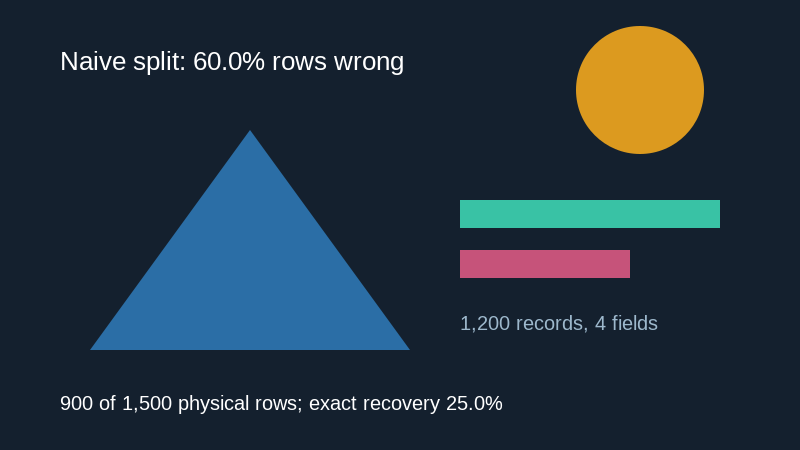
The naive reader split the text into physical lines and then split each line on commas. Against the original 1,200 logical records, that produced 1,500 physical rows, because the 300 records with an embedded line break each broke into two. Of those 1,500 physical rows, 900 had the wrong number of columns, which is 60.0%. The embedded comma group and the embedded newline group contributed rows that were all wrong in column count, while the plain and embedded quote groups produced no column-count errors at all. Judged by whether every field came back exactly as written, the naive reader recovered only 300 of 1,200 records, which is 25.0%.
The second reader, built on the standard csv module, returned 1,200 rows with 0 column-count errors and exact recovery of every field, which is 100%. The entire gap between 25.0% and 100% came from whether the reader honoured the quoting convention.
Where the fields went
Counting wrong rows understates the damage, so the test also counted fields. In the embedded comma group, the naive split cut fields at their internal commas and produced 600 extra fields. Once a row gains extra columns, every value after the internal comma shifts position, so an amount can land where a note belongs and a downstream check that trusts position will read the wrong value with complete confidence.
In the embedded newline group, the damage ran the other way. Splitting on physical lines tore single records into fragments, and the fragments together were missing 900 fields. A fragment row does not announce that it is half of a record. It simply arrives short, and if a loader pads or drops short rows, the missing fields vanish without record.
The embedded quote group is the most instructive, because its column counts were entirely correct. All 300 of its rows came back with the expected number of columns, and all 300 came back with altered content, because the quotation marks inside the fields were left as written rather than restored to the values they encoded. That is a silent error, distinct from the loud structural failures in the other groups. No check that only verifies counts would flag it. Passing a column-count check is evidence about shape, not evidence about fidelity, and treating shape as fidelity is how quoted content gets quietly rewritten at import.
How this was measured
The records in this test were synthetic, invented by a measurement script rather than collected from any customer file or production export. The script built 1,200 records in four constructed groups of 300, wrote them out using proper quoting, and then read the resulting text back with two readers: a naive line-and-comma split and a quoting-aware reader based on the csv module. A fixed seed of 42 makes the record set identical on every rerun. Both readers are hand-built logic inside the script itself: fixed rules, no learning, no external data. This is not a benchmark of any commercial product, and it says nothing about how any vendor importer, spreadsheet application, or platform treats quoting. Every count reported above is a constructed quantity and is stated as such: 1,200 constructed records, 1,500 physical rows under the naive split, and field gains and losses counted exactly as the script defines them.
Questions, answered
If a file passes a column-count check, is it safe to assume the fields are intact? No. In this test the embedded quote group passed column counting completely, with no errors in 300 rows, and still had its content altered in 300 of 300 cases. Column counting verifies shape. It says nothing about whether quotation marks were restored or whether the text inside each field matches what was written.
Which group caused the most damage under a naive split? By field count, the embedded newline group lost the most, with 900 missing fields, while the embedded comma group added 600 extra fields. By exact recovery, both groups failed completely, as did the quote group. Only the plain group survived the naive reader exactly as written, which is why overall exact recovery stopped at 300 of 1,200 records.
Does using a proper parser actually fix all three failure modes? On this constructed file, yes. The quoting-aware reader returned 1,200 rows with 0 column-count errors and 100% exact recovery, covering the comma, quote, and newline groups alike. That is a statement about this test, not a guarantee about every file in the wild.
Summary
The Quoted Comma is the damage done when a reader treats commas, quotes, and line breaks inside fields as if they were always structure. In this test a naive split turned 1,200 correctly written records into 1,500 physical rows, got the column count wrong on 900 of those rows, which is 60.0%, and recovered only 300 records exactly, which is 25.0%. It added 600 extra fields in the comma group, lost 900 fields in the newline group, and silently altered content in all 300 quote-group records while their column counts stayed perfect. A quoting-aware reader recovered 100%. The separator never changed and the file never broke its own rules. The reader simply had to honour them.
Sources
- SmartDataAI measurement W1 (quoted comma and escaping), batch 6, run 2026-11-23; generating script at evidence/sd_batch6_measurements.py, results at evidence/sd_batch6_results.json, both deposited alongside this batch.
- Construction note: the records, their four groups and the two readers were all generated by the seeded script (seed 42); the section above describes the construction in full.