
The Aligned Step: A Wider Step in Atmospheres Recovers 60 of 60 Pressures, and a Narrower One in mmHg Loses 12
Here is the result that breaks the obvious rule. In a measured inventory of 300 pressures in kilopascals to two decimal places, step width alone did n...
Here is the result that breaks the obvious rule. In a measured inventory of 300 pressures in kilopascals to two decimal places, step width alone did not decide survival. Millimetres of mercury step by 0.013332 kPa, only a third wider again, and lost 12 of 60. Psi, stepping by 0.068948 kPa, lost 52 of 60. What decides survival is whether the step lands on the grid's lines or between them: alignment, not narrowness.
What The Aligned Step means
The Aligned Step means a written unit step that falls exactly on the lines of the canonical grid, so every value written in that unit converts back onto a grid line and is recovered exactly, whatever the step's width. The nearest prior concept is The Coarser Grid. The Coarser Grid described the integer-Fahrenheit grid laid over a one-decimal Celsius grid: the Fahrenheit grid was simply coarser than the grid it had to carry, so only 9 of 60 values survived, and the explanation ended at the width comparison. The Aligned Step refines that explanation. Width sets the odds, but alignment settles them. Bar at four decimal places steps by exactly 0.01 kPa — one grid line per step, perfectly aligned — and recovers 60 of 60. Atmospheres step a hair wider, 0.010133 kPa, and still recover 60 of 60 because every converted value rounds home to its own grid line. Psi steps by 0.068948 kPa, nearly seven grid lines at a stride, and recovers 8 of 60.
The Goal and the Prerequisites
The goal of this procedure is a merged pressure inventory in which every row's value in kilopascals is correct to two-decimal precision, with per-unit survival counts known before any row is trusted. Two prerequisites must hold. Prerequisite one: the canonical inventory exists in kilopascals at two decimal places — 300 distinct pressures between 2.00 and 1500.00 kPa in the measured set. Prerequisite two: each foreign spelling's written precision is known (bar and atmospheres at four decimals, psi at two, mmHg at one), because the step width is computed from the precision, not from the unit's name. If a source's written precision is unknown, stop: its rows enter the merge as unverified, not as data.
Step 1: Compute Each Unit's Step Width in Kilopascals Before Converting Anything
Pass criterion: every unit in the merge has a recorded step width in kPa, derived from its conversion factor and its written decimals. The arithmetic is one multiplication per unit: the smallest writable increment, times the unit's factor in kilopascals. One bar is 100 kPa, so a ten-thousandth of a bar is exactly 0.01 kPa; one atmosphere is 101.325 kPa, so a ten-thousandth is 0.010133 kPa; one millimetre of mercury is 0.133322 kPa, so a tenth is 0.013332 kPa; one psi is 6.894757 kPa, so a hundredth is 0.068948 kPa. Record the four widths beside the native grid width before any conversion runs; the widths are the prediction, and the parse is the test of it.
Step 2: Run the Staged Parses and Compare Each Block Against Its Prediction
Pass criterion: the staged counts are recorded, and per-block recovery under the full parse is set against the step table from Step 1. Exact string matching recovers 60 of 300 — the native kPa block only. An SI parse converting kPa and bar, leaving the other three units unparsed, recovers 120 of 300. The full parse, converting every unit and rounding to two decimals, recovers 236 of 300. No stage produces a false merge — 0 at every stage — so every loss here is a value that failed to come home, never one that landed on a neighbour's line. The per-block results, with the step widths that predicted them:
| Written form | Step width in kPa | Exact recovery of 60 |
|---|---|---|
| kPa (native) | 0.01 | 60 |
| bar, four decimals | 0.01 | 60 |
| psi, two decimals | 0.068948 | 8 |
| atmospheres, four decimals | 0.010133 | 60 |
| mmHg, one decimal | 0.013332 | 48 |
Read the table by alignment, not by width. Bar's step equals the grid width exactly, so each bar spelling sits on a grid line by construction and the block is lossless. The atmosphere step is wider than the grid, yet every atmosphere value, converted and rounded to two decimals, lands back on its own line. The mmHg step, only slightly wider at 0.013332 kPa, drifts across grid lines, and 12 rows land between lines and are lost. Psi's step strides across nearly seven lines at once, and only 8 rows survive.
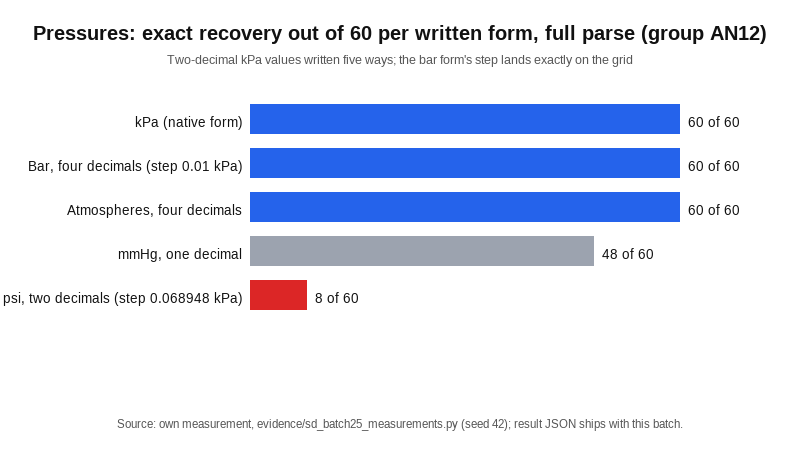
Step 3: Walk One Pressure Through All Five Spellings
Pass criterion: the worked row's five round trips are computed and recorded, including the one that fails. Take 755.27 kPa. Written as "7.5527 bar", it parses back to exactly 755.27 — the aligned step doing its work. Written as "109.54 psi", it parses back to 755.25: 0.02 kPa lost, because the true value falls between two writable psi spellings and the written one rounds home to the wrong grid line. Written as "7.4539 atm" or as "5665.0 mmHg", it parses back to exactly 755.27 — the mmHg spelling being one of that block's 48 survivors. Per-block survival is a rate, not a verdict on any single row: a form that loses a fifth of its rows still carries any given row correctly four times out of five, so a merged row should carry its source form, letting a reader price its risk from the block's rate.
Step 4: Admit Blocks by Their Measured Rate, Not by Their Unit's Reputation
Pass criterion: each block's disposition is written down with its measured recovery count. The kPa, bar and atmosphere blocks enter at full precision, 60 of 60 each. The mmHg block enters with its rate attached — 48 of 60 exact, the other 12 rows either quarantined or carried with their drift recorded. The psi block, at 8 of 60, does not enter as pressure data at all for any purpose needing two-decimal accuracy; it enters, if at all, as approximate readings labelled with a step width of 0.068948 kPa. The measured rate, not the step width, is the only ranking the merge may use: the atmosphere block beat width-based logic and the mmHg block fell short of it.
Completion Check: The Three Counts That Prove the Merge
Three checks close the merge, and all three must pass. First, the count identity: the staged totals reconcile — 60 by exact string, 120 under the SI parse, 236 under the full parse, out of 300 — and the 64 unrecovered rows are accounted for block by block (52 psi, 12 mmHg), not written off as a lump. Check two, the checksum: the source pressures, summed in hundredths of a kilopascal, total 22,336,880; the merged checksum over recovered rows must be a subset sum of that total, the difference exactly the unrecovered rows' contribution. Check three, the false-merge scan: the count stays at 0, as at every stage. If any check fails, the merge rolls back to the per-block state of Step 2 — which is why the blocks and their rates are kept until the checks pass.
Questions on The Aligned Step, answered
1. Atmospheres step wider than the grid, so why did all 60 rows recover? Because width is not the whole mechanism. The atmosphere step is 0.010133 kPa against a 0.01 kPa grid — wider by only about one part in seventy-five — and every converted atmosphere value rounded back onto its own grid line. The mmHg step, 0.013332 kPa, drifts across grid lines as values grow, and 12 of its 60 rows landed between lines.
2. Does an aligned step make a unit safe at any width? No. Alignment in the strict sense — the step landing exactly on grid lines, as bar's 0.01 kPa step does — guarantees recovery at that width. Psi shows the other end: a step of 0.068948 kPa is neither aligned nor narrow, and it recovered only 8 of 60. Between the two, survival is an empirical rate to be measured per block, not inferred from step width alone.
Decision rule: before merging any converted pressure block, compute its step width in the canonical unit and measure its exact recovery on a known sample — admit the block at full precision only if the measured recovery is complete, whatever the step width says, and never on step width alone, because the widest aligned step here lost nothing and a step a third wider than the grid lost a fifth of its rows.