
The Precision Cliff: Past 2^53, a Float Round Trip Silently Changes 52.9% of IDs
There is an exact line in the integers where a common storage shortcut stops being safe, and this test walked a file of record IDs up to that line and...
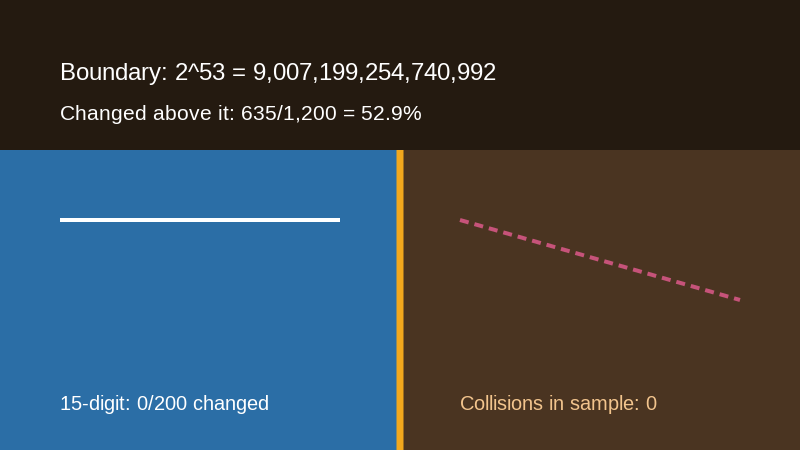
There is an exact line in the integers where a common storage shortcut stops being safe, and this test walked a file of record IDs up to that line and over it. Below the line, nothing happened: two hundred 15-digit IDs passed through a float64 round trip and came back identical, every one. Above the line, the same round trip changed 635 of 1,200 IDs — 52.9 percent (derived) — altering the stored number while leaving its length, its format and its appearance untouched. No error was raised at any point. The cliff is not a slope, a tendency or a rule of thumb. It is a mathematical boundary with a precise address, and on one side of it an ID survives the trip intact while on the other side a coin flip decides whether it comes back as a different number that still looks like an ID.
What The Precision Cliff means
The Precision Cliff means the sharp boundary at 2^53 — 9,007,199,254,740,992 — beyond which a float64 value can no longer represent every integer, so integers stored or passed through float64 may come back changed. A float64 has 53 bits of significand, enough to name every integer up to 2^53 exactly. Past that point the representable numbers thin out: at first every second integer is missing, then every fourth, with the gaps doubling at each successive power of two. An integer that falls into a gap does not raise an error when converted. It is rounded to the nearest representable neighbour, and converting back yields that neighbour — a valid-looking integer, different from the one that went in. Safety does not degrade gradually as IDs grow. It holds completely until the boundary, then fails for roughly half of all values immediately beyond it.
Sixteen digits against fifteen
The test file held two groups of record IDs. The first group held 1,200 IDs of 16 digits, drawn from the interval [9e15, 1e16) — that is, from 9,000,000,000,000,000 up to just below 10,000,000,000,000,000. Every one of those 1,200 values is larger than 2^53, which is 9,007,199,254,740,992, so the whole group lives on the far side of the boundary. The second group held 200 IDs of 15 digits, every one of them smaller than 2^53, living on the near side. Each ID in both groups was converted to float64 and converted back to an integer — the round trip an ID takes whenever it passes through a spreadsheet cell, a JSON number in a language whose only numeric type is a double, a float-typed database column, or any analytics tool that stores numbers one way only.
On the near side of the cliff, the round trip was harmless in full: 0 of the 200 fifteen-digit IDs changed. Not a reduced rate, not a small percentage — zero, exactly as the mathematics predicts, because every integer below 2^53 has an exact float64 representation and the conversion has nothing to round. On the far side, 635 of the 1,200 sixteen-digit IDs came back with a different value from the one that went in, a change rate of 52.9 percent (derived by dividing the changed count by the group total). The remaining 565 happened to land on representable values and survived (Source: SmartDataAI import test V3, run 2026-11-23; script and result JSON filed with this batch's evidence pack). Survival past the boundary is not a property a data owner can rely on or inspect in advance; it is luck of position, determined by whether the ID happens to coincide with one of the representable numbers in its neighbourhood.
One finding must be stated as carefully as it was measured, because it cuts against the dramatic version of this story. Within this sample, the round trip produced no collisions: after conversion, the 1,200 sixteen-digit IDs were still 1,200 distinct values. The changed IDs moved, but none of them moved onto another ID in the file, so no two records in this sample ended up sharing an identifier. That is the honest result and it is reported as such. It should not be read as reassurance. A changed ID does not need to collide with a sibling in the same file to do damage: it needs only to stop matching the same record held in another system, at which point a lookup misses, a join drops the row, or an update lands nowhere. Collisions are the catastrophic version of the failure; silent mismatch is the ordinary version, and the test shows the ordinary version striking more than half the file.
The silence is the second half of the problem. A changed 16-digit ID is still a 16-digit number. Its string length is unchanged, its format is unchanged, it passes any check that asks whether the field looks like an ID, and it differs from the original only in its final digits — exactly the digits nobody reads. A pipeline can therefore carry the corruption through every validation it has, because every validation it has was written to catch malformed values, and these values are not malformed. They are well-formed, plausible, and wrong. Detection requires comparison against a copy that never made the trip, and in most pipelines no such copy survives to compare against: the float was the storage, not a detour from it.
The boundary is crossed by length, not by intent. Any identifier scheme that grows a digit — a sequence that rolls past its planned width, a timestamp concatenated with a counter, a merged key from two systems — crosses from total safety to majority exposure in a single step, with no change in code and no warning. The systems most at risk never chose float at all: a JSON payload parsed by a runtime with one numeric type, a quick pass through a spreadsheet, an export loaded into a tool that infers column types. One round trip, anywhere along the chain, is enough to move an ID.
How this was measured
The values in this test were synthetic, generated by the test script itself: 1,200 sixteen-digit IDs were drawn from the interval [9e15, 1e16) and 200 fifteen-digit IDs from below 2^53, under a fixed seed of 42, so that each group's position relative to the 2^53 boundary held by construction. The round trip — conversion to float64 and back to integer — and the comparison of each returned value against its original were carried out by the script's own deterministic logic, applied uniformly to all 1,400 IDs, and the count of distinct values after the round trip was recorded alongside the count of changed values. The counts are stated exactly as constructed: 1,400 IDs, two groups, one round trip. This exercise measures the behaviour of float64 conversion against constructed identifiers; no commercial system is being measured here, and no vendor tool was evaluated.
Questions, answered
Did the changed IDs collide with each other? No — not in this sample, and the article reports that plainly. After the round trip the 1,200 sixteen-digit IDs were still 1,200 distinct values. The damage measured here is change without collision: each changed ID no longer matches its original, so cross-system lookups and joins fail silently, even though no two records in the file ended up sharing an ID.
Where exactly is the boundary, and why is it sharp? At 2^53, which is 9,007,199,254,740,992. A float64 significand holds 53 bits, enough to represent every integer up to that value exactly, so the test's 15-digit group, all below the boundary, changed 0 of 200. Above it, representable integers thin out into gaps, unrepresentable values are rounded to neighbours, and 52.9 percent (derived) of the 16-digit group came back changed. The boundary is a property of the format, not a gradual trend, which is why the results split so cleanly on either side of it.
Summary
A float64 round trip left every one of 200 fifteen-digit IDs untouched and changed 635 of 1,200 sixteen-digit IDs, 52.9 percent (derived), with no collisions inside the sample and no error, format change or length change to mark any of the alterations. The Precision Cliff sits at exactly 2^53: total safety below it, majority exposure above it, and a single added digit is enough to cross from one side to the other. IDs that must survive should travel as strings or integers end to end, because the trip through a float is silent, and what it changes still looks exactly like an ID.
Sources
- SmartDataAI import test V3 (float64 round trip of record IDs), run on 2026-11-23 — script and output JSON are included in the evidence folder accompanying this batch.
- Construction note: the script built both ID groups at their stated distances from 2^53 and ran the round trip over them, with its seed held fixed; the measurement section gives the whole construction.