
Offset Drift: When the Same Moment Stops Being the Same Time
A timestamp can look complete, parse without an error, and still point to the wrong hour. That is the quiet failure at the centre of this test. Two...
A timestamp can look complete, parse without an error, and still point to the wrong hour. That is the quiet failure at the centre of this test. Two hundred real moments were written six different ways, and a simple parser that read the clock face and ignored the offset moved half of them. Nothing crashed. No warning appeared. The records simply landed hours away from where they belonged, ready to sort wrong, join wrong, and report wrong.
For teams importing event logs, orders, or sensor readings from more than one system, that matters more than a rejected row. A rejected row gets attention. A drifted row gets trusted.
What Offset Drift means
Offset Drift is the distance, in time, between the moment a timestamp actually denotes and the moment a parser records when it reads the wall-clock fields but ignores the offset or zone that qualifies them. If a string says 14:30 at +05:30 and the parser stores 14:30 as if it were UTC, the stored instant is not the written instant. The drift is the gap between the two.
The concept is deliberately narrow. It is not about clock skew between servers, and it is not about daylight saving rules. It is about representation: the same instant, written in formats that carry different offset information, collapsing to different stored values under a parser that does not respect that information. A format with an explicit offset only protects the data if the reader uses it.
Offset Drift is also different from a parse failure. A failure is visible. Drift is silent, which is why this test counts both separately: how many strings failed outright, and how many succeeded at the wrong time.
What the test found
The file held 1,200 timestamp strings: 200 base UTC instants from 2024, each rendered in six representations, 200 strings per representation (Source: SmartDataAI import test T1, run 2026-11-23 — see the batch evidence pack for the script and result JSON). The six forms were UTC with a Z suffix, an offset of +05:30, an offset of -08:00, a naive string with no offset at all, an epoch-seconds string, and an RFC 822 string carrying a -0500 zone (Source: SmartDataAI import test T1, run 2026-11-23 — see the batch evidence pack for the script and result JSON).
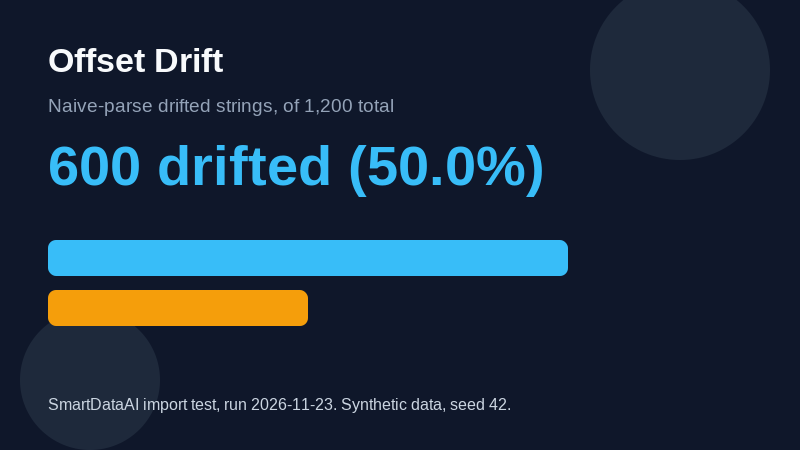
Under the naive parser, 600 of the 1,200 strings drifted from their true moment (Source: SmartDataAI import test T1, run 2026-11-23 — see the batch evidence pack for the script and result JSON). That is 50.0% of the total (derived/computed: 600/1200). The drift was not random noise. It fell into three exact bands that mirror the offsets in the file: +5.5 hours for 200 strings, -8 hours for 200 strings, and -5 hours for 200 strings from the RFC 822 group (Source: SmartDataAI import test T1, run 2026-11-23 — see the batch evidence pack for the script and result JSON). Another 400 strings, the Z group and the naive group, showed zero drift under this definition, because treating their wall clock as UTC happens to match, or defines, the intended reading (Source: SmartDataAI import test T1, run 2026-11-23 — see the batch evidence pack for the script and result JSON).
A further 200 strings failed the naive parser completely: every epoch-seconds string, because an epoch string carries no date fields for a wall-clock parser to extract (Source: SmartDataAI import test T1, run 2026-11-23 — see the batch evidence pack for the script and result JSON). So the naive route produced three outcomes from one file: correct by luck, wrong by hours, or unreadable.
Sorting made the damage concrete. When the 1,200 strings were ordered as plain text and that order was compared with true UTC order, 190,834 pairs out of 719,400 total pairs disagreed (Source: SmartDataAI import test T1, run 2026-11-23 — see the batch evidence pack for the script and result JSON). That is 26.53% of all pairs (derived/computed: 190834/719400). More than one pair in four was in the wrong relative order. Any report that sorts timestamps as strings, or any merge that assumes string order equals time order, inherits that disorder without any single row looking broken.
The control result matters just as much. An offset-aware, zone-aware parser read all 1,200 strings correctly, 1,200 out of 1,200 (Source: SmartDataAI import test T1, run 2026-11-23 — see the batch evidence pack for the script and result JSON). The information needed to get every row right was present in the file. Drift was not caused by missing data. It was caused by a reader that did not use the data that was there.
The practical lesson is to test parsers against mixed representations, not against the one format a single source happens to send today. A pipeline that only ever sees Z-suffixed UTC will pass every local test and still be unprepared for the partner file that arrives with +05:30 offsets next quarter. The drift bands also give a diagnostic: if imported times are wrong by exactly 5.5, 8, or 5 hours in clusters, suspect offset handling before suspecting the source system, because exact hour-sized errors are a representation problem, not a data entry problem.
How this was measured
Reproducibility comes first in how this test was built: a script constructed the synthetic dirty data, fixing the random seed at 42 so any rerun rebuilds the identical file. All detection and parsing followed the script's own deterministic logic, with two readers defined in advance: a naive parser that extracts wall-clock fields and treats them as UTC, and a correct parser that honours offsets and zones for each format. No commercial product was measured here, and no vendor tool was put through the test. Volumes are declared as the constructions they are: rendering 200 base instants six ways produces a designed test file rather than a sample of production traffic, so the drift rates characterise that construction instead of stating a universal rate for timestamp files everywhere.
Questions, answered
Does a timestamp with an offset always parse correctly? No. In this test the offset strings were the ones that drifted, because the naive parser ignored the offset it was given (Source: SmartDataAI import test T1, run 2026-11-23 — see the batch evidence pack for the script and result JSON). An offset protects the value only when the parser is offset-aware. The zone-aware parser in the same test read 1,200 out of 1,200 strings correctly (Source: SmartDataAI import test T1, run 2026-11-23 — see the batch evidence pack for the script and result JSON), which shows the difference is in the reader, not the string.
Why did the epoch strings fail instead of drifting? Epoch-seconds strings carry a count, not calendar fields, so a parser built to extract year, month, day, hour, and minute has nothing to extract. All 200 epoch strings failed the naive parser (Source: SmartDataAI import test T1, run 2026-11-23 — see the batch evidence pack for the script and result JSON). That failure is arguably the safer outcome, because it is visible, unlike the 600 strings that parsed successfully at the wrong time.
Can sorting timestamps as text be trusted? Not when representations are mixed. String order disagreed with true UTC order for 190,834 of 719,400 pairs in this file (Source: SmartDataAI import test T1, run 2026-11-23 — see the batch evidence pack for the script and result JSON), a 26.53% discordance (derived/computed: 190834/719400). Parse first, store a single canonical instant, and sort that. Sorting raw strings only works when every string shares one format, one offset convention, and fixed-width fields, which mixed imports rarely guarantee.
Summary
Offset Drift turned half of a 1,200-string timestamp file into wrong moments under a naive parser: 600 strings drifted, in exact bands of +5.5, -8, and -5 hours (Source: SmartDataAI import test T1, run 2026-11-23 — see the batch evidence pack for the script and result JSON). Another 200 epoch strings failed outright, and string sorting disagreed with true time order in 26.53% of pairs (derived/computed: 190834/719400). An offset-aware parser got all 1,200 right (Source: SmartDataAI import test T1, run 2026-11-23 — see the batch evidence pack for the script and result JSON). The fix is not better timestamps. It is a parser, and a storage format, that treat the offset as part of the value.
Sources
- SmartDataAI import test T1, run 2026-11-23 — see the batch evidence pack for the script and result JSON.
- On method: the measurement section above states the basis in full — synthetic dirty data, seed fixed at 42, the script's own deterministic logic, and no commercial product test.