
The Octal Address: Padding an Address With Zeros Invites Three Different Failures
An IPv4 address looks like one of the safest identifiers in computing. Four numbers, separated by dots, with a specification everyone agrees on. The ...
An IPv4 address looks like one of the safest identifiers in computing. Four numbers, separated by dots, with a specification everyone agrees on. The trouble in this measurement begins with a formatting kindness: an export pads each of the four numbers to three digits with leading zeros, so that columns align and addresses sort neatly as text. The padded address still shows the same digits a person expects to see, in the same order, with nothing added except zeros. Only a reader that parses each segment explicitly as decimal recovers every address. This article counts each failure separately, because lumping them together as formatting problems hides the most dangerous one, the silent change of value.
What The Octal Address means
The Octal Address is the condition in which an IPv4 address whose segments have been zero-padded to three digits is no longer reliably the same address, because different readers treat the leading zeros differently: exact comparison rejects the form, a strict parser rejects the value, and an octal interpretation changes the value. In the measurement, 300 distinct IPv4 addresses were generated, and a second source stored each address with every segment zero-padded to three digits (Source: batch 16 SD measurement results, group AG2). The rules under test were exact equality with the canonical decimal form, strict parsing, octal reading of padded segments, and explicit per-segment decimal parsing.
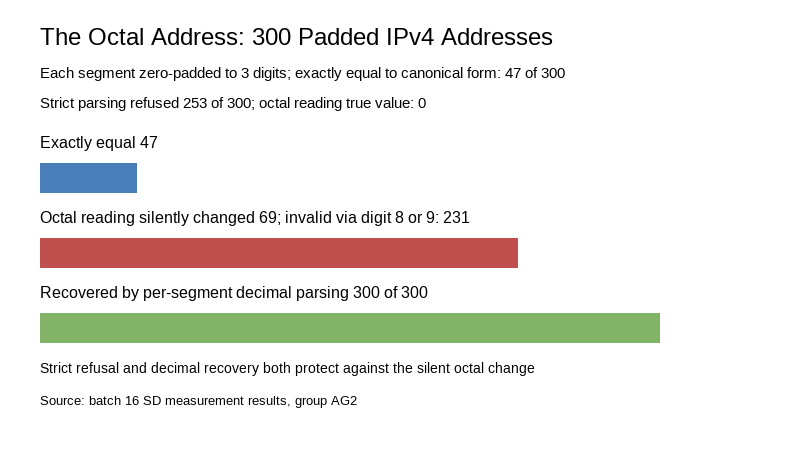
Sample: 300 distinct IPv4 addresses, each segment zero-padded to 3 digits in the second source; exactly equal to the canonical form in 47 of 300 cases; strict parsing refused 253 of 300 (Source: batch 16 SD measurement results, group AG2)
Octal reading: 69 addresses silently read as different addresses, 231 contained a digit 8 or 9 and were invalid in octal, and 0 were read as the true value; per-segment decimal parsing recovered 300 of 300 (Source: batch 16 SD measurement results, group AG2)
The Octal Address differs from its nearest neighbour, The Grouped Code, in what the differing character does. In The Grouped Code, one code existed in a spaced form and a compact form, every letter and digit survived identically in both, and deleting the space reunited the pair completely on the main set, because the space was pure presentation; that article's own discussion set it against leading-zero loss, where a numeric parse destroys characters outright and the lost information cannot be recovered. The padded address belongs to neither pattern. Nothing is lost here: every digit of the true address is present in the padded form, in order. The information is instead misread. A leading zero, which a human reads as padding, is a meaningful signal to an octal reader, an instruction to interpret the following digits in base eight. The grouped code's problem was a character that meant nothing; this problem is a character that means something different to different readers. That is also why the failure splits three ways rather than one, and why one of the three ways changes the address itself instead of merely failing to match it.
Equality and strict parsing fail on the same 253 addresses
The mildest failures are the visible ones. Only 47 of the 300 padded addresses were exactly equal to their canonical forms (Source: batch 16 SD measurement results, group AG2). Those 47 are the addresses whose segments were already three digits long, so padding added nothing and the two forms coincide. The other 253 addresses differed as strings from their canonical forms, because at least one segment had gained one or two leading zeros. An exact join between the padded source and a canonical registry therefore loses 253 of 300 addresses, not because the addresses are wrong, but because the representation is.
The octal reading changes 69 addresses and strands 231
The third reader is the dangerous one, because it does not fail at all on part of the set. Reading each padded segment as an octal number silently produced a different address in 69 cases (Source: batch 16 SD measurement results, group AG2). A segment such as 010, intended as decimal ten, reads in octal as eight, so the resulting address points somewhere else while looking perfectly well formed. The rest of the set could not even be misread consistently. 231 addresses contained a segment with the digit 8 or 9, which has no meaning in octal, so an octal reading of those addresses is invalid (Source: batch 16 SD measurement results, group AG2). Adding the two groups gives the bleakest figure in the measurement: under an octal reading, the number of addresses read as their true value was 0 (Source: batch 16 SD measurement results, group AG2). Every address was either changed or unreadable. The 47 addresses that survived exact comparison do so only because no padding was added; wherever padding was added, the leading zero that was meant as decoration became an instruction, and the instruction was obeyed or rejected, never ignored.
How the padded addresses were built and tested
This section describes the measurement method behind the counts above. Nothing here came from observing a live system: a script built the dataset following a deterministic procedure governed by seed 42, so a rerun recreates identical inputs. The material is synthetic, so the findings say nothing about how any commercial product behaves, and no vendor is scored or ranked (Source: batch 16 SD measurement results, group AG2). The script assembled 300 separate IPv4 addresses, checking that none appeared twice. For each, it wrote a companion version with all four segments lengthened to three characters by prefixing zeros. Four checks were run against those companion versions. Rule one asked whether the padded string matched the canonical spelling exactly. Rule two fed the padded form to a strict parser and noted refusals. Rule three interpreted every segment under octal conventions and tallied addresses that emerged altered, addresses containing an 8 or 9 octal cannot express, and addresses surviving unchanged. Rule four took the opposite approach: it converted each segment on an explicitly decimal basis, reassembled them into a canonical address, and joined on that key (Source: batch 16 SD measurement results, group AG2). This split separates loud failures, such as refusals, from the quiet one, where a value changes silently.
Questions, answered
Why did 47 addresses survive exact comparison if padding breaks the form?
Because padding adds nothing to a segment that is already three digits long. In 47 of the 300 addresses every segment was already three digits, so the padded form and the canonical form are the same string; the other 253 addresses each gained at least one leading zero and failed exact equality (Source: batch 16 SD measurement results, group AG2).
Is the strict parser wrong to refuse padded addresses?
No. Strict parsing refused 253 of 300 padded addresses (Source: batch 16 SD measurement results, group AG2), and the refusal is protective: leading zeros historically signal octal interpretation, so a strict parser treats the ambiguous form as invalid instead of guessing its base. The refusal announces a problem that the octal reading, on the same data, concealed.
How many addresses did the octal reading get right?
None. The octal reading silently changed 69 addresses into different addresses, and 231 addresses contained a digit 8 or 9 and were invalid in octal, leaving 0 addresses read as their true value (Source: batch 16 SD measurement results, group AG2).
What repair recovered every address?
Parsing each segment explicitly as a decimal integer and joining on the reconstructed canonical form recovered 300 of 300 addresses (Source: batch 16 SD measurement results, group AG2). The repair works because it declares the base rather than inferring it from the padded form.
Summary
The Octal Address is a padded representation that three readers treat three ways. Of 300 distinct IPv4 addresses with every segment zero-padded to three digits, only 47 remained exactly equal to their canonical forms, strict parsing refused 253, and an octal reading silently changed 69, found 231 invalid through a digit 8 or 9, and read 0 as their true value (Source: batch 16 SD measurement results, group AG2). Explicit per-segment decimal parsing recovered all 300 (Source: batch 16 SD measurement results, group AG2). Padding is never neutral in a field where a leading zero can be read as an instruction. Declare the base, reconstruct the canonical form, and store that.
Sources
- Batch 16 SD measurement results, group AG2: 300 distinct IPv4 addresses with segments zero-padded to 3 digits; exact equality 47 of 300, strict parsing refused 253 of 300, octal reading changed 69, invalid through digit 8 or 9 in 231, true value in 0, and per-segment decimal parsing recovered 300 of 300.
- Batch 16 SD run record, group AG2: construction of the padded forms and the equality, strict parsing, octal reading, and decimal parsing rules, from the deterministic synthetic measurement script with seed 42.