
The Meeting Point
Temperature looks like one of the safest numbers to compare between two datasets: a single value on a familiar scale, with no names or codes to argue...
Temperature looks like one of the safest numbers to compare between two datasets: a single value on a familiar scale, with no names or codes to argue about. Yet when one source records readings in Celsius and another quietly mixes Celsius with Fahrenheit, the numbers stop meaning the same thing even though each is a perfectly valid temperature. Comparing the two sources directly matched almost nothing, except one reading that can never disagree with itself, because it sits exactly where the two scales cross.
What The Meeting Point means
The Meeting Point is the single temperature at which the Celsius and Fahrenheit scales assign the same number to the same physical reading, so the value survives a change of scale unchanged. That point is -40.0: it converts to exactly -40.0 in the other scale, and back again, leaving no arithmetic trace that a conversion happened. In a mixed-scale dataset it is therefore the one value an exact comparison cannot get wrong — and the one whose agreement proves nothing about the scales around it, since it would agree under any mixture of the two.
The concept neighbours, but does not repeat, The Unit Mirage. That concept described unit suffixes attached to values, where the same number looked different in text because one source wrote a unit marker and the other did not; stripping the suffix revealed that the numbers had agreed all along. The Meeting Point is deeper. Here there are no suffixes to strip, because the readings are unlabeled in both sources, and the stored number itself changes with the scale: most Celsius values become entirely different Fahrenheit values. Only conversion, not tidying, reconciles the two sources — apart from the one reading at the crossing.
A measurement built on unlabeled readings
The measurement used 300 distinct Celsius readings (Source: batch 22 SD measurement results, group AM2). Source A stores all 300 as plain Celsius numbers. Source B stores the same readings in three blocks of 100: 100 kept in Celsius, 100 converted to Fahrenheit exactly, and 100 converted to Fahrenheit and rounded to whole numbers (Source: batch 22 SD measurement results, group AM2). The readings are unlabeled in both sources, so nothing declares which scale any value uses.
That mirrors a common real accident. Sensors, exports and partner feeds routinely change scale at a boundary — a device configured for a different market, a spreadsheet converted by a helpful colleague — without changing the column name or adding a flag. The receiving team sees plausible numbers: some look too warm or cold for the context, but many converted values fall inside the believable range for the original scale, so the mixture survives casual inspection. The measurement strips the problem to essentials: known ground truth, three blocks, no labels.
The exact join and the one survivor
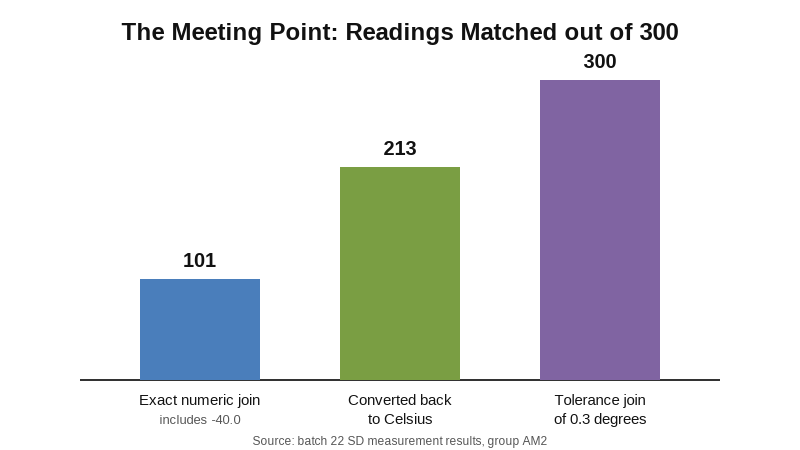
An exact numeric join matched 101 of 300 readings (Source: batch 22 SD measurement results, group AM2). The composition of that total is the interesting part. The 100 readings source B kept in Celsius matched, as expected. Beyond them, exactly one further reading matched: -40.0, which converts to itself and so appears identically in both sources even though it travelled through the Fahrenheit block (Source: batch 22 SD measurement results, group AM2). None of the other 199 Fahrenheit-stored readings matched anything in source A.
The lone extra match warns against trusting join totals at face value. A count of 101 looks merely disappointing, the kind of number blamed on missing rows or a partial feed. Its structure tells a sharper story: a clean block of 100 agreements, plus one agreement mathematically guaranteed in any Celsius–Fahrenheit mixture containing that reading. Teams that investigate only the size of a shortfall, not which values matched, can miss a diagnosis sitting in a single row. The survivor is not noise; it is the signature of two scales sharing one dataset.
Converting back, and where rounding resists
The natural repair is to convert Fahrenheit-stored values back to Celsius before joining. Doing so matched 213 of 300 readings (Source: batch 22 SD measurement results, group AM2). The block of 100 exact conversions returned in full, because an exact conversion reverses exactly. Alongside it, 13 rounded readings also matched: their rounding happened to invert exactly when converted back, landing precisely on the original Celsius value (Source: batch 22 SD measurement results, group AM2).
The other 87 rounded readings did not come back, and their failure is structural rather than careless. Rounding to a whole Fahrenheit degree discards information, and several nearby Celsius values can round to the same whole Fahrenheit number; converting that number back yields one Celsius value, equal to at most one original. No care in the conversion formula restores discarded detail. So 213 is not a staging post on the way to 300 by the same technique, but the ceiling of what exact reversal can recover from this mixture.
A tolerance join finishes the repair
The final strategy admitted near matches instead of demanding identical numbers. A tolerance join allowing a difference of 0.3 degrees matched 300 of 300 readings (Source: batch 22 SD measurement results, group AM2). Every rounded reading, once converted back, fell within that window of its original value, so the tolerance absorbed exactly the error rounding had introduced; nothing required a wider window.
Tolerance joins carry a risk exact joins avoid: two genuinely different readings lying close together can be paired wrongly. That risk was controlled here by construction — the readings are distinct, and the window was chosen against the known rounding error rather than widened until matches appeared. Verification also held independently: after full repair, the 300 readings sum to 12,364.3 in Celsius from both sources (Source: batch 22 SD measurement results, group AM2). A scheme pairing wrong neighbours would rarely reproduce the same total from both sides, so checksum and count corroborate each other.
How the measurement was assembled and how to repair mixed scales
The measurement is a deterministic synthetic measurement with self-written parsing rules, not a commercial product test. Three hundred distinct Celsius readings were written into source B by fixed rules: one block untouched, one converted with the exact Celsius-to-Fahrenheit formula, and one converted and rounded to whole numbers. Each join strategy — exact comparison, conversion back then exact comparison, and conversion back then a 0.3-degree tolerance — was applied to the same pair of sources, with matches counted against the known construction. Rebuilding the same sources and rules reproduces the same counts of 101, 213 and 300.
For real datasets, the repair order matters. First, suspect scale mixture whenever a numeric column joins far worse than expected while its values still look plausible, and inspect which values did match, since a survivor at -40.0 is diagnostic. Second, convert the foreign-scale values back with the exact formula and rejoin exactly, recovering everything never rounded. Third, only then apply a tolerance sized from the known rounding step, and report how many matches depend on it, because those pairings are inferences, not certainties. Keep original values untouched, record which rows were converted and which tolerance-matched, and confirm the repaired column against an independent aggregate such as the Celsius sum of 12,364.3 (Source: batch 22 SD measurement results, group AM2). The durable fix sits at the boundary: store the scale with the reading.
Questions, answered
Why did the exact join match 101 readings rather than exactly 100? Because one Fahrenheit-stored reading converts to itself. The 100 readings kept in Celsius matched directly, and -40.0, where the scales meet, appears identically under both, bringing the total to 101 of 300 (Source: batch 22 SD measurement results, group AM2).
Why did converting the Fahrenheit values back stop at 213 matches? Conversion reverses exactly only where no information was discarded. The 100 exactly converted readings all returned, and 13 rounded readings happened to invert exactly, but the rest had lost detail conversion cannot restore, leaving the exact repair at 213 of 300 (Source: batch 22 SD measurement results, group AM2).
What finally matched all 300 readings, and how was it verified? A tolerance join of 0.3 degrees, after converting values back to Celsius, matched 300 of 300 (Source: batch 22 SD measurement results, group AM2). The Celsius checksum verified it independently: after full repair the readings sum to 12,364.3 from both sources (Source: batch 22 SD measurement results, group AM2).
Summary
The Meeting Point is the one temperature, -40.0, where Celsius and Fahrenheit agree numerically, and it was the sole Fahrenheit-stored reading an exact join could find, lifting the total to 101 of 300. Converting back recovered 213 readings exactly, and a 0.3-degree tolerance completed the repair at 300 of 300, confirmed by the shared Celsius sum of 12,364.3. When unlabeled numbers join badly, examine which values matched before deciding what is missing, because a single survivor can identify the whole problem.
Sources
- Batch 22 SD measurement results, group AM2.