
One MAC Address, Five Spellings: The Twelve Digits Underneath
Of 300 identical MAC addresses written five ways, an exact string match finds only 61. The other 239 addresses are present, complete, and correct, yet...
Of 300 identical MAC addresses written five ways, an exact string match finds only 61. The other 239 addresses are present, complete, and correct, yet a plain comparison reports them as missing, because each one wears a different spelling: colons in one list, hyphens in another, dots in a third, no separators at all in a fourth, and capital letters scattered through a fifth. Nothing about the addresses themselves changed; only the decoration around them changed. This article works through the measured stages that recover all 300, with 0 false merges at every stage.
What The Twelve Digits means
The Twelve Digits is the fact that a MAC address is twelve hexadecimal digits, and every common spelling of it — colon-separated, hyphen-separated, written as dot triplets, or written bare, in either case — is decoration around the same twelve digits, so matching succeeds only when the decoration is stripped. The nearest prior concept is The Variant Address, a prior concept about one email address appearing under several local-part spellings. The Variant Address varies characters inside an email address's local part, so the payload itself differs between spellings. The Twelve Digits keeps the payload identical and varies only the separators and case wrapped around it. That difference decides the fix: a variant MAC spelling needs only a parser, because the twelve digits underneath never changed.
The 2 Inventories And The 300 Address Ground Truth
The prerequisites are two inventories of the same 300 distinct MAC addresses, with ground truth known before matching begins. Inventory A stores all 300 in one canonical written form: colon-separated lowercase, six pairs of hex digits joined by colons. Inventory B stores the same 300 addresses spread across five surface spellings, in five blocks of 60. The first block repeats the canonical form, colon-separated lowercase. The second block uses colons with uppercase letters. The third block uses hyphens in lowercase. The fourth block uses dot triplets in lowercase, grouping the twelve digits into three blocks of four. The fifth block writes the bare twelve hex digits with no separators at all. Because the ground truth is fixed in advance, every match can be checked: a reunion is either a true pair or a false merge, two different addresses wrongly joined.
The Seed 42 Method Behind The 300 Addresses
The counts here come from a synthetic measurement built for this batch, not from any commercial product. A deterministic script, run with seed 42 and written using only the standard library, first fixed 300 addresses whose true twelve digits were known in advance. It then wrote those addresses twice: once in the canonical form, and once spread across the five surface spellings above. Matching strategies were applied in stages, from exact comparison to a full parse, counting reunions and false merges against the known truth at each stage. The script and its result JSON ship in the evidence for this batch, so every number here can be reproduced exactly.
Step 1: Exact Matching On 300 Addresses Reaches 61
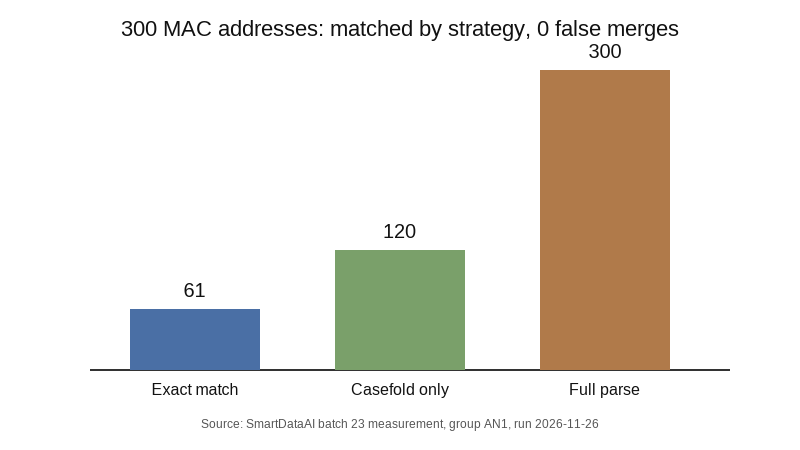
The first step is the cheapest: compare each Inventory B string with the Inventory A strings exactly as written, character for character, and keep every pair that is already identical. Completion marker: this step reaches 61 of 300 matched, with 0 false merges. The 61 are easy to explain. The canonical block contributes its 60 rows, because both inventories chose the same spelling there. The uppercase colon block contributes exactly 1 further row: one address whose twelve digits contained no letter a to f at all, so its uppercase and lowercase spellings are the same string, and exact matching cannot tell them apart. Every other block contributes nothing, because a hyphen, a dot, or a missing separator makes the string different even when the digits underneath are identical. Exact matching therefore gives a safe floor of 61 certain pairs, and a warning: 239 real addresses look absent when they are only respelled.
Step 2: Casefolding On 300 Addresses Reaches 120
The second step adds one normalisation: fold case before comparing, so uppercase and lowercase letters count as the same character, while separators still count exactly as written. Completion marker: this step reaches 120 of 300 matched, with 0 false merges. The gain of 59 comes from the uppercase colon block, whose remaining 59 rows now match their lowercase canonical partners, joining the 61 already found. Casefolding fixes the decoration that lives inside the characters themselves. It cannot fix decoration between the characters: a hyphen is not a colon in any case, and a bare string has no separators to compare at all. So the two colon blocks are fully reunited, while the other three blocks, 180 addresses, are still reported missing. The step is cheap and safe, but its ceiling is set by separators, not by effort.
Step 3: Stripping 3 Separator Kinds From 300 Addresses Reaches 300
The third step stops comparing spellings and starts reading addresses: strip every separator, whether colon, hyphen, or dot, fold case, and read what remains as twelve hex digits. Completion marker: this step reaches 300 of 300 matched, with 0 false merges. One worked example shows the reduction. Take the address written in colon lowercase as 3a:7f:c2:09:5e:b1. In colon uppercase it is 3A:7F:C2:09:5E:B1. With hyphens it is 3a-7f-c2-09-5e-b1. As dot triplets it is 3a7f.c209.5eb1. Bare, it is 3a7fc2095eb1. Remove the separators from any form and the digits are 3a7fc2095eb1. Five strings, one address, because all five reduce to the identical sequence 3, a, 7, f, c, 2, 0, 9, 5, e, b, 1. This illustrative address shows the mechanism; the counts in the table are the measured data for all 300.
| Matching strategy for 300 addresses | Matched | False merges |
|---|---|---|
| Exact string match | 61 | 0 |
| Casefold only | 120 | 0 |
| Full parse, strip separators and read hex | 300 | 0 |
Step 4: Verifying 300 Addresses Against 2 Checksums
The fourth step verifies the result with checksums that ignore spelling entirely. Completion marker: this step confirms 300 of 300 matched, with 0 false merges, and both checksums equal on the two inventories. The first checksum sums the first byte of each address, and it comes to 38,817. The second checksum sums each address read as a full 48-bit integer, and it comes to 42,847,830,187,609,901. Match counts alone show how many rows were paired; the checksums show that the values inside those rows survived unchanged, because a merge that paired the wrong addresses, or altered a single digit, would move at least one total. Verification therefore closes the guide: the staged counts say the parse found everything, and the checksums say what it found is what was there.
The 3 Sticking Points In 300 Address Matches
Three sticking points account for nearly every surprise in this run. The first is the digit-only address: an address whose twelve digits contain no letter a to f has the same spelling in both cases, so it matches one stage earlier than its block suggests, which is why the exact stage found 61 rather than 60. The second sticking point is the dot triplet: it regroups twelve digits into three blocks of four, so a reader expecting pairs will misread its boundaries unless separators are stripped first. The third sticking point is the bare form: a matcher that requires a colon will skip all 60 bare rows even though each is a complete address. All three share one shape: the decoration misleads a rule written for one spelling, while the twelve digits stay readable throughout.
Questions on the twelve digits, answered
Q: Why does exact matching find 61 addresses rather than the 60 in the canonical block? A: One uppercase row had twelve digits with no letter a to f, so its uppercase and lowercase spellings are the same string. That row matched exactly as well, giving 60 plus 1, which is 61.
Q: Why does casefolding stop at 120 of 300? A: Casefolding fixes letters only. It reunites the two colon blocks, 120 rows in total, but hyphens, dot triplets, and bare spellings differ in their separators, which casefolding does not touch.
Q: Did the full parse merge any 2 different addresses by mistake? A: No. The full parse recorded 0 false merges while reaching 300 of 300, and the two checksums, 38,817 for the first bytes and 42,847,830,187,609,901 for the full 48-bit values, confirm the pairings.
The 300 Address Completion Checklist
Use this checklist before any MAC address merge is called complete. First, confirm both inventories hold 300 rows and the ground truth pairing is known. Second, record the exact-match count and check it against 61, including the 1 digit-only row. Third, record the casefold count and check it against 120. Fourth, run the full parse, stripping colons, hyphens, and dots, and check the count against 300 with 0 false merges. Fifth, recompute both checksums, 38,817 and 42,847,830,187,609,901, and stop if either differs. When every box is ticked, the five spellings have collapsed back into the twelve digits they always were.
Sources
> Source: SmartDataAI batch 23 measurement, group AN1 (evidence/sd_batch23_measurements.py and evidence/sd_batch23_results.json, run 2026-11-26).