
The Single Meridian: Every Longitude Spelling Survives — the Merge Waits in the Normalisation
Here is the counterintuitive result first: in a 300-item longitude inventory written four different ways — signed decimals, hemisphere letters, degree...
Here is the counterintuitive result first: in a 300-item longitude inventory written four different ways — signed decimals, hemisphere letters, degrees-minutes-seconds with symbols, degrees-minutes-seconds with colons — a parser that knows all four grammars recovers all 300 values exactly, with zero false merges. Not one spelling loses information. And yet the inventory still contains a merge waiting to happen, between the two rows nobody misspelled: +180 and -180, the same meridian carrying two signed names. The spellings are innocent. The merge, when it comes, will be committed by the range normalisation that runs after parsing, quietly folding -180 onto +180 because a system decided its longitudes live in the interval (-180, 180].
What The Single Meridian means
The Single Meridian means the antimeridian's double identity: the line at 180 degrees is one meridian that answers to two signed coordinates, +180 and -180, so an inventory can hold two correct, perfectly spelled rows for a single place on Earth. The nearest prior concept is The Hemisphere Letter. The Hemisphere Letter covered latitudes, where the letter suffix — 33.8688S against a signed -33.8688 — spells one value two ways on a scale that runs only from pole to pole, and where the two endpoints, the poles, are distinct points that can never coincide. The Single Meridian is what changes when the same letter device is wrapped around a full circle: longitude's two endpoints meet. Latitude's extremes are two places; longitude's extremes are one place with two names, and every operation that treats the names as different values — or forces them into a range that admits only one — has to decide what to do with a duplicate that no spelling error created.
1 The Case: One Longitude, -23.4845, Followed Through Four Spellings
The case item sits off the coast of Brazil, at -23.4845 in the canonical inventory, where inventory A stores signed decimal degrees to four decimal places. Follow it through inventory B's four written forms, checking each step's output as the case proceeds. Step one, the canonical form itself: -23.4845, matched by exact string comparison — this block contributes 75 of the inventory's 300 exact matches. Step two, the hemisphere form: 23.4845W. The minus sign is gone, carried instead by the letter W; a hemisphere-strip parse restores -23.4845 exactly, and with this block the running match count reaches 150 of 300. Step three, degrees-minutes-seconds with symbols: 23°29'04.20"W. The conversion back — 23 + 29/60 + 4.20/3600 = 23.484500 — lands on the canonical value to all four decimal places, because the seconds were written to two decimal places, fine enough that no rounding survives the round trip. Step four, the colon form: 23:29:04.20W, same value, different punctuation, same exact recovery. After four steps the case item has been written four ways and lost nothing at any step. The per-step output check is the same each time: parse, round to four decimals, compare — pass, pass, pass, pass.
2 The Full Run: 300 Longitudes, Three Parsers, No Losses
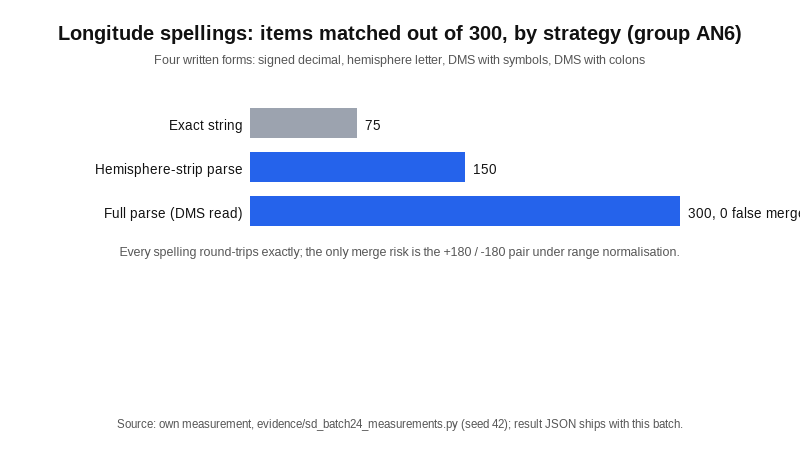
Generalising the case: across all 300 items, exact string matching recovers 75 (the canonical block), the hemisphere-strip parse recovers 150 (both decimal blocks), and the full parse that also reads both degrees-minutes-seconds forms recovers 300 of 300 with zero false merges. The checksum over the set — the longitudes summed in ten-thousandths of a degree — is -7,229,910, identical for both inventories by construction. Compare this with sibling measurements in the same series: latitude spellings also reached 300 of 300, but file sizes reached only 72 of 300 under a full parse and temperatures 249 of 300. Longitude's clean sheet has a specific cause. Its alternative forms are re-encodings, not approximations: the hemisphere letter moves the sign without touching the digits, and degrees-minutes-seconds at two-decimal seconds subdivides the degree more finely (0.01 arc-second is about 0.0000028 degrees) than the four-decimal grid the values live on. Where a form re-encodes, a good parser is enough. Where a form rounds, no parser can be.
3 The Variant: +180 and -180, the Rows That Were Never Misspelled
Now apply the same follow-along to the variant case, the pair the measurement forced into the set deliberately. The value +180 is stored canonically as 180.0000 and written in hemisphere form as 180.0000E. The value -180 is stored as -180.0000 and written as 180.0000W. Each parses back to its own signed value exactly — the letter does its job — so the staged counts above include both rows as clean matches. But the two rows are the same meridian. Any downstream step that normalises longitude into a half-open interval merges them: fold -180 into the (-180, 180] convention and it becomes +180, and the inventory now holds two rows with one value, one of which will be deleted as a duplicate or, worse, kept as a phantom second location 0 kilometres from the first. The variant's lesson inverts the usual data-cleaning instinct. Teams audit spellings because spellings are where loss usually lives; here the audit passes everywhere and the loss lives one step later, in a range rule that nobody thinks of as a spelling at all. A pipeline can be correct at every parse and still halve the antimeridian. The fold also leaves a detectable signature, which is worth knowing before it happens: after normalisation the inventory still has 300 rows, but only 299 distinct values, and the checksum shifts by exactly the folded amount — a distinct-value count that drops while the row count holds is the fingerprint of a range merge, distinguishable at a glance from a spelling loss, which removes matches without ever making two stored values identical.
4 Applying the Case: Where to Put the Check
The application generalises to any coordinate inventory that mixes sources. Put the antimeridian check at the normalisation step, not the parsing step: before any range fold, count rows at exactly +180 and exactly -180, and decide explicitly whether the merged inventory should carry one row or two — for most place inventories one, since they are one meridian; for track or boundary data possibly two, since a path can legitimately touch the line from both sides. Apply the same suspicion symmetrically to the other wrap point of any circular scale: the value that is both the maximum and the minimum of its scale is the value a normaliser can silently duplicate or delete. And keep the parsing result from this measurement in perspective: 300 of 300 is the ceiling of what spelling hygiene can buy. It buys nothing at all against a range rule, which is why the review belongs after the parse.
Questions on The Single Meridian, answered
1. Which longitude spelling loses information? None of the four measured. Signed decimals, hemisphere letters and both degrees-minutes-seconds forms all round-trip exactly at four-decimal precision; the full parse recovered 300 of 300 with zero false merges.
2. If every spelling is lossless, where does the merge risk live? In range normalisation. +180 and -180 are the same meridian under two signed names; folding values into an interval such as (-180, 180] maps -180 onto +180 and merges two correct rows into one value.
Review point: revisit any longitude inventory at the moment its storage range is next changed — when a system migrates between [-180, 180] and [0, 360) conventions, re-run the antimeridian count before and after the migration and confirm the +180 and -180 rows were merged or kept by decision, not by default.