
Leading-Zero Loss: When a ZIP Code Survives the Import but Stops Being a ZIP Code
A ZIP code can pass through an import without an error, without a warning, and without anyone noticing, and still come out the other side damaged. Nothing...
A ZIP code can pass through an import without an error, without a warning, and without anyone noticing, and still come out the other side damaged. Nothing crashes. No row is rejected. The value simply gets shorter, and a shorter ZIP code is not a slightly untidy version of the original. It is a different string, one that will fail lookups, break joins against reference tables, and quietly sort into the wrong place. The damage is especially easy to miss because the surviving digits look plausible. A four-digit value in a ZIP column reads like data. Only a length check, or a comparison against the source, reveals that something was taken away.
That is the pattern this article examines, using a controlled import test built for the purpose. The test is deliberately simple, because the failure it isolates is simple: store a postal code as a number, and the number has no way to remember that its first character was a zero. Numbers do not carry leading characters. Strings do. The moment a code crosses from text into an integer and back again, any leading zero is gone, and no downstream process can tell whether the original value ever had one. The question worth answering is not whether this can happen, but how much of a realistic file it touches, how reliably a basic check catches it, and whether the standard repair actually restores every damaged value or only most of them.
What the numbers show
The test file held 1,000 US ZIP codes in three groups: 400 codes starting with 0, 500 ordinary 5-digit codes, and 100 ZIP+4 codes. Every value was pushed through an integer round trip, converted to a number and then back to text (Source: SmartDataAI import test T5, run 2026-11-23 — batch evidence pack contains the script and result JSON).
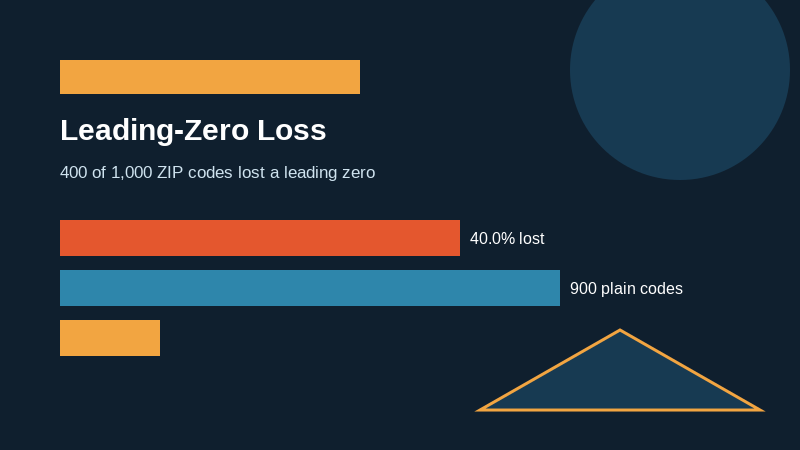
After that round trip, 400 codes had lost their leading zero. That loss is 40.0% of all 1,000 codes in the file. Looked at against only the 900 plain 5-digit codes, the damaged share rises to 44.44% (derived: 400/900), because the ZIP+4 group is counted separately below. Nearly one plain code in two that entered the pipeline as text came back changed, and every single change was of exactly the same kind: the first character deleted, the remaining four digits intact.
Detection, at least, proved straightforward. A simple length check, flagging any plain code shorter than 5 characters after the round trip, caught 400 values, which is all of the damaged plain codes. Nothing slipped past the check, and nothing undamaged was flagged by it, because ordinary 5-digit codes that never began with zero keep their full length through the same conversion. In this test, length is a perfect tripwire for this specific injury, which matters for practice: a team does not need a sophisticated validator to find leading-zero loss, only a check that many import templates never bother to run.
Repair matched detection. Padding each damaged value back to five characters with leading zeros, the zfill(5) operation in the test script, repaired 400 of the 400 damaged plain codes. The fix is total here for a structural reason: the injury removed exactly one known character from a known position, so restoring it requires no guesswork, no external reference data, and no judgement call. That combination, perfect detection plus perfect repair, is unusually good news, and it holds only because the damaged values were still in hand and still recognisably short. Once a shortened code has been merged, deduplicated, or matched against something else, the trail gets colder.
The ZIP+4 group tells a harder story. All 100 of the 100 ZIP+4 codes were damaged by the attempted integer round trip (Source: SmartDataAI import test T5, run 2026-11-23 — batch evidence pack contains the script and result JSON). A ZIP+4 value contains a hyphen, and an integer conversion cannot accept it, so no numeric round trip exists for these values at all. They do not come back shortened; they fail the conversion outright, and any pipeline that forces them through a numeric step will either error, drop them, or coerce them into something unrecognisable. A repair strategy built for plain codes does nothing for this group. The two groups share a column in most real files, which is exactly why a single numeric type decision injures both, in two different ways.
How the test was built matters for how far these numbers travel, so the method belongs here rather than in a footnote. The file was synthetic dirty data assembled by the test script, not records taken from a live customer file. With the seed fixed at 42, the run is reproducible: the same construction produces the same file every time. The script's own deterministic logic did the work throughout: build the three groups, convert each value through an integer round trip, count length changes, apply the length check, then apply the padding repair and recount. No commercial product was measured, and no vendor tool was tested, scored, or compared. The volumes, 400 codes starting with zero, 500 ordinary codes, and 100 ZIP+4 codes, are declared as constructed volumes, and the percentages describe this constructed file, not the frequency of zero-leading codes in any real population. What the test establishes is the behaviour of the conversion itself: given a code that starts with zero, the loss is not probabilistic. It happens every time.
Questions, answered
Does storing a ZIP code as a number always destroy a leading zero?
Yes, for any code that has one. In the test, 400 of the 400 zero-leading plain codes lost the zero in the integer round trip (Source: SmartDataAI import test T5, run 2026-11-23 — batch evidence pack contains the script and result JSON). A number has no leading characters, so the zero cannot survive conversion, and it cannot be recovered from the number alone.
Can a simple check find the damage?
In this test, yes, completely. A length check for values shorter than 5 characters flagged 400 values, matching the damaged count exactly. The check works because the injury always shortens the value. It would not catch a different injury that preserves length, so it should sit alongside, not instead of, source-to-output comparison on sampled rows.
Does padding repair everything?
It repaired 400 of the 400 damaged plain codes in the test, because the missing character and its position are known. It does not address the ZIP+4 group, where 100 of 100 codes were damaged by the conversion attempt itself. Padding fixes the plain-code injury; preventing the numeric conversion in the first place protects both groups.
Should ZIP codes ever be stored as numbers?
No. A ZIP code is an identifier, not a quantity. Nothing meaningful comes from adding two ZIP codes or averaging them, and the test shows the concrete cost of the numeric treatment: 40.0% of a 1,000-code file changed or damaged. Declaring the column as text at import, before any conversion runs, prevents the entire class of loss.
What Leading-Zero Loss means
Leading-Zero Loss is the silent shortening of an identifier when a value that begins with the character zero is stored or passed through a numeric type, which strips the zero and returns a shorter string that no longer matches the original identifier. The loss is defined by three properties. First, it is total within its exposure set: every value that enters a numeric round trip carrying a leading zero loses it, with no partial or occasional outcomes. Second, it is silent: the conversion succeeds, the row survives, and the output looks like ordinary data. Third, it is type-caused rather than content-caused: the digits themselves were correct, and the injury came entirely from how the pipeline chose to hold them. An identifier that merely contains zeros elsewhere, or a numeric quantity such as a count or an amount, does not suffer this loss, because nothing about its meaning lives in a leading character.
Summary
In a constructed file of 1,000 ZIP codes, an integer round trip stripped the leading zero from 400 codes, 40.0% of the file and 44.44% of the 900 plain 5-digit codes, while all 100 ZIP+4 codes were damaged by the conversion attempt. A length check caught every damaged plain code, and padding repaired all 400 of them. The lesson is cheaper than the repair: identifiers belong in text columns from the first step of an import, because the most reliable fix for Leading-Zero Loss is never letting a number hold a code.
Sources
- SmartDataAI import test T5, run 2026-11-23 — batch evidence pack contains the script and result JSON. Data synthetic and dirty by construction, seed fixed at 42, logic deterministic and script-owned; no commercial product was measured.
- Derived figures computed from the T5 counts stated in the article: 400/1,000 = 40.0%; 400/900 = 44.44%.