
The Hemisphere Letter: A Latitude's Sign Lives in Two Different Places
The safest character in a latitude string is the one most parsers throw away: the letter at the end. That is the counterintuitive conclusion of the me...
The safest character in a latitude string is the one most parsers throw away: the letter at the end. That is the counterintuitive conclusion of the measurement behind this article. A latitude can carry its sign at the front, as a minus, or at the back, as a hemisphere letter, and a reader that only looks in one of those two places will read half the planet as positive. The failure is quiet, because the number itself parses cleanly; only its sign is wrong. Nothing in the output looks broken, no error is raised, and the row joins successfully against the wrong half of the map, which is why this particular defect survives casual inspection and only shows up when a checksum or a full parse is run against the whole set of 300 values.
What The Hemisphere Letter means
The Hemisphere Letter means the finding that a latitude's sign can be carried in two different places: by a leading minus in a signed decimal string, or by a trailing hemisphere letter, N or S, in an unsigned string. Its nearest prior concept is The Written Degrees, which covers the degree-based forms a coordinate can be written in. The difference is one of focus: The Written Degrees is about the degree forms a coordinate takes, while The Hemisphere Letter is specifically about where the sign lives, in front as a minus or at the end as a letter, and what breaks when a parser looks in only one place.
Stage 1 to Stage 4: the 300-latitude reading process
A process diagnosis follows one latitude string through four stages, noting what each stage takes in and what it hands on. Stage 1, read the string, takes a raw text value such as 33.8688S as input and outputs the string unchanged; nothing is interpreted yet. Stage 2, find the sign, takes that string as input and must output a sign, positive or negative. For a signed decimal string the sign is the leading minus or its absence. For a hemisphere form the sign is the trailing letter: S means negative, N means positive. Stage 3, convert the form, takes the unsigned number and the sign as input and outputs a decimal degree value; for a degrees-minutes-seconds form this stage also folds minutes and seconds into the degree value. Stage 4, compare, takes the converted value as input and outputs a match or no match against the canonical inventory, at four-decimal precision. The diagnosis covers 300 distinct latitudes at four-decimal precision, between -66.5 and 78.2. Inventory A stores all 300 as signed decimal degrees. Inventory B stores the same 300 in four blocks of 75: signed decimal, hemisphere-letter suffix in the 33.8688S style, degrees-minutes-seconds with symbols and a hemisphere letter, and degrees-minutes-seconds colon-separated with a hemisphere letter. In the DMS blocks, seconds were carried to two decimal places, 0.01 arc-second, fine enough that converting back to four-decimal degrees is exact for every item, so no stage of this process can blame rounding for a miss.
The breakpoint at Stage 2 for 150 hemisphere and DMS rows
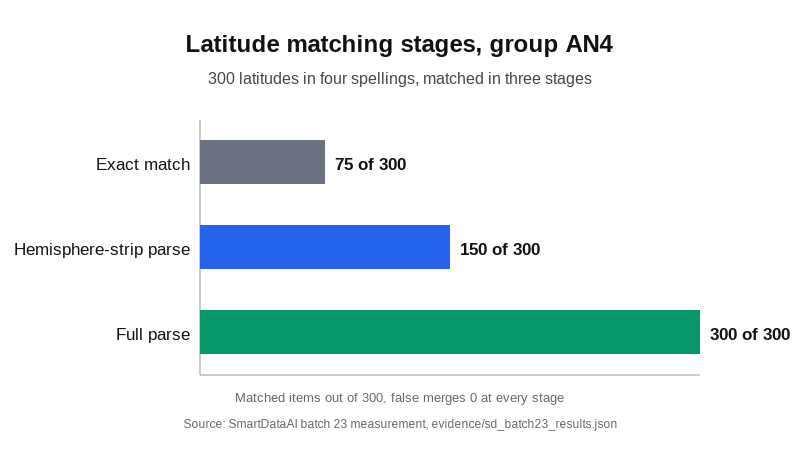
The breakpoint is Stage 2, find the sign, and the stage table below shows exactly where the process loses rows. A reader that compares strings exactly, without any sign handling at all, reunites only the signed decimal block. A reader that strips the hemisphere letter and parses the remaining number as a float reunites both decimal blocks, but it has thrown the letter away, so it can only be right where the sign was never in the letter. The two DMS blocks fall out at the same stage for a related reason: their sign also lives in a trailing letter, and their number is not a single float at all, so a float parse cannot even begin until Stage 3 conversion has run.
| Parse stage | Matched of 300 | False merges | Inventory B forms covered, with block sizes |
|---|---|---|---|
| Exact match | 75 | 0 | Signed decimal (75) |
| Hemisphere-strip float parse | 150 | 0 | Signed decimal (75) and hemisphere-letter suffix (75) |
| Full parse | 300 | 0 | All 4 forms at 75 each: signed decimal, hemisphere-letter suffix, DMS with symbols and hemisphere letter, DMS colon-separated with hemisphere letter |
Read the table as a funnel with one narrow point. Exact matching reaches 75 of 300. The hemisphere-strip float parse reaches 150 of 300, covering both decimal blocks, and still records 0 false merges at four-decimal rounding. Only the full parse, which reads the letter as the sign and converts the DMS forms properly, reaches 300 of 300, with 0 false merges. The 150 rows lost between the second and third stages are not corrupt and not ambiguous; they are simply written in forms whose sign sits where a simple parser never looks, at the end of the string, after the digits it was reading.
The repair order for 3 form groups and the -33.8688 example
The repair order follows the breakpoint: fix the forms in the order that removes the most risk first. First, the decimal forms, because they are the most common and their repair is small: read a leading minus where one exists, and where a trailing letter exists, take the sign from the letter before the letter is stripped. Second, the letter itself, treated as data rather than decoration in every form that carries one, so no later stage can discard it. Third, the DMS forms, whose conversion runs only after the sign has been secured. One latitude in all four spellings shows the order working. Sydney's latitude, -33.8688, is written as signed decimal -33.8688, as 33.8688S, as 33°52'07.68"S, and as 33:52:07.68S. The DMS conversion runs as follows: 0.8688 degrees multiplied by 60 gives 52.128 minutes, so the minutes are 52; then 0.128 minutes multiplied by 60 gives 7.68 seconds. In three of the four spellings there is no minus anywhere, and the negative sign arrives entirely from the letter S. A repair that secures the letter first therefore fixes three spellings at once, while a repair that only teaches the parser DMS arithmetic would still leave every southern latitude in those forms positive.
How the 300 latitudes were measured in batch 23
These counts come from a synthetic measurement assembled for this batch, not from a trial of any commercial product. A deterministic program, seeded with 42 and built only on the Python standard library, began by fixing 300 latitudes whose true four-decimal values were recorded beforehand. Each latitude was then written twice, once in the canonical signed decimal form and once in one of four surface spellings, assigned in equal blocks. The program applied its reading strategies in stages, exact comparison first, then the hemisphere-strip float parse, then the full parse, and tallied both successful matches and false merges against the recorded truth at each stage. Because the truth was fixed before any spelling was produced, a miss can only mean the reader failed the spelling, never that the underlying latitude moved. The program and the result file travel with the batch evidence, so the counts can be rerun and checked.
Questions on the hemisphere letter, answered
Question 1: Why does the hemisphere-strip parse stop at 150 of 300? Because it only handles the two decimal blocks, signed decimal and hemisphere-letter suffix, 75 rows each. The two DMS blocks are not single floats, so they need the full parse, which converts degrees, minutes and seconds and takes the sign from the letter.
Question 2: Can the full parse confuse 2 different latitudes? No. The full parse recorded 0 false merges at four-decimal rounding across all 300 latitudes, and the DMS seconds precision of 0.01 arc-second makes the back-conversion exact for every item.
The re-check point after any 1 parser change
Fix one re-check and hold it permanently: any coordinate import must be re-run against the checksum after a parser change, before its output is used. The checksum for this set is the sum of latitudes in ten-thousandths of a degree, 14,879,905. A parser that drops the hemisphere letter can still produce smooth, plausible output, so plausibility is no defence; only the re-run against 14,879,905 proves the sign survived.
Sources
> Source: SmartDataAI batch 23 measurement, group AN4 (evidence/sd_batch23_measurements.py and evidence/sd_batch23_results.json, run 2026-11-26).