
Joint Gap: When Two Missing Fields Are Worth More Than the Sum of Their Absences
Completeness reports usually count one field at a time. A column is present for this share of records, missing for that share, and the reader is left to...
Completeness reports usually count one field at a time. A column is present for this share of records, missing for that share, and the reader is left to imagine how the gaps overlap. That imagination is where the trouble hides. Two fields can each look moderately incomplete in isolation while being absent together, in the very same records, almost every time. When that happens, the records are not partially documented with scattered holes. They are undocumented in a block, and any use that needs both fields at once, a listing with a verified location and a reviewable image, for example, fails not at the rate of either gap but at the rate of their overlap.
This article measures that overlap directly in a real listings dataset, rather than inferring it from separate column statistics. The dataset is a working research file of data-service companies, and the two fields in question are the headquarters country and the image source page. One supports basic verification of where a company is based. The other supports checking the rights and origin of the image used to represent it. A record missing either one needs work. A record missing both needs the same research pass to even begin, and counting the two gaps separately understates how many records sit in that starting position.
What Joint Gap means
Joint Gap is the share of records in which two specified fields are missing at the same time in the same record, counted directly rather than estimated from the two individual missing rates. The definition rests on a distinction that single-field statistics cannot make. If two gaps were independent, their overlap would be roughly the product of their separate rates, and many records would carry one field even when they lacked the other, leaving something to work with. A Joint Gap far above that product means the absences travel together: the same records were never researched deeply enough to capture either field, so the missingness describes the record's history, not two unrelated accidents. The measure also has a companion, the distribution of missing-field counts per record, which shows whether gaps are spread thinly across a file or concentrated in a block of barely started records. Together, the joint count and the distribution turn a vague sense of incompleteness into a statement about how many records are usable, how many are nearly usable, and how many have not really been started.
What the numbers show
The recount covered 50 companies in the listings dataset (Source: SmartDataAI listings dataset, 50 companies checked 2026-11-11, recomputed 2026-11-23). A field counted as missing when its cell was empty in the source file, and per-company missing-field counts were obtained by splitting the missing_fields column on its separator, following the counting rules recorded with the recompute.
The joint count is stark. In 41 of the 50 companies, the headquarters country and the image source page were both missing at the same time, a joint share of 82.0% (derived: 41/50) (Source: SmartDataAI listings dataset, 50 companies checked 2026-11-11, recomputed 2026-11-23). Only 9 companies in the entire file were missing just one of the counted fields, and not one company was missing none.
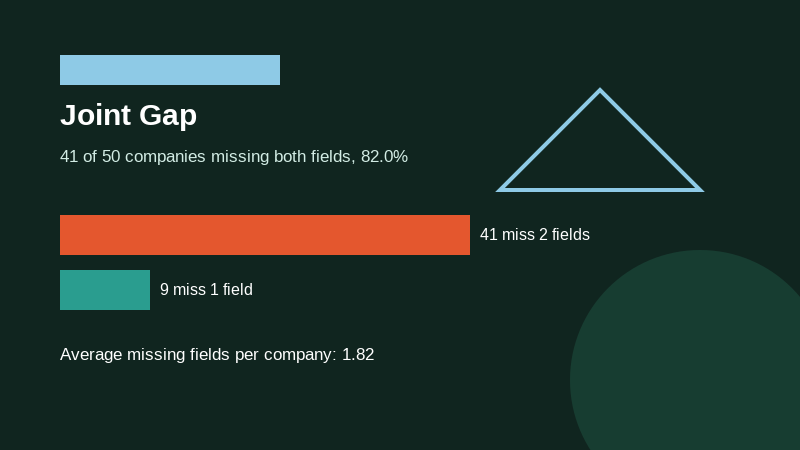
The per-company distribution confirms the block pattern. The average number of missing fields per company was 1.82, and the distribution behind that average has only two values: 9 companies miss exactly 1 field, and 41 companies miss exactly 2 fields. No company misses 0 fields, and no company misses 3 or more. An average of 1.82 could, in principle, hide a gentle spread, a few clean records, many single-gap records, a tail of worse ones. Here it hides nothing of the sort. The file is effectively split into a small group that is one field short and a large group that is two fields short, with no middle and no finished records at all.
For background, the single-field counts from the same source and the same check date put the two gaps in perspective: the headquarters country was missing for 48 of the 50 companies, and the image source page was missing for 43 of the 50 (Source: SmartDataAI listings dataset, 50 companies checked 2026-11-11, recomputed 2026-11-23). Read separately, those numbers say each field is missing in the high eighties or nineties percent. Read jointly, the sharper fact emerges: the overlap is 41 companies, which means nearly every record that lacks one field lacks the other too. Only a handful of records hold one field while missing its partner. The two research tasks, verifying a headquarters and sourcing an image page, were evidently not done independently and partially across the file. Where the work was done at all, it tended to be done for one field in a few cases; for the large majority, neither was done.
That structure changes the remediation plan. If gaps were scattered, a team could harvest quick wins by completing the records that are one field short, and the file's usable share would climb steadily. Here the quick-win group is exactly 9 companies. Behind them stands a block of 41 companies that each need both fields researched from the start, which is not two small tasks multiplied but a single backlog with a single cause: those records entered the file as candidates and were never carried through the verification pass. The Joint Gap therefore points at process, not at data entry. The fix is a research sweep over a named block of 41 records, sized and counted in advance, rather than a general instruction to improve completeness.
How this was measured
This analysis is a recompute, carried out on 2026-11-23, of an existing source file: the SmartDataAI listings dataset, 50 companies, originally checked on 2026-11-11. It is not a fresh survey and not a sample; all 50 records in the file were counted. The counting rules were explicit. A named field counted as missing when its cell was empty in the CSV. The per-company count of missing fields came from splitting the file's missing_fields column on the semicolon separator and counting the entries for each company. The joint count required both named cells, headquarters country and image source page, to be empty in the same record. Percentages marked as derived are simple divisions of the stated counts, shown with their arithmetic so any reader can repeat them from the same file.
Questions, answered
Why not just report the two missing rates separately?
Because the separate rates, 48 of 50 missing a headquarters country and 43 of 50 missing an image source page, cannot tell you how many records are missing both, and that joint count is what decides usability. The direct count found 41 of 50 records in the joint gap, 82.0% (derived: 41/50), a fact that no combination of the two separate rates can state exactly (Source: SmartDataAI listings dataset, 50 companies checked 2026-11-11, recomputed 2026-11-23).
What does the missing-field distribution add?
It shows the shape behind the average of 1.82 missing fields per company: 9 companies missing 1 field and 41 missing 2, with none at zero. That shape reveals a block of barely started records rather than evenly scattered gaps, which changes the remedy from general tidying to a defined research sweep over the 41 two-gap records.
Summary
Counted jointly, the two gaps in this 50-company listings file are one gap: 41 companies, 82.0% of the file, are missing their headquarters country and their image source page at the same time, the average record is missing 1.82 fields, and the distribution is a clean split between 9 companies one field short and 41 companies two fields short. Joint Gap earns its place as a measure because it converts two column statistics into a single operational fact: how many records cannot be used until a full verification pass has been done, and exactly which records they are.
Sources
- SmartDataAI listings dataset, 50 companies checked 2026-11-11, recomputed 2026-11-23. Counting rules: a field is missing when its CSV cell is empty; per-company missing-field counts split the missing_fields column on the semicolon separator.
- Derived figures computed from the counts stated in the article: 41/50 = 82.0%.