
The Invisible Separator: Only 240 of 1,200 Numbers Survive a Standard Check
Some separators you can see. A comma announces itself, but a non-breaking space inside a number looks exactly like an ordinary grouping space, and a...
Some separators you can see. A comma announces itself, but a non-breaking space inside a number looks exactly like an ordinary grouping space, and a full-width space can look like nothing more than generous spacing. In this test, the same 240 integers were written five different ways, using four different whitespace characters as internal grouping separators plus one plain form with no separator at all. A conventional reader that trimmed the ends of each string and then demanded plain ASCII digits accepted only the plain form. Every grouped form failed completely, group after group. The numbers were all valid representations of the same values. What failed was the assumption that trimming the edges of a string is enough to deal with whitespace inside data.
What The Invisible Separator means
The Invisible Separator means a whitespace-class character sitting inside a value or attached to a key, where it performs the visual role of a separator or of harmless spacing, while preventing exact parsing and exact matching from succeeding. The characters at issue are an ordinary space, a non-breaking space at U+00A0, a tab character, and a full-width space. None is hidden in the sense of having zero width. Each renders as space, which is precisely the problem. A human reviewer sees a grouped number that looks entirely normal, or a key that looks identical to the key being searched for, while a program comparing bytes or applying a narrow digit rule sees a different string and rejects or misses it.
That definition separates this concept from its nearest neighbour, the Invisible Character Load measured in the first batch. That earlier concept concerned zero-width characters, characters that occupy a position in a string while rendering as nothing, counted inside fields such as email addresses during deduplication. The Invisible Separator is not about zero-width characters. It is about whitespace-class characters, characters with real, visible width from the family of spaces and tabs, appearing where a parser or a lookup does not expect them: inside the digits of a number, as a prefix before a key, or as a suffix after it. The repair differs accordingly. Hunting zero-width characters does nothing for a non-breaking space used as a thousands separator, and a rule tuned for hidden characters will walk straight past a full-width space standing in front of a key.
The concept covers two surfaces. The first is values: a number written with internal grouping whitespace cannot be parsed by a reader that only trims the outside of the string, because trimming stops at the first non-whitespace character and never reaches the interior. The second is keys: a dictionary key carrying a whitespace prefix or suffix is a different key from its clean twin, so an exact lookup fails even though the two keys look the same when displayed. This test measured both surfaces, and on both the failure under exact handling was total, and the recovery under whitespace-aware handling was also total.
Numbers that look right and parse as nothing
The value test held 1,200 numeric strings, built from the same set of 240 integers rendered in five written forms, with 240 strings in each form. One form was plain, with no separator at all. The other four used an ordinary space, a non-breaking space, a tab, and a full-width space as the grouping separator inside the number. Every form represented the same underlying integers, so any difference in outcome could only come from the separator character itself.
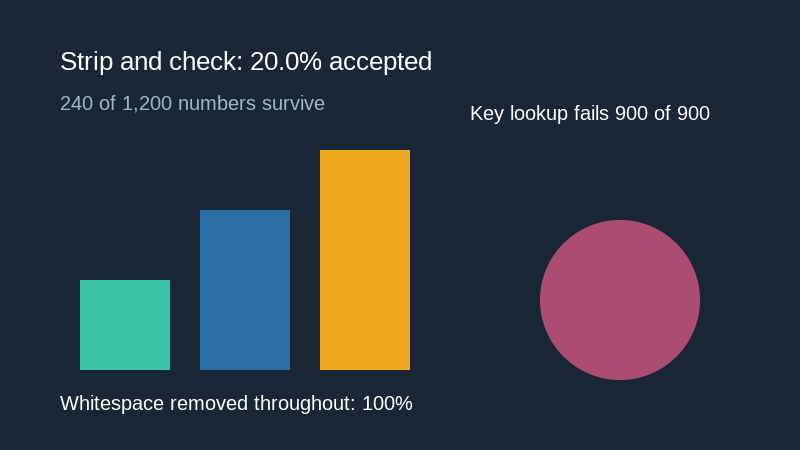
The first reader followed a common pattern: strip whitespace from the two ends of the string, then check that what remained matched a plain ASCII digit pattern in full. That reader accepted 240 of 1,200 strings, which is 20.0%. Its successes were exactly the plain group, accepted in full at 240 of 240. Each of the four whitespace-separated groups was accepted at 0. An ordinary space inside the number failed just as completely as the more exotic characters: any internal separator, however familiar, sits beyond the reach of a trim operation, and a full-match digit check has no tolerance for it. The reader rejected these numbers outright, a loud failure at the level of the individual value, but one easy to misdiagnose as bad source data when the source is in fact consistently formatted in a convention the reader never anticipated.
The second reader removed whitespace-class characters throughout the string, not only at the edges, before applying the same check. That reader accepted 1,200 of 1,200 strings, which is 100%. Nothing about the values changed. The only change was whether internal whitespace was treated as removable formatting or as disqualifying content, and that single decision moved acceptance from 20.0% to 100%.
Keys that look identical and match nothing
The key test performed 900 lookups against a dictionary whose keys were clean. The lookup keys were not clean: they carried a non-breaking space as a suffix, a full-width space as a prefix, or a tab as a suffix, in three sets of 300. Displayed side by side, a contaminated key and its clean counterpart look the same. Compared exactly, they are different strings, and a dictionary lookup has no notion of close enough.
Exact lookup failed 900 of 900 times, for every contaminated key in every set. After the lookup keys were normalised by removing the whitespace-class contamination, lookup succeeded 900 of 900 times. Again the outcome was binary in both directions.
How this was measured
The strings in this test were synthetic, generated by a measurement script rather than harvested from any live spreadsheet, export, or customer file. The script took one constructed set of 240 integers and rendered each integer in five written forms to produce 1,200 numeric strings, and it separately constructed 900 key lookups in three contamination patterns of 300 against clean dictionary keys. With the seed pinned at 42, the strings never vary between runs. Every reader and lookup procedure is deterministic code belonging to the script, executing fixed rules without learning and without outside data. No commercial product is measured by this exercise; no vendor parser, spreadsheet application, or platform was evaluated. All counts are constructed quantities and are stated as such: 1,200 constructed numeric strings and 900 constructed lookups.
Questions, answered
Why does stripping a string not fix a grouped number? Because stripping only removes whitespace from the two ends of a string. A grouping separator sits inside the number, between digits, where a trim operation never reaches. In this test that limitation alone rejected all four whitespace-separated groups completely, at 0 accepted in each group, while the plain group passed in full.
Is the ordinary space really as damaging as the exotic characters? In this test, yes. The group grouped with an ordinary space failed at the same rate as the groups using a non-breaking space, a tab, and a full-width space: none was accepted by the strip-and-check reader. Exotic characters are harder to spot, but the parsing failure itself does not depend on exoticness. Any internal separator defeats a reader that only trims the edges.
How can a lookup fail when the key is visibly present? Because lookup compares characters, not appearances. A key with a non-breaking space suffix, a full-width space prefix, or a tab suffix is a different string from the clean key it resembles. Exact lookup failed 900 of 900 times for that reason, and succeeded 900 of 900 times once the keys were normalised, confirming that the records were present throughout and only the comparison was failing.
What is the safest general repair? Removing whitespace-class characters throughout a numeric string before validation recovered acceptance from 20.0% to 100%, and normalising keys before lookup recovered success from none to all 900. The caution is scope: wholesale removal suits values that should never contain meaningful spaces, such as numbers and identifier keys here. Apply it field by field, not to free text where internal spacing carries meaning.
Summary
The Invisible Separator is whitespace doing quiet damage from inside a value or around a key. In this test, a strip-and-check reader accepted only 240 of 1,200 numeric strings, which is 20.0%, and none at all in any of the four whitespace-separated groups, while removing whitespace-class characters throughout raised acceptance to 100%. Exact key lookup failed 900 of 900 times against contaminated keys, and normalised lookup succeeded 900 of 900 times. Nothing was missing and nothing was miscalculated. The data only needed its spaces treated as what they were: characters, with positions and consequences.
Sources
- SmartDataAI measurement W2 (whitespace variants), batch 6, run 2026-11-23; script and results are stored as evidence/sd_batch6_measurements.py and evidence/sd_batch6_results.json with this batch.
- Construction note: the numeric strings, their written forms, the contaminated keys and every reader trace back to the seeded script (seed 42); how they were built is set out in the measurement section.