
Hidden Duplicate Share: Half the File Was a Second Copy
A deduplication check that reports zero duplicates feels like a clean bill of health. In this file it was wrong about half the records. Every person in...
A deduplication check that reports zero duplicates feels like a clean bill of health. In this file it was wrong about half the records. Every person in the file appeared twice, and a byte-exact check found none of it, because the two copies of each name were not byte-identical. They were the same text in two different Unicode forms, which look the same on screen and differ underneath.
This is the kind of duplicate that survives visual inspection, manual spot checks, and exact matching at the same time.
What the test found first
The file held 600 records covering 300 distinct people, each person appearing in two byte forms: an NFC composed form and an NFD decomposed form of a name containing accented characters (Source: SmartDataAI import test T4, run 2026-11-23; script and result JSON are in the evidence pack for this batch). Byte-exact deduplication found 600 unique byte strings and detected 0 duplicates (Source: SmartDataAI import test T4, run 2026-11-23; script and result JSON are in the evidence pack for this batch).
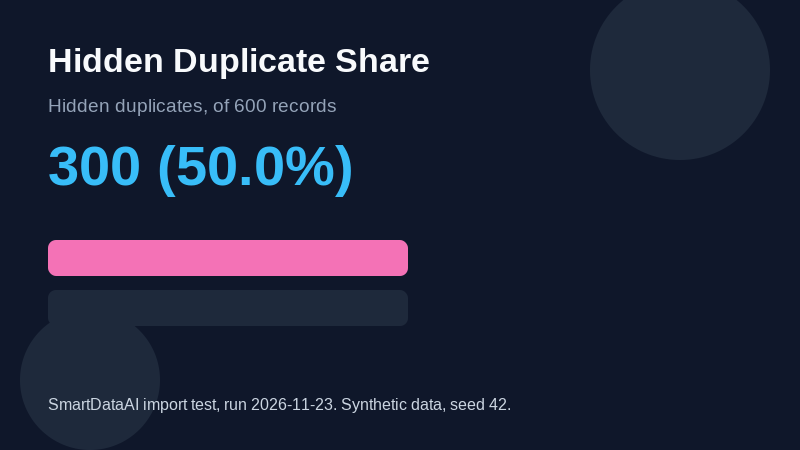
After NFC normalisation, the file resolved to 300 unique people, revealing 300 hidden duplicates (Source: SmartDataAI import test T4, run 2026-11-23; script and result JSON are in the evidence pack for this batch). The hidden duplicates were 50.0% of the file (derived/computed: 300/600). Put differently, byte-exact deduplication had a detection rate of 0% for this class of duplicate in this construction. Half of the file was redundant, and the standard first check reported the file as fully unique.
The construction deserves a note, because it was designed to be fair to the byte-exact method. Only name combinations whose NFC and NFD byte forms actually differ were kept, so every person genuinely appeared in two different byte forms (Source: SmartDataAI import test T4, run 2026-11-23; script and result JSON are in the evidence pack for this batch). There were no accidental identical pairs that an exact check should have caught. The failure is therefore attributable to the representation difference itself, not to a trick in the data.
What Hidden Duplicate Share means
Hidden Duplicate Share is the proportion of a file made up of duplicate records that an exact, byte-level comparison cannot see because the duplicates differ in byte representation while representing the same text. It is measured by comparing a count before and after a defined normalisation: unique byte strings first, then unique values after normalising Unicode form. The difference between the two counts is the hidden duplicate count, and that count as a share of the file is the share.
The concept is narrower than duplicate rate in general. Ordinary duplicates, where the same bytes repeat, are visible to exact deduplication and are not hidden in this sense. Hidden duplicates arise when the same content arrives through systems that encode it differently: one source storing composed characters, another storing decomposed characters, both displaying identically. Any count, mailing list, or customer total built on byte-exact uniqueness will overstate the true number of distinct entries by exactly this hidden share.
How this was measured
Synthetic dirty data, constructed inside a script with the random seed fixed at 42, underlies this test, so the run is reproducible. Deduplication and normalisation followed the script's own deterministic logic: a byte-exact comparison first, then NFC normalisation and a second unique count. No commercial product was measured, and no vendor deduplication tool was tested. Volumes are declared as constructed: the file was built so that every person appears exactly twice, once per Unicode form, which real files rarely do so evenly. The 50.0% share (derived/computed: 300/600) describes this construction; the transferable finding is the mechanism, that byte-exact checks can miss this class entirely, not a claim that half of any real file is hidden duplication.
In practice, the measurement is easy to repeat on a real file: count unique values exactly as stored, normalise to NFC, count again, and compare. If the counts differ, the difference is a concrete, inspectable set of records, not a statistical estimate. That inspectability is what makes the share useful as a routine data quality check rather than a one-off research result.
It is worth being precise about where this problem tends to enter a file. Names with accented characters often pass through several systems before they are analysed: a form, a customer database, a spreadsheet export, a mailing tool. Each system may store or export text in a different Unicode form, and none of them will flag the difference, because nothing is visibly wrong at any single step. The duplication only becomes visible when records from two such paths are placed in one file and compared. That is also why spot checks fail to catch it: a human reviewing a sample sees correct-looking names, and an exact check reviewing the same sample sees unique strings. Both reviews pass, and both are, on their own terms, accurate. Only a comparison across the normalisation boundary reveals the overlap, which is an argument for making that comparison a routine step whenever text from more than one source is combined, rather than an investigation launched after totals already look suspicious.
Questions, answered
Why do the two forms look identical if the bytes differ? Accented characters can be stored as one composed code point or as a base letter followed by a combining mark. Both render as the same visible character. In this test each of 300 people appeared in both an NFC composed form and an NFD decomposed form (Source: SmartDataAI import test T4, run 2026-11-23; script and result JSON are in the evidence pack for this batch), so the screen showed one name while the file held two different byte strings.
Did the byte-exact check make an error? No. It correctly reported that all 600 byte strings were unique (Source: SmartDataAI import test T4, run 2026-11-23; script and result JSON are in the evidence pack for this batch). The error is in treating byte uniqueness as person uniqueness. The check answered the question it was asked; the question was too narrow for data that mixes Unicode forms.
How large was the hidden share in this test? After NFC normalisation there were 300 unique people and 300 hidden duplicates (Source: SmartDataAI import test T4, run 2026-11-23; script and result JSON are in the evidence pack for this batch), which is 50.0% of the 600-record file (derived/computed: 300/600). That share is a property of this deliberate construction, where every person was given exactly two forms.
What is the simplest defence? Normalise Unicode form before deduplicating, counting, or joining on text. NFC is a common canonical choice. In this test that single step moved the unique count from 600 byte strings to 300 people (Source: SmartDataAI import test T4, run 2026-11-23; script and result JSON are in the evidence pack for this batch), exposing every hidden duplicate the exact check had missed.
Can this affect joins and counts, not just deduplication? Yes. Any exact comparison on text, including a join key or a distinct count, compares bytes unless normalisation is applied first. The same representation gap that hid 300 duplicates here (Source: SmartDataAI import test T4, run 2026-11-23; script and result JSON are in the evidence pack for this batch) would also prevent an exact join between a composed-form table and a decomposed-form table from matching those names at all.
Summary
A 600-record file contained 300 people twice over, and byte-exact deduplication detected 0 duplicates because the copies differed as bytes while reading as the same names (Source: SmartDataAI import test T4, run 2026-11-23; script and result JSON are in the evidence pack for this batch). NFC normalisation revealed 300 hidden duplicates, a Hidden Duplicate Share of 50.0% (derived/computed: 300/600). The defence is one normalisation step, applied before any exact comparison is trusted.
Sources
- SmartDataAI import test T4, run 2026-11-23; script and result JSON are in the evidence pack for this batch.
- Method note: see the measurement section above — the run rests on synthetic dirty data, a fixed seed of 42, and the script's own deterministic logic, and it is not a commercial product test.