
The Collapsing Prefix: 60 Distinct Frequencies in GHz Produce Only 2 Distinct Spellings
Start with the count that should not be possible: 60 distinct frequencies, each one a different value in the canonical inventory, were written in giga...
Start with the count that should not be possible: 60 distinct frequencies, each one a different value in the canonical inventory, were written in gigahertz and produced only two distinct spellings between them. Every one of the 60 rows shares its spelling with at least one other row. Nothing was mistyped and no value was large: the inventory runs from 0.50 to 5,000.00 hertz, small decimals on a two-decimal grid. The collapse is manufactured by the notation itself. Each prefix multiplies the unit by 1,000 while the decimal places are held almost fixed — four in kilohertz, five in megahertz, six in gigahertz — so the written step grows from 0.1 Hz to 10 Hz to 1,000 Hz, until the largest prefix can name almost nothing in the range it is asked to carry.
What The Collapsing Prefix means
The Collapsing Prefix means a family of prefixed units written at fixed decimal counts, where each larger prefix multiplies the unit by 1,000 but adds too few decimals to compensate, so the written step grows by orders of magnitude until distinct values collapse onto shared spellings. The nearest prior concept is The Precision Cliff, which describes a hard edge inside the float64 format itself: once an integer passes 2^53 (9,007,199,254,740,992), the format stops holding every integer exactly, and its test saw 0 of 200 fifteen-digit IDs altered under that line against 635 of 1,200 sixteen-digit IDs altered over it. That boundary sits inside the number system itself. The Collapsing Prefix is not that. Nothing in this measurement approaches any representational limit — the values are small decimals, nowhere near 2^53 — and the collapse is a notation choice. Decimals are held fixed at 4 in kHz, 5 in MHz and 6 in GHz while each prefix multiplies the unit by 1,000, so the written step grows from 0.1 Hz to 10 Hz to 1,000 Hz until the spelling space itself collapses: 60 distinct frequencies written in GHz produce only two distinct spellings. A float64 could hold every one of these values exactly enough; the spelling cannot.
1 The Case: One Frequency, 4,553.61 Hz, Followed Through 5 Spellings
Follow the case item step by step, checking each spelling's output before moving to the next. The canonical value is 4,553.61 Hz, stored at two decimal places in inventory A. Step one, the canonical form itself: "4553.61 Hz", matched by exact string comparison — this block contributes 60 of the inventory's 300 exact matches, and the case item passes. Step two, kilohertz at four decimal places: "4.5536 kHz". Parsed back, it returns 4,553.60 Hz. The four-decimal kHz step is 0.1 Hz, ten grid lines wide against the 0.01 Hz grid, and the case item lands one grid line low — close, plausible, and wrong. Step three, megahertz at five decimal places: "0.00455 MHz". Parsed back, it returns 4,550.00 Hz. The five-decimal MHz step is 10 Hz, and the case item has now lost 3.61 Hz without any error being raised. Step four, gigahertz at six decimal places: "0.000005 GHz". Parsed back, it returns 5,000.00 Hz. The six-decimal GHz step is 1,000 Hz, wider than most of the values in this inventory, and the spelling does not merely round the case item — it invents 446.39 Hz that were never measured, returning the only round number the nearby spelling space can name. Step five, revolutions per minute as an integer: "273217 rpm". Parsed back by dividing by 60, it returns 4,553.62 Hz, one grid line high. The rpm step is 1/60 Hz, about 0.016667 Hz — roughly one and two-thirds grid lines — so the case item nearly survives the one form that is not a prefix at all. After five steps the pattern is visible in a single row: as the prefix grows, the error grows with it, from one grid line, to 3.61 Hz, to 446.39 Hz invented outright.
2 The Full Run: 300 Frequencies, 3 Parsers, 102 Recovered
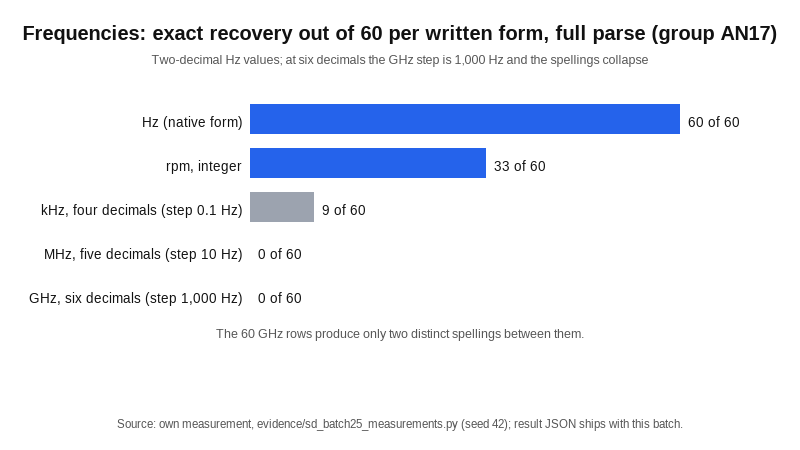
Generalising the case: across all 300 items, exact string matching recovers 60 (the Hz block), the prefix parse that converts kHz, MHz and GHz recovers 69 of 300, and the full parse that also reads rpm recovers 102 of 300, with zero false merges at every stage. Adding the whole prefix family to the grammar buys nine rows over exact matching; adding rpm buys 33 more. The checksum over the set — the frequencies summed in hundredths of a hertz — is 78,060,880, identical for both inventories by construction. The per-form table shows where the loss concentrates:
| Written form | Decimals | Step in Hz | Distinct spellings produced | Exact recovery of 60 |
|---|---|---|---|---|
| Hz | 2 | 0.01 | 60 | 60 |
| kHz | 4 | 0.1 | Not reported in the run notes | 9 |
| MHz | 5 | 10 | Not reported in the run notes | 0 |
| GHz | 6 | 1,000 | 2 | 0 |
| rpm | 0 (integer) | 0.016667 | Not reported in the run notes | 33 |
Two honest notes belong beside the table. First, the measurement reports the distinct-spelling count only for the GHz block, where the collapse is total: 60 rows, two distinct spellings, every row sharing. For the other converted forms the recovery counts are the measured fact, and no distinct count is claimed here. Second, the rpm block is the honest middle case: integer rpm quantises frequency at about 0.016667 Hz per step, about 1.7 grid lines, so roughly half the rows survive — 33 of 60 here — and the rest land one grid line off with no error raised. The prefix blocks fail by growth; the rpm block fails by a small, fixed margin.
3 Variant Applications: Wherever a Prefix Ladder Meets a Fixed Decimal Count
Apply the case wherever a unit family is written by climbing a prefix ladder while holding decimals nearly fixed. The first variant is direct: any frequency feed that promotes values into MHz or GHz for display and lets the display spelling become the stored record will collapse a low-frequency inventory exactly as measured here, because the values sit far below the step the largest prefixes can write. The second variant is the general rule: before accepting any prefixed spelling as a record, convert its step back into the canonical unit and compare it with the canonical grid — here 0.01 Hz. A step at or below the grid can carry the inventory; a step ten times wider, as in kHz at 0.1 Hz, already recovered only 9 of 60; steps of 10 Hz and 1,000 Hz recovered nothing. The third variant is the rpm lesson applied sideways: a non-prefixed form with a step close to the grid, even an unfashionable one like integer rpm at about 0.016667 Hz, can outperform the prestigious large prefixes, recovering 33 of 60 against their combined 9 of 180. The discipline in every variant is the same: store in the unit whose written step fits the grid, convert only for display, and never let a display prefix become the only surviving spelling of a measured value.
Questions on The Collapsing Prefix, answered
1. Why do the GHz spellings collapse to only two? Because the written step is 1,000 Hz. Six decimal places of a gigahertz still move in steps of 1,000 Hz, and the inventory runs only from 0.50 to 5,000.00 Hz, so the 60 values in the GHz block can land on almost no spellings at all: two distinct spellings for 60 distinct values, with every row sharing its spelling.
2. Which non-canonical form recovered the most rows? Revolutions per minute, at 33 of 60. Its integer step is 1/60 Hz, about 0.016667 Hz, close to the 0.01 Hz grid, so roughly half its rows round-trip exactly. The three prefixed forms together recovered 9 of 180: kHz 9 of 60, MHz 0 of 60 and GHz 0 of 60.
3. Is this the same failure as a float64 precision limit? No. The values are small decimals far from any representational boundary such as 2^53. The collapse is a notation choice: decimals held at 4, 5 and 6 while each prefix multiplies the unit by 1,000, so the written step grows from 0.1 Hz to 10 Hz to 1,000 Hz until the spelling space itself gives out.
Review point: revisit any frequency inventory at the moment a new prefixed unit is admitted to its schema — before the first MHz or GHz spelling is stored, convert that form's step back into hertz, compare it with the inventory's 0.01 Hz grid, and record the comparison; if the step is wider than the grid, admit the prefix for display only and keep the hertz spelling as the record.