
The Expansion Ceiling: Expanding Address Abbreviations Recovers Half the Matches — Then Stops
Address matching usually begins with a dictionary: expand the abbreviations, then compare. The test built for this article ran that standard play on 200...
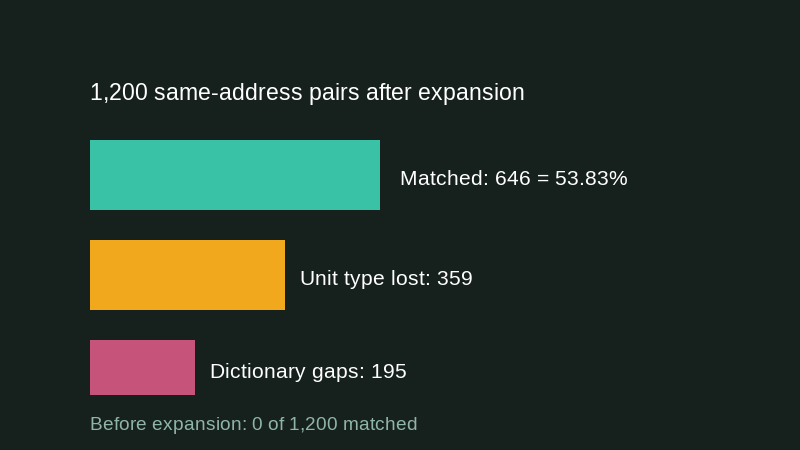
Address matching usually begins with a dictionary: expand the abbreviations, then compare. The test built for this article ran that standard play on 200 addresses, each written four ways, and measured both halves of the outcome. The dictionary worked — before expansion, not one of the 1,200 same-address pairs in the file matched exactly; after expansion, 646 did. But the recovery stopped at 53.83%, and the autopsy of the 554 pairs that still failed splits into exactly two causes. One of them is not a dictionary problem at all, and no dictionary, however large, will ever fix it.
What The Expansion Ceiling means
The Expansion Ceiling means the limit on match recovery that abbreviation expansion runs into once the easy differences are gone: the point where the remaining mismatches are caused not by unexpanded abbreviations but by information that one variant carries and another has lost. It is measured as the share of same-address pairs still unequal after a stated dictionary has been applied, broken down by cause. A ceiling is different from a coverage gap. Coverage can be bought — add the missing abbreviations and those pairs recover. A ceiling is structural: when one writing of an address records a unit type and another drops it, expansion cannot invent the missing fact, and the pair stays unequal forever.
How this was measured
The file was constructed synthetically: 200 canonical addresses, each rendered in four written variants by the test script, yielding 800 rows and 1,200 same-address pairs to compare. The script then applied its own fixed abbreviation dictionary — the deterministic expansion logic written for the test, seeded at 42 for reproducibility — and counted exact-equality pairs before and after, and classified every pair that remained unequal by the cause the construction had built into it. The dictionary is the test's own, not a commercial address engine; the proportions are properties of this constructed file, declared here rather than dressed as field statistics.
Where the 554 failures live
Start with the dictionary's reach. Across the file, abbreviation tokens appeared 1,134 times; the dictionary covered 939 of them, a coverage of 82.80%. That coverage converted a file with zero exact-matching pairs — 0 of 1,200 before expansion — into one with 646 matching pairs, 53.83% (Source: SmartDataAI import test U3, run 2026-11-23; script and result JSON filed in this batch's evidence pack). Judged as a dictionary exercise, that is a success: more than half the duplicate groups became findable by exact comparison alone.
The remaining 554 pairs divide cleanly. The first cause is ordinary and fixable: 195 pairs failed on uncommon street-suffix abbreviations the dictionary did not contain — the long tail of shortened forms that a bigger dictionary would eventually absorb. The second cause is the ceiling itself: 359 pairs failed because one variant wrote the unit designator with a hash sign, discarding the unit type — the difference between a suite, an apartment and a unit number was present in one writing and absent in the other, and once absent, no expansion of the surviving text can restore it. The third bucket in the classification — everything else — came back empty: zero pairs failed for any other reason. Two causes explain all 554 failures, and the larger of the two, at 359 pairs against 195, is the unfixable kind.
The pair arithmetic shows why the ceiling bites so hard in group terms. Each address contributes six pairs — four variants taken two at a time — so a single unrecoverable difference does not cost one match, it costs every pair that difference touches. A variant whose unit type was flattened disagrees with its three siblings at once, and the 359 pairs in that bucket are what a few hundred flattened unit fields look like after pair multiplication (the pair count itself is derived: 200 addresses × 6 pairs = 1,200). Deduplication metrics reported per pair will always make an intake problem look larger than it felt at the keyboard — and, read the other way, fixing the intake field repairs six pair outcomes at a stroke. On the dictionary side the same arithmetic applies to the 195 uncovered abbreviation tokens the expansion left behind (1,134 tokens in total, 939 covered): each uncovered token can poison every pair its variant participates in, which is why modest dictionary gaps produce outsized pair losses.
The implication for deduplication work is a reordering of effort. Teams typically respond to missed address matches by growing the dictionary — chasing the 195-pair cause, which is real but smaller. The ceiling says the bigger prize is upstream: capture the unit type at intake, or preserve it through normalisation, because once a pipeline has flattened a suite designator to a bare hash and a number, the information needed to match that address against its fully-written twin no longer exists anywhere in the data. Matching cannot recover what recording discarded.
Questions, answered
Why did zero pairs match before expansion? By construction, every variant of each address differed from its siblings in at least one abbreviation, so exact comparison found nothing — 0 of 1,200 pairs. The figure dramatises a real condition: in raw exports, the same address almost never arrives spelled the same way twice.
Is 82.80% dictionary coverage good or bad? It is the wrong number to optimise. Coverage bought the recovery from 0% to 53.83% of pairs, but the residual failures are dominated by the unit-type cause, which coverage cannot touch. A dictionary at 100% coverage would still leave those 359 pairs unmatched.
What exactly is lost in the hash-sign variants? The type of the unit. One writing says, in effect, "suite 400"; the other says "#400". The number survives; the category does not — and a matcher comparing the two strings cannot know whether the hash conceals a suite, an apartment or something else, so exact matching correctly refuses them.
Can fuzzy matching break the ceiling? It can guess across it, at a price. A probabilistic matcher might pair the hash variant with its twin — and will sometimes pair it with the wrong unit of the same building instead. The ceiling describes exact matching after expansion; crossing it means accepting a false-match rate in exchange, which is a different trade, not a refutation.
What is the first fix a team should make? Stop the loss at intake. Preserve unit-type fields as structured data instead of flattening them into a single address line, and the 359-pair cause largely disappears before matching ever runs. Dictionary growth comes second — it addresses the smaller cause.
Summary
Abbreviation expansion took a file of 200 four-times-written addresses from zero matching pairs to 646 of 1,200 — 53.83% — and then stopped. Of the 554 pairs still failing, 195 trace to dictionary coverage, a fixable gap; 359 trace to unit types discarded by hash-sign shorthand, information no dictionary can restore; and none trace to anything else. That hard residue is the Expansion Ceiling: the point where address matching stops being a vocabulary problem and becomes a data-capture problem.
Sources
- SmartDataAI import test U3 (address standardisation), executed 2026-11-23 — the generating script and result JSON are in the evidence pack delivered alongside this batch.
- The construction — 200 canonical addresses in four variants, a fixed in-script dictionary, a fixed seed — is set out in the measurement section; all quoted figures are the run's own counts.