
The Whole-Number Gate: Why a Kilowatt-Hour Spelling Keeps Only the 6 of 60 Energies That Are Whole Watt-Hours
What happens to the other nine-tenths? An energy inventory records values in watt-hours to one decimal place — 43,009.7 Wh, say — and a report asks fo...
What happens to the other nine-tenths? An energy inventory records values in watt-hours to one decimal place — 43,009.7 Wh, say — and a report asks for them in kilowatt-hours to three decimals. Three decimals of a kilowatt-hour sounds precise. It is not: a thousandth of one is a whole watt-hour, ten times the 0.1 Wh grid step, so the spelling can only name whole watt-hours. In a measured inventory of 300 energies, the kWh block recovered exactly 6 of 60 rows — those that were whole watt-hours to begin with. Every other row came back changed, or not at all.
What The Whole-Number Gate means
The Whole-Number Gate means what happens when a unit's written step is an exact multiple of the canonical grid: there is no drift, because a value either sits exactly on one of the step's lines and survives whole, or falls between the lines and is unrecoverable. The nearest prior concept is The Rounding Quantum. The Rounding Quantum described two-decimal spellings imposing a staircase of rounding steps on file sizes, so values drift by up to half a step — 5 bytes in kilobytes, about 5,000 bytes in megabytes — but stay near their truth. The gate is the sharper case. Kilowatt-hours at three decimals step by exactly 1 Wh, ten times the 0.1 Wh grid: a whole-watt-hour value passes through unchanged, and any other value cannot be written at all, so it is rounded to a whole number it never was. The Rounding Quantum bends values; the gate admits some and turns the rest into different values entirely.
The Template: An Energy Conversion Record That Keeps the Step in Watt-Hours Visible
The remedy is a conversion record — a template filled in for every energy entering the inventory from a foreign unit, so the unit, its decimals and its step in watt-hours are examined before the value is trusted. Its six fields are built from the measured per-unit table below.
| Written form | Decimals | Step in Wh | Step as a multiple of the 0.1 Wh grid | Exact recovery of 60 |
|---|---|---|---|---|
| Wh | 1 | 0.1 | 1x | 60 |
| kWh | 3 | 1 | 10x | 6 |
| MJ | 3 | 0.2778 | 2.778x | 24 |
| kcal | 1 | 0.1163 | 1.163x | 49 |
| BTU | integer | 0.2931 | 2.931x | 12 |
Field 1 — Value as written. The string exactly as received, suffix included: for example, "43.010 kWh". Never strip the unit at intake; the suffix and its decimals show which gate the value passed through.
Field 2 — Declared unit. Wh, kWh, MJ, kcal or BTU, copied from the suffix, with the decimals beside it — kWh at three decimals and kWh at two are different gates.
Field 3 — Step in watt-hours. Copied from the table above: 0.1 for one-decimal Wh, 1 for three-decimal kWh, 0.2778 for three-decimal MJ, 0.1163 for one-decimal kcal, 0.2931 for integer BTU. The predictive field: an exact multiple of the grid step means a gate; anything else means drift.
Field 4 — Step as a grid multiple. The step divided by 0.1 Wh. A whole number here — 10x for kWh — marks the gate case: survival is all-or-nothing, and the expected survivors are the values on the step's lines.
Field 5 — Converted value and round-trip check. The value in watt-hours at one decimal, computed with the exact factors (1 Wh = 0.0036 MJ = 0.8598452 kcal = 3.412142 BTU), then converted back into the declared unit at the same precision and compared with Field 1.
Field 6 — Disposition. One of: passed the gate (round-trip equal), gated out (the value was not on a step line; the converted value is a rounding, recorded as such), drifted (round-trip unequal by less than a step), or quarantined (unit undeclared).
Field-by-Field Guidance: Where Each Field Goes Wrong
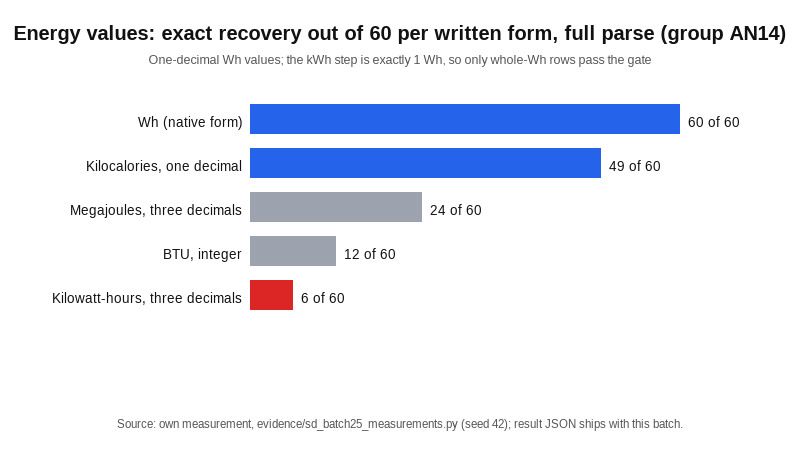
Field 1 fails by tidiness: normalising the string on arrival destroys the decimals Field 3 needs. Field 3 is the field everyone wants to skip, and it predicts the outcome: survival tracks the step — 60 of 60 at 0.1 Wh, 49 of 60 at 0.1163, 24 of 60 at 0.2778, 12 of 60 at 0.2931, and 6 of 60 at the gate step of 1 Wh. It also exposes the surprise: the best-converted form is the non-metric one — kilocalories recover eight times better than the metric kilowatt-hour. Field 4 fails when treated as decoration: the whole-number multiple warns that survivors will be a special subset, not a random sample. Field 5 fails by rounded factors: shortening the seven-significant-figure kcal and BTU factors manufactures drift the check will blame on the unit. Field 6 fails by euphemism: a gated-out value recorded as "converted" is a false count downstream sums will trust.
A Filled Example: 43,009.7 Wh Through the Record
Take the example energy, 43,009.7 Wh, in each foreign spelling. As kWh: written "43.010 kWh"; Field 3 records the step, 1 Wh; Field 4 records 10x, a gate; Field 5 gets 43,010.0 Wh — 0.3 Wh higher than truth, the 0.7 Wh fraction gone, because the spelling has no line for a non-whole value; disposition, gated out. As MJ ("154.835 MJ", step 0.2778 Wh) and as kcal ("36981.7 kcal", step 0.1163 Wh), Field 5 returns exactly 43,009.7 both times; disposition, passed. As BTU: written "146755 BTU"; step 0.2931 Wh; Field 5 returns 43,009.6, one grid line low; disposition, drifted 0.1. One true energy, four records, three dispositions — and the kWh record is the only one that destroyed the value outright. The staged parses agree: exact matching recovers 60 of 300, a metric parse recovers 66 of 300 — the native rows plus the 6 survivors — and the full parse recovers 151 of 300, with 0 false merges at every stage.
Common Filling Mistakes
Four mistakes recur wherever this record is adopted. Mistake one: assuming the metric unit is the safe unit — the kWh block was the worst converted block measured, 6 of 60, while the non-metric kilocalorie, with the finest foreign step, recovered 49 of 60. Mistake two: filling Field 3 from the unit's name instead of its precision — the gate is a property of the spelling, and kWh at four decimals would face no gate. Mistake three: reading a gated block's survivors as representative; the 6 survivors are exactly the whole-watt-hour rows, so statistics from them describe those rows, not the inventory. Mistake four: dropping gated-out rows from the count. The checksum — the energies summed in tenths of a watt-hour, 78,883,841 — reconciles only when gated, drifted and quarantined rows are counted too; 149 of 300 rows sit outside the full parse's exact recoveries, and forgetting them loses half the inventory behind a clean-looking conversion.
Questions on The Whole-Number Gate, answered
1. Why did kilowatt-hours recover only 6 of 60 when they are written to three decimals? Because three decimals of a kilowatt-hour is one whole watt-hour. The step is 1 Wh against a 0.1 Wh grid — an exact 10x multiple — so only whole-watt-hour values sit on a writable kWh line. Six of the 60 rows qualified; the other 54 were rounded to whole numbers their true values never were.
2. Why is there no drift at the gate, when other units drift? Drift is what a non-multiple step produces: megajoules step by 0.2778 Wh, so values land near their truth and round home or one line off. An exact-multiple step leaves no "near": a value is either on a step line, and survives whole, or between lines, and the form cannot hold it at all.
3. Why did kilocalories, a non-metric unit, recover best of the converted forms? Because recovery follows the written step, not the unit system. One-decimal kilocalories step by 0.1163 Wh, barely wider than the grid, so most values round home: 49 of 60.
4. Would writing kWh to four decimals remove the gate? Yes, for this grid. Four decimals of a kilowatt-hour step by 0.1 Wh — exactly the grid step — so every watt-hour value sits on a writable line. The gate belongs to the spelling "kWh at three decimals", not to the unit itself; Field 2 therefore captures the decimals with the unit.
Closing checklist for any converted energy inventory: record the value as written, suffix and decimals included; declare the unit and its written precision, never the unit alone; copy the step in watt-hours and its grid multiple from the standing table before converting; treat a whole-number multiple as a gate and expect only on-line values to survive; convert with unshortened factors and run the round-trip check at the source's precision; and carry gated-out and drifted rows in the count until the checksum reconciles.