
The Ninety Minutes: Five Ways to Write One Duration, One That Loses It
How many different strings in a merged dataset can mean exactly ninety minutes? In the measurement behind this article the answer is five, and the fiv...
How many different strings in a merged dataset can mean exactly ninety minutes? In the measurement behind this article the answer is five, and the five do not behave alike. Four can be converted back to ninety minutes without loss. The fifth, the decimal-hour spelling, sometimes cannot, and that weakness decides how a migration between two duration inventories must be planned, staged, and checked before anyone trusts the merged result.
What The Ninety Minutes means
The Ninety Minutes means the finding that one fixed duration of ninety minutes is written PT1H30M, 1:30:00, 5400s, 1.5h and 90m by five different systems, so the same value arrives as five unrelated-looking strings that no plain text comparison will group together. Its nearest prior concept is The Unit Mirage, about the same quantity looking different when its unit changes. The difference is narrow: The Unit Mirage is about units making quantities look bigger or smaller, while The Ninety Minutes is about spellings inside one fixed unit family, one of which is lossy and cannot always give the duration back.
The 300-duration pre-migration inventory in 5 spellings
The pre-migration inventory holds 300 distinct whole-minute durations, from 30 to 1,440 minutes. Inventory A stores every one in a single canonical form, ISO 8601, using the PT#H#M pattern, so ninety minutes is always PT1H30M there. Inventory B holds the same 300 durations, spread across five surface spellings in five blocks of 60. One block uses ISO 8601, as Inventory A does. A second uses a colon clock form, H:MM:SS, giving 1:30:00. A third uses raw seconds with an s suffix, giving 5400s. A fourth uses decimal hours with an h suffix, giving 1.5h. A fifth uses total minutes with an m suffix, giving 90m. Only the first block of 60 uses a form Inventory A already has; the other 240 rows each need a reading rule.
The 90-minute mapping table for 5 forms
The mapping table fixes the target for the switch. Every row is the same duration, ninety minutes, and every block behind the row holds 60 durations written that way. The round-trip column matters most: it records whether converting the spelling to minutes and back returns the original value exactly.
| Spelling of 90 minutes | Form | Block size in Inventory B | Round-trips exactly |
|---|---|---|---|
| PT1H30M | ISO 8601 | 60 | Yes |
| 1:30:00 | Colon clock H:MM:SS | 60 | Yes |
| 5400s | Raw seconds with s suffix | 60 | Yes |
| 1.5h | Decimal hours with h suffix | 60 | No, lossy for some values |
| 90m | Total minutes with m suffix | 60 | Yes |
Read the decimal-hour row with care. The spelling 1.5h itself round-trips, because one and a half hours is exact, but the form does not guarantee that for its other rows, so the table marks the form, not just this spelling, as the lossy one.
Step 1 of the switch: exact match on 300 rows
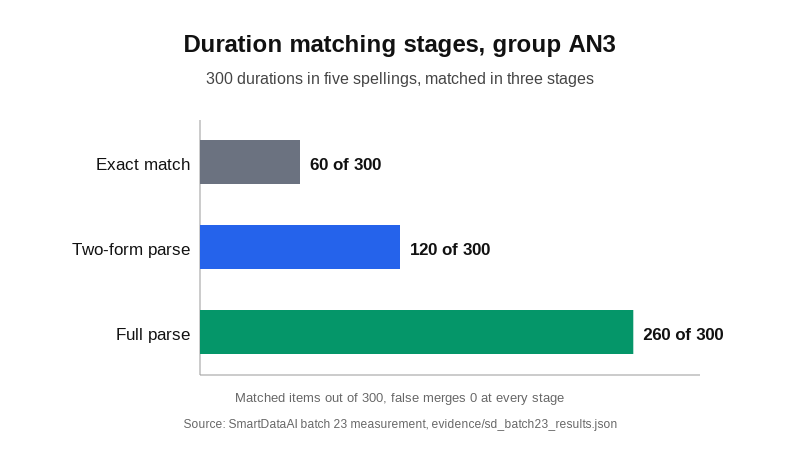
The first switch step is the cheapest: compare each Inventory B string with the Inventory A strings exactly as written, and keep every pair that is already identical. This reunites 60 of 300 durations, all from the ISO 8601 block, the one block where both inventories chose the same spelling. The other four blocks contribute nothing here, because 1:30:00, 5400s, 1.5h and 90m are different strings from PT1H30M even when they name the same ninety minutes. Exact matching also produces 0 false merges, establishing a safe floor of 60 certain pairs before any parsing risk is taken.
Step 2 of the switch: the 2-form parse reaching 120 rows
The second step adds a small parser that understands two forms: ISO 8601 and the total-minutes form with the m suffix. The minutes form is the easiest second form, because the number before the m already is the duration in minutes, so 90m becomes ninety minutes with no division or rounding. The matched total rises to 120 of 300, the gain of 60 coming entirely from the minutes block, with 0 false merges. Each step adds one form and is counted on its own, so if a later count moves unexpectedly, the team knows which form caused the move.
Step 3 of the switch: the full 5-form parse reaching 260 rows
The third step parses all five forms, converting each spelling to minutes: ISO 8601 by its hour and minute parts, the colon clock by hours, minutes and seconds, raw seconds by dividing by 60, total minutes directly, and decimal hours by multiplying by 60. This full parse reaches 260 of 300, again with 0 false merges. The shortfall of 40 sits entirely in the decimal-hour block, and a worked example shows why. Take 61 minutes. Written as decimal hours it is 61 divided by 60, which is 1.016666..., and at six significant figures that becomes 1.01667h. Parsing that back gives 1.01667 multiplied by 60, which is 61.0002 minutes, not 61, so an exact reunion with the Inventory A row for 61 minutes fails. Across the block, 40 of the 60 decimal-hour spellings fail this round-trip, while 20 do round-trip, namely those exact at six significant figures, such as 1.5h for ninety minutes.
The rollback point for 40 decimal-hour rows
Every migration switch needs a rollback point, a line past which changed rows cannot be restored, and here the decimal-hour block sets it. The 40 rows that cannot be converted back exactly must be kept in their original form, alongside any converted value, because once 1.01667h is replaced by a rounded minute count, no later process can tell whether the true duration was 61 minutes or a value a fraction away. Keeping those 40 rows is not a failure; it is the switch working honestly. The other 260 rows move to the canonical form and stay there, while the 40 rows carry both spellings until a source with the exact minute count for each can be found.
Post-switch verification against the 12,437,280-second checksum
After the switch, verification uses a checksum that does not depend on spelling: the total seconds across all 300 durations, 12,437,280. Any post-switch inventory claiming to hold the same 300 durations must reproduce that total when every row is converted to seconds and summed. Match counts show how many rows were reunited; the checksum shows whether the values survived, because a switch that reunited all 300 rows but nudged 40 by a fraction would still fail the total. Verification runs in two parts: the stage counts, 60, then 120, then 260, each with 0 false merges, and then the single total, which either matches or sends the team back to the rollback point.
How the 300 durations were measured in batch 23
The numbers here come from a controlled synthetic measurement built for this batch, not from a test of any commercial product. A deterministic script, run with seed 42 and written using only the Python standard library, first fixed 300 durations whose true minute counts were known in advance. It then wrote them twice: once in the canonical ISO 8601 form, and once spread across the five surface spellings above. Matching strategies were applied in stages, from exact comparison through the two-form parse to the full five-form parse, counting reunions and false merges against the known truth at each stage. The decimal-hour spellings were written at six significant figures, which exposed the 40 round-trip failures. The script and its result file ship with this batch as evidence, so every count here can be reproduced exactly.
Questions on the ninety minutes, answered
Question 1: Why does exact matching find only 60 of the 300 durations? Because only one block of 60 in Inventory B uses ISO 8601, the spelling Inventory A uses. The other 240 rows hold values in four different spellings, and exact comparison cannot see through a spelling difference.
Question 2: Which of the 5 forms makes the full parse stop at 260? The decimal-hour form. Its 60 spellings were written at six significant figures, and 40 do not round-trip to the exact minute count, as the 61-minute example shows.
Question 3: Did any switch step merge 2 different durations by mistake? No. Every stage recorded 0 false merges, so each reunion joined two spellings of one duration.
Question 4: What proves the 300 values survived the switch unchanged? The checksum: the total across all 300 durations is 12,437,280 seconds, and a post-switch inventory must reproduce it exactly.
The red line at 1 stored form for 90 minutes
Treat the decimal-hour block as a warning label for every duration field you will ever merge: a spelling can carry six significant figures and still be unable to give the exact value back. Keep the original string for the 40 rows that fail the round-trip, and verify against the 12,437,280-second checksum. Never let a decimal-hour spelling be the only stored form of an exact duration.
Sources
> Source: SmartDataAI batch 23 measurement, group AN3 (evidence/sd_batch23_measurements.py and evidence/sd_batch23_results.json, run 2026-11-26).