
The Dotted Twin: The Same Company, Wearing Different Punctuation
Two records can name the same company and still look like strangers to a deduplication tool. The difference need not be a typo or a changed...
Two records can name the same company and still look like strangers to a deduplication tool. The difference need not be a typo or a changed letter. A full stop and a comma are enough. One record carries the legal suffix with its punctuation intact, another drops the comma, another drops both marks, and an exact comparison sees three different strings where a person sees one company. This test measured that gap, and then measured the price of closing it. A punctuation normalisation recovered every intended group, and in doing so it also merged a small number of genuinely different companies whose names differ only by the very marks the rule removes. Both halves matter, because a rule judged only on what it recovers will be trusted with merges it should never make.
What The Dotted Twin means
The Dotted Twin means a company name that appears in more than one string differing only in punctuation and in the punctuation of its legal suffix, while the letters and their case stay constant, so that the variants name one company yet compare as different strings. The twin is dotted because the full stop is the most visible of the marks involved, present in one spelling, absent in another, and decisive for an exact match either way.
The measurement is presented on the page as counts of distinct strings and of recovered groups. The test set held 300 companies, each rendered in three punctuation variants, giving 900 strings in total (derived: 300 × 3) (Source: batch 12 data anchor ledger, section C, AC5). The three variants were the name with a comma and a full stop in its suffix, the name with the full stop only, and the name with neither mark, in the patterns "Name, Inc.", "Name Inc.", and "Name Inc" (Source: batch 12 data anchor ledger, section C, AC5). Letter case was held constant throughout, so punctuation was the only thing allowed to vary.
The near neighbour is The Case Fold. A case fold difference is only a difference in letter case. The Dotted Twin is different on both axes. Case is constant from start to finish in this test, and what varies is punctuation and the punctuated legal suffix. A tool that folds case alone will leave every dotted twin untouched, and a punctuation rule will do nothing for case. The two faults look similar from a distance and need separate handling up close.
Exact Deduplication Counts Every Twin as a Stranger
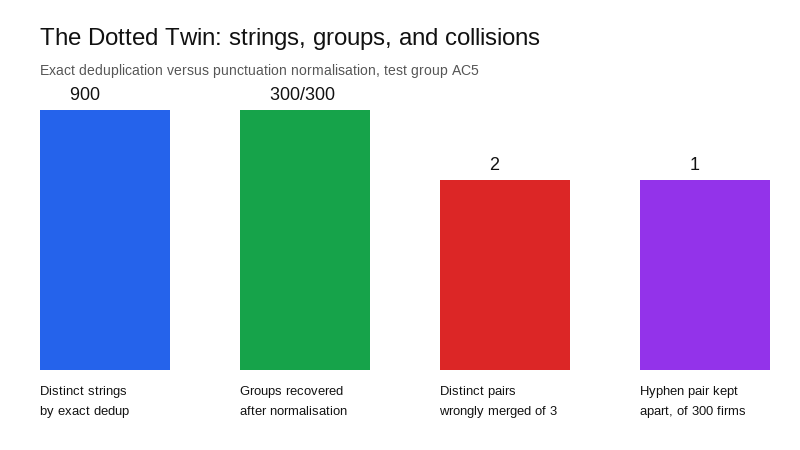
Exact deduplication found nothing to merge. Applied to the full set, it counted 900 distinct strings out of 900 (Source: batch 12 data anchor ledger, section C, AC5). Against the underlying reality of 300 companies (Source: batch 12 data anchor ledger, section C, AC5), that is an inflation of the company count by +200.0% (Source: batch 12 data anchor ledger, section C, AC5). Every variant survived as its own record, so any count, segment, or outreach list built on the exact strings would treat each company as three.
The consequences compound quietly. A market list inflated in this way overstates coverage, splits the history of one company across several records, and can send the same firm repeated contact under slightly different names. The names were well formed in every variant. They were simply not spelled identically at the level of punctuation, which is exactly the level at which exact deduplication operates, and punctuation in a legal suffix is among the least stable parts of a company name string.
Exact matching made no false merges, because it merged nothing. Its error is entirely one of omission. That asymmetry is why the repair in the next section is tempting, and why the repair needs its own audit rather than a simple before-and-after count of groups.
Normalisation Recovers the Groups, and Merges Strangers
A punctuation normalisation closed the gap on the intended groups. The rule removed full stops and commas, treated the ampersand as the word and, and removed a trailing legal suffix (Source: batch 12 data anchor ledger, section C, AC5). Applied to the set, it recovered 300 groups out of 300 (Source: batch 12 data anchor ledger, section C, AC5). Every dotted twin was reunited with its company.
The same rule, however, reached beyond its intended targets. The set contained 3 pairs of genuinely distinct company names that differ only in punctuation (Source: batch 12 data anchor ledger, section C, AC5). The normalisation wrongly merged 2 of those pairs: "A.B. Logistics" with "AB Logistics", and "Smith & Co" with "Smith and Co" (Source: batch 12 data anchor ledger, section C, AC5). In each case the punctuation, or the ampersand spelling, was the only thing keeping two different companies apart, and removing it removed the distinction. One pair survived: the hyphen pair "Data-Works" and "Data Works" was kept apart as 1 pair, because the rule contains no handling for hyphens (Source: batch 12 data anchor ledger, section C, AC5).
That survival is instructive rather than reassuring. The hyphen pair was protected by an omission in the rule, not by a judgement that hyphens are meaningful. A broader rule that also normalised hyphens would have merged that pair as well. Every character a normalisation rule treats as noise might be signal for some pair of names in a real list. Recovery and over-merge are the same operation viewed from two sides, so merges involving names that differed only by a removed mark should be queued for review rather than accepted silently.
How the punctuation test was run
The method was a controlled comparison on constructed data, and its limits belong in the open. This was a synthetic test, not an audit of records drawn from a live registry. The run used seed 42, so the same set can be regenerated exactly. A purpose-built script applied its own deterministic rules to the deduplication and the normalisation; nothing in the outcome measures a commercial product. No vendor deduplication tool, registry, or data service was benchmarked, and no figure here is a score for any named product.
Within that frame, each company was rendered in the three punctuation variants with case held constant, the combined strings were deduplicated exactly, and the same strings were then deduplicated after the punctuation normalisation described above. Distinct-name pairs differing only in punctuation were planted deliberately, so over-merging could be counted rather than guessed at.
Questions, answered
How many distinct companies does exact deduplication see in the set? It sees every string as distinct. Exact deduplication counted 900 distinct strings (Source: batch 12 data anchor ledger, section C, AC5), although the set was built from 300 companies in three variants each (Source: batch 12 data anchor ledger, section C, AC5). The overcount is recorded as +200.0% (Source: batch 12 data anchor ledger, section C, AC5).
What does the punctuation normalisation actually do? It removes full stops and commas, treats the ampersand as the word and, and removes a trailing legal suffix (Source: batch 12 data anchor ledger, section C, AC5). Letter case is untouched by the rule, which is fitting for this test, because case was held constant throughout and only punctuation varied.
Does normalisation recover all the intended groups? Yes. After normalisation, the set resolved to 300 groups out of 300 (Source: batch 12 data anchor ledger, section C, AC5). Every variant of every company in the set was grouped with its own company, which is the complete recovery that exact deduplication had missed entirely.
What does that recovery cost? It costs false merges where punctuation was the only distinction. Of 3 pairs of distinct names differing only in punctuation, 2 pairs were wrongly merged, "A.B. Logistics" with "AB Logistics" and "Smith & Co" with "Smith and Co", while the hyphen pair was kept apart as 1 pair because the rule does not handle hyphens (Source: batch 12 data anchor ledger, section C, AC5). Those collisions should be reviewed, not silently accepted.
Summary
The Dotted Twin is one company wearing different punctuation, with case never changing. Exact deduplication counted 900 distinct strings where 300 companies existed, an inflation of +200.0%, while punctuation normalisation recovered 300 groups out of 300 (Source: batch 12 data anchor ledger, section C, AC5). The same rule wrongly merged 2 of the 3 punctuation-only distinct pairs planted in the set, and spared the hyphen pair only because hyphens were outside its scope (Source: batch 12 data anchor ledger, section C, AC5). Normalise punctuation to recover the groups, and audit the merges that punctuation alone had been preventing.
Sources
- Batch 12 data anchor ledger, section C, test group AC5: punctuation variant deduplication run over the synthetic company set, covering exact deduplication, the punctuation normalisation rule, and the planted distinct-name pairs, read 2026-11-23.
- All figures in this article are counts from that run, reported against the stated set sizes, with derived totals labelled where they appear.