
The Decorated Identifier: Braces, Prefixes, and Capital Letters Around One UUID
A universally unique identifier is designed to be copied. It travels between databases, logs, configuration files, and ticket systems, and nearly ever...
A universally unique identifier is designed to be copied. It travels between databases, logs, configuration files, and ticket systems, and nearly every tool that touches it feels entitled to dress it for its own conventions: wrapping it in braces, prefixing it with a scheme label, shouting it in capitals, or stripping its hyphens to save space. None of these costumes changes which identifier it is. All of them change the string, and a join that compares strings will treat one identifier in five costumes as five different identifiers. This article measures that split on a constructed pair of files and separates the costumes that mere tidying can remove from the one that only real parsing can repair.
What The Decorated Identifier means
The Decorated Identifier is a UUID stored with visible decoration added, removed, or restyled — braces around it, a URN scheme prefix ahead of it, capitals in place of lowercase, or its hyphens taken out — so that the same 128-bit value circulates under several unequal strings. A row exhibits it when one source stores the canonical hyphenated lowercase form and the other stores any dressed variant of the same value. Each source in the measurement held 300 records carrying 300 distinct UUIDs (Source: batch 21 SD measurement results, group AL3).
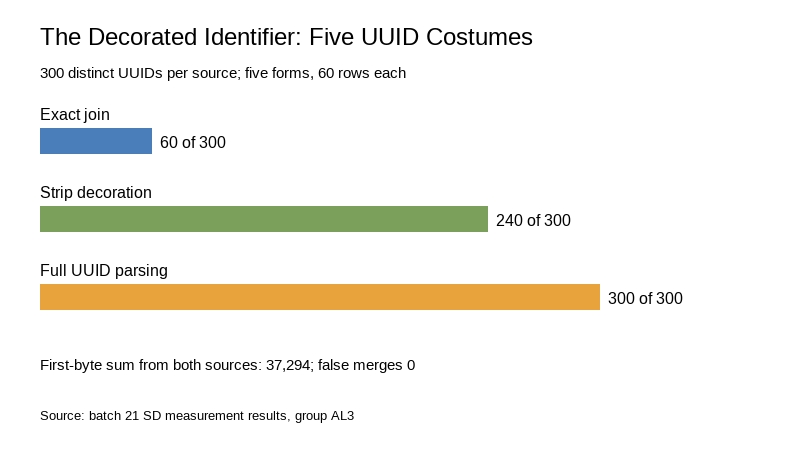
> Census: 300 records per source; an exact join matched 60 of 300, stripping decoration matched 240 of 300, and full UUID parsing matched 300 of 300, with 0 false-merge pairs (Source: batch 21 SD measurement results, group AL3)
The Decorated Identifier differs from its nearest neighbour, The Zero-Width Identifier, in the visibility of what was added. In The Zero-Width Identifier, the extra characters were invisible code points slipped inside an identifier, rendering with no width at all, so two different strings looked pixel-identical on screen and the corruption could only be found by inspecting code points. Here every addition is plain to see. Braces, a scheme prefix, and capital letters announce themselves to any reader, and the missing hyphens are equally obvious once the string's length is noticed. The information is also complete in both cases, yet the flavour of the fault is opposite: one hides inside an identifier that looks clean, the other decorates an identifier in the open. The Zero-Width Identifier is a detection problem; The Decorated Identifier is a normalisation problem, and it is solved by removing or parsing through decoration that nobody tried to conceal.
Five costumes and a single exact match block
The first source stored all 300 UUIDs in the canonical hyphenated lowercase form, while the second spread its rows evenly across five forms, 60 apiece: the canonical form itself, a hyphenless string of 32 hexadecimal characters, a braces-wrapped form, a form carrying the urn:uuid: prefix, and a hyphenated form in full capitals (Source: batch 21 SD measurement results, group AL3). Compared exactly as stored, the strings agreed on just 60 rows and disagreed on the remaining 240 (Source: batch 21 SD measurement results, group AL3). The surviving block is once again the coincidence block, the rows where the second writer used the same costume as the first, and each of the other four blocks fails in full. What makes this scatter instructive is that the four failing costumes are not four versions of one mistake. Braces and the prefix are additions at the edges of the string. Capitals are a restyling of every letter inside it. The hyphenless form is a subtraction from its skeleton, removing the four landmarks that divide the value into its familiar groups. A single cleaning rule rarely addresses additions, restyling, and subtraction at once, which is exactly what the staged repairs demonstrate.
Tidying strips the costumes it can see
The first repair tidied rather than parsed: it folded letter case, removed braces, and removed the urn:uuid: prefix before comparing (Source: batch 21 SD measurement results, group AL3). That pass matched 240 of 300 rows and failed on 60 (Source: batch 21 SD measurement results, group AL3). It recovered the braces block, the prefix block, and the capitals block in their entirety, three fifths of the file rescued by three simple operations, and it left the hyphenless block exactly where the exact join had left it. The reason is structural. Case folding and decoration stripping operate on characters that are present in the string; the hyphenless form's problem is characters that are absent. Knowing where the hyphens belong requires knowing the canonical grouping of a UUID, which is knowledge about the identifier's grammar, not about its surface dirt. A tidy-up can restore what decoration covered, but it cannot rebuild a skeleton it never reads.
Parsing rebuilds the skeleton
The complete repair handed each string to a UUID parser and joined on the canonical hyphenated lowercase form the parser returns (Source: batch 21 SD measurement results, group AL3). A parser accepts the hyphenless string because it reads the 32 hexadecimal characters as the value itself and re-inserts the grouping from the specification, which is the step no amount of stripping can imitate. The outcome was complete in both directions: 300 matches from 300 rows, no failures, and no pair of distinct identifiers ever folded into one, false merges standing at 0 (Source: batch 21 SD measurement results, group AL3).
The aggregate evidence that nothing was distorted is a deliberately humble statistic. Summing the first byte of every UUID in the first source gives 37,294, and summing the first byte of every fully parsed value from the second source gives the same 37,294 (Source: batch 21 SD measurement results, group AL3). First bytes are arbitrary, which is precisely why their agreement is persuasive: a repair that scrambled values, dropped rows, or merged identifiers would disturb a total built from 300 independent bytes, and this total survives the round trip through all five costumes untouched. Every form carried all 128 bits of its identifier from start to finish (Source: batch 21 SD measurement results, group AL3), so a complete recovery was always available to any process willing to parse rather than tidy.
Minting identifiers and dressing them
The file was built from the value outward. From seed 42, the generator minted 300 distinct UUIDs as 128-bit values, wrote them canonically into one source, and then dressed the second source in five equal costume blocks, each block applying exactly one transformation to every string it touched (Source: batch 21 SD measurement results, group AL3). The three joins, exact, tidied, and parsed, were run over the same pair of files, and collisions among parsed keys were counted on their own line rather than folded into the match rate. The whole exercise is a deterministic synthetic measurement whose parsing rules were written by hand for the occasion in the standard library; it audits no commercial product, and its percentages describe this constructed wardrobe of forms, not the behaviour of any identifier service in production.
Questions, answered
Which costume defeats the tidying repair, and why? The hyphenless form. Tidying matched 240 of 300 rows and failed on exactly the 60 hyphenless rows (Source: batch 21 SD measurement results, group AL3), because folding case and stripping braces or a prefix cannot restore grouping characters that are not there; only a parser knows where the hyphens belong.
Does removing the decoration ever risk merging two different identifiers? Not in this measurement. Full parsing produced 0 false-merge pairs across the file (Source: batch 21 SD measurement results, group AL3), because each of the 300 UUIDs was distinct and every costume maps back to the single value it was dressed from.
Summary
The Decorated Identifier sends one UUID out in five costumes and lets an exact join recognise a single one of them: 60 of 300 rows matched as stored, tidying away case, braces, and prefix reached 240 of 300, and parsing recovered all 300 rows with 0 false merges (Source: batch 21 SD measurement results, group AL3). The first-byte total of 37,294, identical from both sources, certifies that every costume carried its full value throughout (Source: batch 21 SD measurement results, group AL3). Against The Zero-Width Identifier, whose intruders hide inside a string that looks untouched, the decoration here is visible, honest, and removable — provided the cleaner graduates from stripping surfaces to parsing structure, since the one costume built on absence can be repaired in no other way.
Sources
- Batch 21 SD measurement results, group AL3: 300 records per source, 300 distinct UUIDs; source B forms 60 each across standard hyphenated lowercase, hyphenless 32-character hexadecimal, braces-wrapped, URN-prefixed, and hyphenated uppercase; exact join 60 matched, 240 failed; decoration-strip repair 240 matched, 60 failed; full parsing 300 matched, 0 failed, 0 false-merge pairs; first-byte sum 37,294 from both sources.
- Measurement script sd_batch21_measurements.py, group AL3: deterministic synthetic construction, seed 42, self-written parsing rules, pure standard library; not a commercial product measurement.