
The Country Census: A Column That Is Almost Entirely Absent
Most data quality checks go looking for wrong values: misspellings, duplicates, codes that belong to another system. A census of a column asks a prior...
Most data quality checks go looking for wrong values: misspellings, duplicates, codes that belong to another system. A census of a column asks a prior question, which is whether the column contains values at all. A column can appear in every export and still be empty on nearly every row. Anyone who later builds a report, a filter, or a join on that column inherits the emptiness without warning, because empty cells do not raise errors.
What The Country Census means
The Country Census is a count of what a country column actually holds in a specific file, row by row, including the blank as a counted outcome rather than an inconvenience to be ignored. It treats missingness as a finding in its own right. It asks how much of the file the column covers, and whether any analysis built on the column would describe the file or merely its small covered corner.
The neighbouring concept is The Fifteen Labels, which counted a category column crowded with 15 competing values. That column suffered from excess: too many labels competing for the same meaning, so the work was consolidation. The precise difference is that this column has the opposite disease, almost no values at all, and the missingness itself is the finding. No consolidation or relabelling can help here, because the rows that need a country do not carry a wrong country; they carry none.
Counting a real listings file
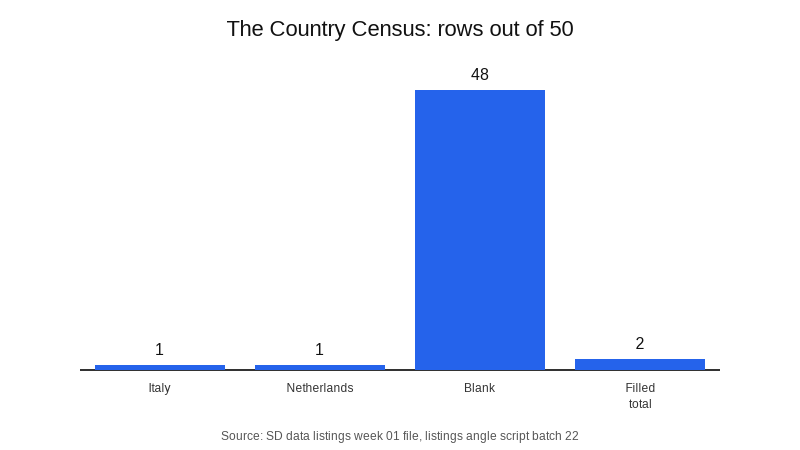
The source file is a 50-row listings file, the SD data listings for week 01, checked 2026-11-11. A census of its headquarters_country column finds the column filled on only 2 of 50 rows: Italy on 1 row and Netherlands on 1 row. The column is blank on 48 of 50 rows, which is 96.0% of the file. Those are the whole contents of the column. There is no long tail behind them: two different countries appear once apiece, and the rest of the file is silent.
Counting the blank as a value, the column holds 3 distinct values. Many tools quietly exclude blanks and would describe this column as holding 2 values, which sounds like a small but real breakdown. The dominant value is not Italy or Netherlands. It is the absence of a value.
The concentration index for the column, the HHI computed by the batch 22 listings angle script, is 0.9224, driven almost entirely by the blank. Read naively, a high concentration figure might suggest a file focused on one country. Read with the census beside it, the figure says the opposite: the file is concentrated on not saying. An index should never be quoted without the counts that produced it.
What an empty column does downstream
Any group-by, filter, or join on this column silently drops or lumps 96.0% of the file. A group-by gathers the 48 blank rows into one group that dwarfs the two real country groups. A filter for a specific country returns at most 1 row, not because the file contains only one such company, but because only one row ever recorded its country. A join on a country key finds nothing to join on for nearly every row.
The danger is the silence. Nothing in those operations announces that the underlying column was almost entirely blank. A dashboard can render, a report can circulate, and a decision can be taken on the apparent geography of a file whose geography was never collected. The two filled rows can even mislead by their plausibility: Italy and Netherlands are real answers, cleanly written, and their very tidiness invites a reader to trust the column as a whole. A census blocks that invitation. It forces the coverage figure, 2 filled rows out of 50, to travel with any use of the column, so a reader can weigh a country breakdown against the fact that it rests on a tiny fraction of the file while the rest recorded nothing at all.
The practical responses follow from the diagnosis, and none of them is a cleaning rule. The file's owner can be asked whether headquarters country was ever collected for the other rows, and whether another field or another source holds it. Analysts can label the column as unusable for geographic work in its current state, so future projects do not rediscover the emptiness the hard way. Reports already built on it can be reissued with the coverage stated plainly. What should not happen is quiet imputation: guessing countries from company names, languages, or domains and writing those guesses into the column would convert an honest blank into an unverifiable claim, and the census exists precisely to keep that conversion from passing unnoticed.
There is also a lesson here about the order in which quality checks should run. Checking values for spelling, coding, and consistency is worthwhile only after coverage has been established, because a perfectly spelled value on a handful of rows still leaves the column unable to support analysis. Coverage first, correctness second, and concentration read alongside both: that order prevents effort from being spent polishing the small filled corner of a column while its dominant fact, the blank, goes unreported and continues to shape every result built on top of it in silence.
How the census was assembled
This is a real-file census, not a synthetic measurement. The column was counted exactly as stored in the file by a short script, with no values inferred or filled in. Every row was read as it stood, blanks were counted rather than skipped, and the batch 22 listings angle script produced the distinct counts and the HHI figure of 0.9224 from those stored values. Because nothing was cleaned before counting, the census describes the file downstream work would actually meet.
Questions, answered
Can the two filled rows still be used for anything? They can be used as two individual facts: one listed company records Italy as its headquarters country and one records Netherlands. They cannot support a distribution, a comparison between countries, or a claim about where the file's companies are based, because 48 of 50 rows record nothing. Used as anecdotes they are accurate. Used as a breakdown they would misrepresent the file.
Why count the blank as a value instead of ignoring it? Because downstream operations cannot ignore it. A group-by must put the 48 blank rows somewhere, and a filter must decide what to do with them, so the blank behaves like a value whether analysts name it or not. Counting it openly gives the column 3 distinct values and exposes that the largest of them is missingness, which is the fact every user of this column most needs to know.
Summary
The census of the headquarters_country column in the 50-row listings file found 2 filled rows, Italy on 1 and Netherlands on 1, and 48 blank rows amounting to 96.0% of the file. Counting the blank, the column holds 3 distinct values, and its concentration index of 0.9224 is driven almost entirely by the blank rather than by any real geographic focus. Any group-by, filter, or join on this column silently drops or lumps 96.0% of the file, so the correct treatment is to report the coverage, label the column unfit for geographic analysis as stored, and resist filling the blanks with guesses. Sometimes the most important measurement of a column is not what its values say, but how few of them there are.
Sources
- SD data listings, week 01 file, checked 2026-11-11: the 50-row listings file whose headquarters_country column was counted, with Italy on 1 row, Netherlands on 1 row, and 48 blank rows.
- Batch 22 listings angle script output: the census counts for the headquarters_country column and the concentration index (HHI) of 0.9224 computed from the stored values.