
Completeness Floor: A Category Can Be Full of Companies and Empty of Finished Records
A directory category with fifteen companies in it looks substantial. A category with ten looks established. But the count of companies in a category...
A directory category with fifteen companies in it looks substantial. A category with ten looks established. But the count of companies in a category answers only one question, how many names were collected, and says nothing about how many of those names have been carried through verification. A category can be crowded and still have a completeness of zero: not one company in it with the basic facts and a headquarters on record. Anyone browsing such a category sees a market. Anyone trying to use it sees a list of leads that have not been checked, where every single entry still needs the same foundational work.
This article measures that floor across a real listings dataset of data-service companies. Rather than averaging completeness over the whole file, which lets a few finished records lift the picture, it asks the question category by category: in how many categories does at least one company have both its facts and its headquarters recorded, and in how many is the count exactly zero? The answer turns out to be more useful than any average, because it tells a research team precisely where finished, citable records exist and where a category, however long its list, is still entirely a work queue.
What Completeness Floor means
Completeness Floor is the lowest level of verified completeness a category reaches when completeness is judged by its finished records: specifically, the count and share of categories in which at least one company has both a recorded fact source and a recorded headquarters, and, at the extreme, the number of categories where that count is zero. The concept deliberately uses a low bar. It does not ask whether a category is well documented on average, or whether most of its companies are verified. It asks whether the category contains even one finished record, a single company whose basic facts and headquarters are both on file and can be cited without further research. A category that clears the floor has a foundation: an example of the finished state, and proof the verification pass has reached it. A category at zero has none, regardless of how many candidate names it holds. The floor is therefore a measure of coverage of effort, not of effort itself. It shows where verification has arrived at all, and where it has not yet begun to land.
How this was measured
The analysis is a recompute, carried out on 2026-11-23, of the SmartDataAI listings dataset: 50 companies, originally checked on 2026-11-11. All 50 records were counted; this is a full recount of the file, not a sample or a fresh survey. The counting rules were fixed before the count. A company counted as having a complete record when two cells were both non-empty in the source CSV: the fact source field and the headquarters country field. In the language of the recompute, that state is described as fact and HQ recorded. A field counted as missing when its cell was empty. Companies were grouped by the category recorded in the file, giving 15 categories across the 50 companies, and each category was scored by how many of its companies met the two-field standard. The validation status recorded for each company was cross-tabulated against headquarters missingness to show which stage of the research pipeline the incomplete records occupy. Percentages described as derived are plain divisions of the stated counts, with the arithmetic shown, so the results can be repeated from the same file by anyone applying the same rules.
What the numbers show
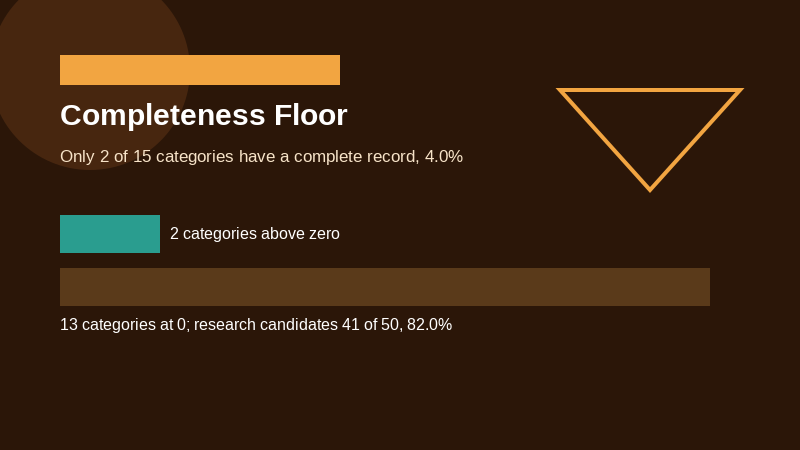
Across the 15 categories in the dataset, only 2 categories contain even one company with fact and headquarters both recorded (Source: SmartDataAI listings dataset, 50 companies checked 2026-11-11, recomputed 2026-11-23). In CRM data quality, 1 of the category's 4 companies meets the standard. In Email verification, 1 of its 10 companies meets it. The remaining 13 categories, covering the large majority of the file's companies, have zero: not one finished record in any of them.
The file-wide context explains why the floor sits so low. Only 2 of the 50 companies have a headquarters country recorded at all. Since a complete record requires a headquarters, the number of complete records in the whole file is capped at 2 before any other field is even considered, and those 2 companies happen to sit in 2 different categories. Companies with a complete record are 4.0% of the file (derived: 2/50) (Source: SmartDataAI listings dataset, 50 companies checked 2026-11-11, recomputed 2026-11-23). The other 48 companies fail the standard on the headquarters field alone, whatever else their records contain.
The cross-tabulation by validation status shows where the unfinished work sits in the pipeline. Two companies carry the status indicating that an official-source fact and the headquarters country are both documented: 2 companies, with 0 of them missing a headquarters. Seven companies carry the status indicating that an official-source fact is documented while the headquarters still requires review: 7 companies, all 7 missing a headquarters. And 41 companies sit at the research candidate stage, pending required fields: 41 companies, all 41 missing a headquarters (Source: SmartDataAI listings dataset, 50 companies checked 2026-11-11, recomputed 2026-11-23). Research candidates alone are 82.0% of the file (derived: 41/50).
Read together, the three rows describe a pipeline with a narrow exit. Fact-gathering has reached 9 companies in some form, 2 fully and 7 partially, but the headquarters step has been completed for only the same 2 companies that finished everything. The 7 partially documented companies are the nearest-term opportunity: each needs one field to reach the standard, and completing them would raise finished records from 2 to 9. The 41 research candidates need the full pass, facts and headquarters alike. Treating the backlog as uniform would misallocate effort in both directions.
The category view also reframes what the file currently is. Thirteen categories at zero does not mean those markets are empty; several hold many candidate companies. It means the file, today, functions as a research map rather than a verified directory for those categories. Publishing category coverage on the strength of company counts alone would overstate what the data supports in 13 of 15 cases. The floor makes that distinction countable, and therefore hard to blur.
Questions, answered
What exactly counts as a complete record here?
A company whose fact source and headquarters country are both recorded, meaning both cells are non-empty in the source file. By that standard the file holds 2 complete records among 50 companies (Source: SmartDataAI listings dataset, 50 companies checked 2026-11-11, recomputed 2026-11-23).
Which categories clear the floor?
Two of the 15 categories: CRM data quality, with 1 of 4 companies complete, and Email verification, with 1 of 10 companies complete. The other 13 categories have zero complete records.
Why is the floor so low when some facts are documented for more companies?
Because the headquarters field is the bottleneck. Only 2 of the 50 companies have a headquarters recorded at all, so no more than 2 records can meet a standard that requires one. Seven further companies have a documented fact but still lack a headquarters.
What is the fastest way to raise the floor?
Complete the headquarters field for the 7 companies whose facts are already documented. That would lift finished records from 2 to 9 without any new fact research, and any of those companies sitting in a zero category would lift that category above the floor.
Does a zero floor mean a category should be removed?
No. It means the category is a research queue, not a verified listing. The 41 research candidates, 82.0% of the file (derived: 41/50), are the raw material for raising the floor; removing their categories would discard the map of what to verify next.
Summary
Judged by finished records rather than company counts, this 50-company, 15-category listings file has a Completeness Floor near the ground: 2 categories contain a company with fact and headquarters both recorded, 13 categories contain none, only 2 companies in the file have a headquarters recorded at all, and complete records are 4.0% of the file while research candidates are 82.0%. The floor is a useful number precisely because it is unforgiving. It separates the categories where verification has landed from the categories where it has not, and it points to the cheapest progress available: seven nearly finished records, one field each, standing between the file and a measurably higher floor.
Sources
- SmartDataAI listings dataset, 50 companies checked 2026-11-11, recomputed 2026-11-23. Counting rules: a record is complete when the fact source and headquarters country cells are both non-empty; a field is missing when its cell is empty.
- Derived figures computed from the counts stated in the article: 2/50 = 4.0%; 41/50 = 82.0%.