
The Blocked Account: An IBAN Printed in Groups of Four Refuses to Join Itself
An international bank account number is printed in blocks for a reason: long digit strings are hard to read, dictate, and check, so the standard prese...
An international bank account number is printed in blocks for a reason: long digit strings are hard to read, dictate, and check, so the standard presentation breaks the number into groups of four characters separated by spaces. The electronic form of the same number has no spaces at all. Both forms are correct, both are the same account, and they are different strings. This article measures that miss on constructed account files, including the awkward accounts whose final group is short, and shows why the check digits built into the number make a complete and verifiable repair possible.
What The Blocked Account means
The Blocked Account is an IBAN that exists in both its continuous electronic form and its space-grouped print form, so that one account circulates under two or three unequal strings and a text join treats the print presentation as a different account. A row exhibits it when one source stores the continuous form and the other stores a grouped form of the same number. Each source in the measurement held 300 records carrying 300 distinct IBANs, every one of them constructed with genuine check digits (Source: batch 21 SD measurement results, group AL4).
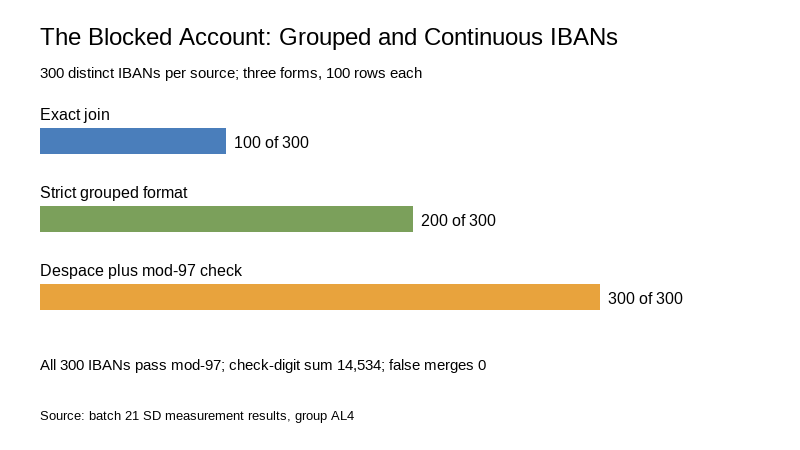
> Census: 300 records per source; an exact join matched 100 of 300, a strict grouped-format repair matched 200 of 300, and removing spaces with mod-97 validation matched 300 of 300, with 0 false-merge pairs (Source: batch 21 SD measurement results, group AL4)
The Blocked Account differs from its nearest neighbour, The Grouping Space, in the status of the spaces themselves. In The Grouping Space, a space served as an informal grouping separator inside a number, a piece of presentation dirt that cleaning had to strip before values could be compared, with no way to ask the number itself whether the cleaned result was right. Here the grouped presentation is not dirt. Spacing an IBAN in blocks of four is the sanctioned print form of the standard. Better still, the number carries its own evidence: two check digits computed from the whole string, which a repair can verify after removing the spaces. The Grouping Space is about spaces as noise to be cleaned on faith; The Blocked Account is about spaces as standard presentation, removable with proof.
Three forms across six country lengths
The accounts were constructed under six national formats, with lengths of 16 characters for BE, 24 for ES, 18 for NL, 21 for CH, 22 for DE, and 27 for FR (Source: batch 21 SD measurement results, group AL4). The realised file distributed its 300 accounts across those lengths as 59 of length 16, 43 of length 18, 44 of length 21, 45 of length 22, 74 of length 24, and 35 of length 27 (Source: batch 21 SD measurement results, group AL4).
The first source stored all 300 accounts in continuous form, while the second divided its rows evenly across three forms, 100 apiece: continuous, grouped with a full final group, and grouped with a short final group (Source: batch 21 SD measurement results, group AL4). The full-final-group block drew only on the BE and ES accounts, whose lengths divide by four, and the short-final-group block drew only on the NL, CH, DE, and FR accounts, whose lengths do not (Source: batch 21 SD measurement results, group AL4). Joining on the stored string matched 100 of 300 rows and failed on 200 (Source: batch 21 SD measurement results, group AL4), the survivors being the continuous block alone.
A strict print pattern rejects the legal short group
The tempting first repair accepts the print form, but only in its tidiest shape: a grouped string is admitted when every group, including the last, holds exactly four characters, and its spaces are then removed (Source: batch 21 SD measurement results, group AL4). That pass matched 200 of 300 rows and failed on 100 (Source: batch 21 SD measurement results, group AL4). It recovered the full-final-group block completely, and it rejected the entire short-final-group block. A final group of one to three characters is what the standard's grouping rule produces for most lengths in this file; four of the six national formats cannot end on a full group.
Removing spaces, then asking the number
The complete repair ignored presentation entirely: it removed every space and then required the resulting string to pass the ISO 13616 mod-97 check, the remainder test that an IBAN's own check digits must satisfy (Source: batch 21 SD measurement results, group AL4). Failures under that rule: none. All 300 rows matched, and two different accounts were never collapsed into one key — false merges tally 0 (Source: batch 21 SD measurement results, group AL4). All 300 constructed accounts pass the mod-97 check, a validity rate of 300 of 300, because their check digits were computed with the real algorithm at construction time (Source: batch 21 SD measurement results, group AL4). A string that lost or gained a digit while its spaces were being handled would fail that check and announce itself, so the repair does not merely assert that the grouped and continuous forms agree; it verifies each recovered number against evidence embedded in the number itself. The check digits of the 300 accounts sum to 14,534 (Source: batch 21 SD measurement results, group AL4).
Minting accounts with honest check digits
The accounts in this file were minted, not harvested. Working from seed 42, the generator built numeric account bodies under the six national length plans, then computed each account's two check digits with the genuine ISO 13616 mod-97 algorithm, so every constructed number is a valid IBAN rather than a digit string shaped like one (Source: batch 21 SD measurement results, group AL4). The three joins, exact, strict-pattern, and space-removal with validation, were run over that single pair of files. Everything here is a deterministic synthetic measurement executed with hand-written rules from the standard library; it audits no commercial product.
Questions, answered
Why does the exact join lose two thirds of the accounts? Because two of the three forms in the second source contain spaces and the continuous form contains none. The exact join matched 100 of 300 rows, the continuous block only, and failed on all 200 grouped rows (Source: batch 21 SD measurement results, group AL4).
Is a final group shorter than four characters a sign of a damaged IBAN? No. It is the necessary result of grouping any account whose length is not divisible by four, which covers the NL, CH, DE, and FR formats in this file, and the short-final-group block held 100 entirely valid accounts (Source: batch 21 SD measurement results, group AL4).
Why did the strict grouped-format repair stop at two thirds? Because it admitted grouped strings only when the final group also held exactly four characters. It matched 200 of 300 rows and rejected all 100 short-final-group accounts (Source: batch 21 SD measurement results, group AL4), mistaking the tidiest presentation for the only legal one.
What does the mod-97 check add beyond removing spaces? Proof. Once spaces were removed and the check required to pass, all 300 rows found their match, while false merges stayed at 0 (Source: batch 21 SD measurement results, group AL4).
Could two different accounts ever collapse into one under this repair? Not in this file. The full repair produced 0 false-merge pairs (Source: batch 21 SD measurement results, group AL4) in this file, because removing spaces is a one-to-one transformation over distinct accounts.
Summary
The Blocked Account prints one account number in sanctioned groups of four and stores it in another file with no spaces at all, and an exact join sees only the continuous third of the file: 100 of 300 rows matched as stored, a strict print pattern reached 200 of 300 while rejecting every legal short final group, and space removal guarded by the mod-97 check recovered all 300 rows with 0 false merges (Source: batch 21 SD measurement results, group AL4). Against The Grouping Space, where a grouping space is dirt to be stripped on trust, the spaces here belong to the standard's own print form, and the number itself, through its check digits, certifies the repair.
Sources
- Batch 21 SD measurement results, group AL4: 300 records per source, 300 distinct IBANs with genuine mod-97 check digits, all 300 valid; lengths 16 on 59 rows, 18 on 43, 21 on 44, 22 on 45, 24 on 74, and 27 on 35; source B forms 100 each across continuous, grouped with full final group, and grouped with short final group; exact join 100 matched, 200 failed; strict grouped repair 200 matched, 100 failed; space removal with mod-97 validation 300 matched, 0 failed, 0 false-merge pairs; check-digit sum 14,534.
- Measurement script sd_batch21_measurements.py, group AL4: deterministic synthetic construction, seed 42, self-written parsing rules, pure standard library; not a commercial product measurement.