
The Base Sixteen: The Same Integer in Decimal and Three Hexadecimal Dresses
Every programmer learns early that a number and its written form are different things, yet data pipelines forget the lesson daily. An integer exported...
Every programmer learns early that a number and its written form are different things, yet data pipelines forget the lesson daily. An integer exported from one system in decimal can arrive from another in hexadecimal, wearing a prefix, a hash sign, or no marker beyond its capital letters. The value has not moved. The text has changed completely, and a join that compares text will report two inventories of identical numbers as strangers. This article counts that disagreement on a constructed pair of files, spelling by spelling, and shows which parsing rules close it and which popular shortcut closes only half of it.
What The Base Sixteen means
The Base Sixteen is the condition in which one integer is stored either as a decimal string or in one of several hexadecimal spellings, so that equal values carry unequal text and a string join splits a single set of numbers into notation camps. A row exhibits it when one source stores the decimal form and the other stores a hexadecimal form of the same value, with or without a prefix marking the base. Each source in the measurement held 300 records carrying 300 distinct integers (Source: batch 21 SD measurement results, group AL2).
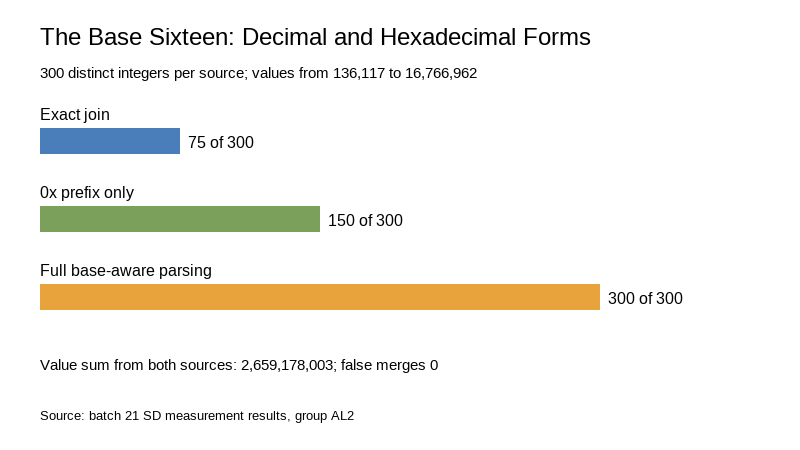
> Census: 300 records per source; an exact join matched 75 of 300, a parser recognising only the 0x prefix matched 150 of 300, and full parsing matched 300 of 300, with 0 false-merge pairs (Source: batch 21 SD measurement results, group AL2)
The Base Sixteen differs from its nearest neighbour, The Octal Address, in whether a careless reading changes the value or merely the match. In The Octal Address, zero-padded segments of an address could be read as octal, and that reading silently produced a different address: the digits survived while the value they denoted was rewritten by the base assumption. Here the danger runs the other way. No reading in this measurement corrupts a value once the base is identified, because each spelling denotes its integer exactly; the failure is that unidentified spellings never reach a reading at all and simply fail to join. The Octal Address warns that a wrong base changes numbers; The Base Sixteen shows that an unstated base hides them, and that full parsing restores every one unchanged.
Four spellings split the file into quarters
The first source stored all 300 integers as decimal strings, while the second divided its rows evenly across four spellings, 75 apiece: decimal, lowercase hexadecimal with a 0x prefix, lowercase hexadecimal with a hash prefix, and bare uppercase hexadecimal with no prefix at all (Source: batch 21 SD measurement results, group AL2). Joining on the stored string matched 75 of 300 rows and failed on 225 (Source: batch 21 SD measurement results, group AL2). As in any pure notation scatter, the survivors are the rows where both writers chose the same camp, and the three hexadecimal camps fail completely and uniformly, each for the same reason: not one character sequence in them can equal the decimal string of the same value, however small the value is.
The values themselves were drawn widely enough that notation, not magnitude, is the only variable. The integers run from a minimum of 136,117 to a maximum of 16,766,962 (Source: batch 21 SD measurement results, group AL2), drawn from a construction range starting at 256 and running up to the exclusive bound of 2^24 (Source: batch 21 SD measurement results, group AL2).
Recognising one prefix rescues one camp
A common halfway repair teaches the join to recognise hexadecimal only when it announces itself with the conventional 0x prefix. That pass matched 150 of 300 rows and failed on 150 (Source: batch 21 SD measurement results, group AL2). It recovered the entire 0x block and doubled the headline score, and it did nothing at all for the other two hexadecimal camps. The hash-prefixed rows announce a base, but not the one the repair was taught, so they are read as text and missed. The bare uppercase rows announce nothing; their only tell is the presence of letters among the digits, a signal the halfway repair never consults. The pattern is the familiar one for partial grammars: each unrecognised notation fails at one hundred percent inside its own block, and the file-wide rate improves in proportion to how much of the file happened to use the fashionable prefix.
The full rule, and a sum checked twice
The complete repair stated its grammar explicitly and applied it to every string: a 0x or hash prefix means hexadecimal, a bare string containing a letter from A to F means hexadecimal, and an all-digit string means decimal (Source: batch 21 SD measurement results, group AL2). The rule is unambiguous in this file because the bare hexadecimal block was constructed so that every spelling in it contains at least one such letter, guaranteeing that no bare hexadecimal row can be mistaken for a decimal string (Source: batch 21 SD measurement results, group AL2). Under that grammar, not one row was left over: each row found its partner, failures came to 0, and wrongly merged pairs also 0 (Source: batch 21 SD measurement results, group AL2).
The aggregate check confirms that parsing moved values without bending them. Summed as stored, the decimal source totals 2,659,178,003, and the second source, summed after full parsing, totals the same 2,659,178,003 (Source: batch 21 SD measurement results, group AL2). That equality is practical evidence that the recovered keys are the original integers, read in the base each spelling declared or implied.
Drawing integers that can wear every dress
The construction began with values, not strings. Working from seed 42, the generator drew 300 distinct integers from its stated range, stored them as decimal in one source, and then rendered the second source in four equal blocks, taking care that the bare uppercase block always contained a hexadecimal letter so the full grammar would never face a genuinely ambiguous string (Source: batch 21 SD measurement results, group AL2). Three joins followed over the identical pair of files: raw text, the single-prefix grammar, and the full grammar, with collisions among parsed keys counted as their own figure. This is a deterministic synthetic measurement built from hand-written parsing rules in the standard library; it audits no commercial product, and its rates describe the constructed file alone.
Questions, answered
Why does the exact join succeed on exactly one quarter of the file? Because only one of the four spellings in the second source is decimal, and only identical strings match. The exact join matched 75 of 300 rows, the size of the decimal block, and failed on all 225 hexadecimal rows (Source: batch 21 SD measurement results, group AL2).
Why is teaching a parser the 0x prefix not enough? Because two other hexadecimal spellings exist in the file and neither uses that prefix. The single-prefix repair matched 150 of 300 rows and still failed on 150 (Source: batch 21 SD measurement results, group AL2), leaving the hash-prefixed and bare uppercase blocks untouched.
What makes a bare string of digits and capital letters safe to read as hexadecimal? In this construction, every bare hexadecimal spelling was guaranteed to contain at least one letter from A to F, while decimal strings contain digits only, so the letter test separates the two camps without overlap (Source: batch 21 SD measurement results, group AL2).
Did full parsing merge any two different integers? No. The complete grammar produced 0 false-merge pairs (Source: batch 21 SD measurement results, group AL2), and the parsed total, 2,659,178,003, agreed exactly with the decimal source's own total (Source: batch 21 SD measurement results, group AL2).
Summary
The Base Sixteen writes one set of integers in decimal and three hexadecimal dresses, and an exact join sees only the decimal quarter: 75 of 300 rows matched as stored, recognising a single prefix reached 150 of 300, and the full base-aware grammar recovered all 300 rows with 0 false merges (Source: batch 21 SD measurement results, group AL2). The sums, 2,659,178,003 on both sides, certify that parsing changed no value (Source: batch 21 SD measurement results, group AL2). Against The Octal Address, where a mistaken base rewrote the value itself, the failure here is shallower and kinder: the value waits, exact, inside every spelling, and only an explicit grammar can collect them all.
Sources
- Batch 21 SD measurement results, group AL2: 300 records per source, 300 distinct integers from 136,117 to 16,766,962; source B spellings 75 each across decimal, 0x-prefixed hexadecimal, hash-prefixed hexadecimal, and bare uppercase hexadecimal; exact join 75 matched, 225 failed; 0x-only repair 150 matched, 150 failed; full parsing 300 matched, 0 failed, 0 false-merge pairs; value sum 2,659,178,003 from both sources.
- Measurement script sd_batch21_measurements.py, group AL2: deterministic synthetic construction, seed 42, self-written parsing rules, pure standard library; not a commercial product measurement.