
The Assumed Country: Defaulting Every Phone Number to the US Misroutes 93.33%
Twelve hundred phone numbers went into the test, drawn evenly from six countries and written in the five forms people actually type them. One...
Twelve hundred phone numbers went into the test, drawn evenly from six countries and written in the five forms people actually type them. One normalisation rule was applied to all of them — the rule buried in a thousand import scripts: if in doubt, treat it as American. The rule mishandled 1,120 of the 1,200 numbers, a failure rate of 93.33%. Every non-US number was misrouted, all two hundred from each of the five other countries — and, more surprisingly, the assumption failed 120 of the 200 genuinely American numbers too, because even a US number written without its country code is not necessarily in the shape the assumption expects.
The numbers behind the failure
The file was balanced by construction: six countries, five written forms each, forty numbers per country-and-form cell, 1,200 in total. The naive rule — assume the United States, prepend the US country code where a number looks domestic — produced a wrong or unusable result for 1,120 numbers, 93.33% of the file. The five non-US countries contributed a clean sweep: 200 of 200 wrong from each, a thousand numbers misrouted with total consistency. The American block contributed the subtle damage: 120 of its 200 numbers also came out wrong, because forms like a domestic trunk prefix or a bare local number do not survive being reinterpreted under the wrong country's dialling plan, even when the country happens to be the right one (Source: SmartDataAI import test U2, run 2026-11-23; the script and its result JSON sit in this batch's evidence pack).
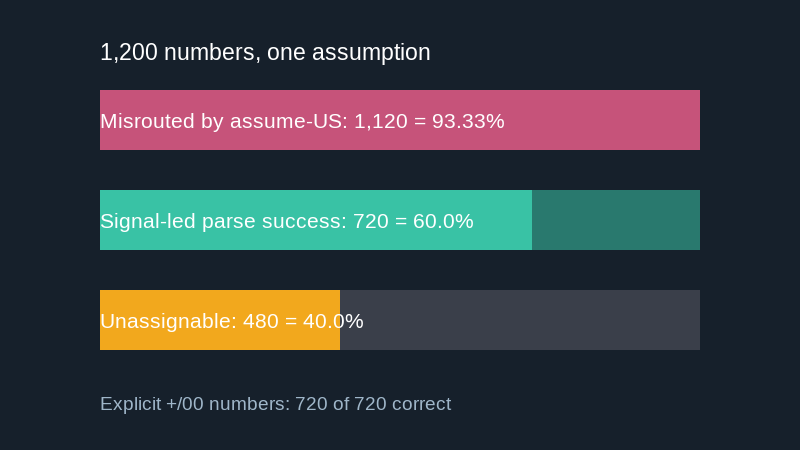
Against that baseline, the test ran a second rule: parse by explicit country signal first. Numbers carrying an international prefix — the plus form or the double-zero form — resolved perfectly: all 720 such numbers, across all six countries, were normalised correctly, a 100% success rate on the explicitly-marked subset. Across the whole file the signal-led rule succeeded on 720 of 1,200 numbers, 60.0%. The remaining 480 numbers, 40.0% of the file, carried no country signal at all — domestic trunk forms and bare local numbers — and for those the honest result was not a guess but an admission: unassignable without more information. The test counts that admission as a non-success, and it is still the better outcome. A number marked unknown can be queued for review; a number confidently misrouted to the wrong country code dials a stranger, or no one, and reports success.
Scale the measured rate and the shape of the risk changes. A directory import of ten thousand mixed numbers, built the way this file was built, would carry roughly 9,333 misrouted entries out the other side (derived by applying the measured 93.33% to a round file size) — not as a tail of exceptions for a cleanup crew, but as the bulk of the file. And the failures would not announce themselves by country: because the assumption also mangles the domestic block, a team cannot even triage by saying "the foreign records are the broken ones". In this test the only records guaranteed safe under the naive rule were the minority of American numbers that happened to arrive in exactly the shape the rule expected — 80 of 1,200 numbers, one in fifteen, survived an assumption that was supposedly made in their favour (derived from the run's counts: 200 domestic numbers minus the 120 it mishandled).
There is an asymmetry underneath the arithmetic that the percentages alone do not show. A number the signal-led rule cannot assign stays visibly incomplete — a missing country code is a hole a reviewer can see, filter on and fix. A number the assumed-country rule has processed is visibly complete and factually wrong, and it will pass every downstream format check built on the same assumption. Errors of the first kind accumulate in an exceptions report. Errors of the second kind accumulate in the dialler. That is why the test scores the honest unknown as the better failure: of the two ways to be unsure about a phone number, only one of them dials the wrong country and calls it success.
What The Assumed Country means
The Assumed Country means the silent default a normalisation process applies to a phone number that carries no explicit country signal — the country the system decides the number must belong to, because it has to decide something. The test measures the cost of that decision when it is made by assumption rather than by evidence. An assumed country is not a neutral fallback. Applied to a mixed file it is wrong for essentially every foreign number and for a majority of domestic ones, and its failures are worse than an honest unknown, because they are confident: the output looks normalised, passes format checks, and is wrong in a way only a dialled call would reveal.
How this was measured
For this test the script generated its numbers synthetically — six countries, five written forms per country, forty per combination — under a fixed seed of 42, then applied two deterministic rules of its own: the assume-US rule and the signal-led rule. The counts are therefore properties of the constructed file and the stated rules, reproducible byte-for-byte from the filed script; nothing here benchmarks a commercial phone library, and the construction proportions are declared in the open rather than presented as field data.
Questions, answered
Why did the assumption fail American numbers too? Because "American" is not one format. A US number written with a domestic trunk prefix or as a bare local number does not fit the shape the assume-US rule reconstructs, so the rule mangles 120 of the 200 domestic numbers even though it guessed their country correctly. The assumption fails on format before it ever gets to geography.
What made the signal-led rule succeed where it did? The explicit international prefix. Every number that carried one — 720 of the 1,200 — was normalised correctly, in all six countries. Where the signal exists, parsing is nearly a solved problem; the entire difficulty lives in the 40% of numbers that arrive without one.
Is marking 40% of a file "unknown" acceptable in practice? Compared with the alternative measured here, yes. The assumed-country rule converted that same uncertainty into a 93.33% error rate spread across the whole file. An unknown can be reviewed, enriched or asked about; a confidently wrong country code is a defect that looks like data.
Summary
Assuming one country for an unmarked, multinational phone file mishandled 93.33% of 1,200 test numbers — every foreign number and 60% of the domestic ones. Parsing by explicit signal succeeded on all 720 numbers that carried one, and honestly declined the 480 that did not. The Assumed Country is the most expensive default in the phone column: it turns missing information into wrong information at industrial scale, and the test puts its price at fourteen numbers in fifteen.
Sources
- SmartDataAI import test U2 (phone country-code normalisation), executed 2026-11-23 — the generating script and the result JSON accompany this batch as its evidence pack.
- The file's construction — six countries, five forms, forty per cell, fixed seed — is described in the measurement section; the figures quoted are the run's own output.