
The Finer Foot: 60 of 60 Areas Survive in Square Feet, 0 of 60 in Hectares
Here is the contrast in one line: in a measured inventory of 300 distinct areas, every one of the 60 values written in square feet came back exactly,...
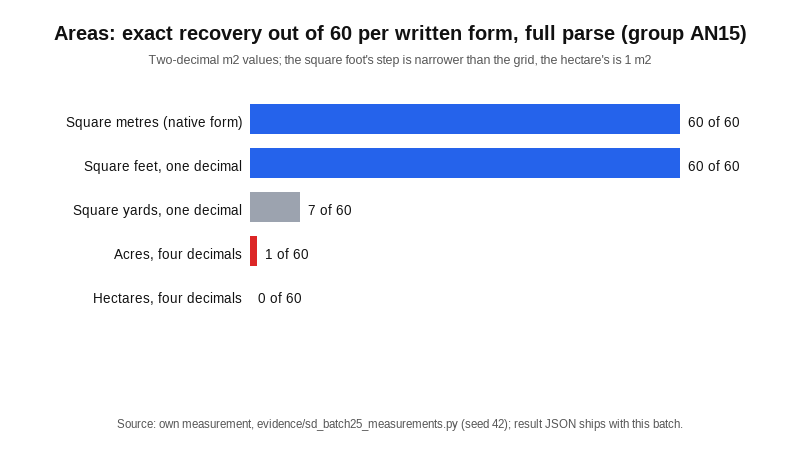
Here is the contrast in one line: in a measured inventory of 300 distinct areas, every one of the 60 values written in square feet came back exactly, and not one of the 60 values written in hectares did. The imperial form, the one a metric-minded cleaning team would replace first, was the only converted form that lost nothing. The hectare, the canonical system's own large unit, written carefully to four decimal places, lost every row it carried. No parser failed and no factor was wrong. The difference sits entirely in step width: one decimal of a square foot is a smaller step, in square metres, than the two-decimal grid the inventory lives on, and four decimals of a hectare step by exactly one whole square metre.
What The Finer Foot means
The Finer Foot means a converted written form whose step, expressed in the canonical unit, is narrower than the canonical grid, so the round trip can be lossless even though the form belongs to a different unit system. The nearest prior concept is The Mismatched Ruler. The Mismatched Ruler covered speeds written in miles per hour, knots and metres per second, which recovered in the order of each unit's written step width in kilometres per hour — 60, 41, 38 and 21 of 60 — because every converted step was wider than the 0.01 km/h grid, so recovery there was always partial. The Finer Foot is the opposite case inside the same law. Square feet at a one-decimal step move by 0.00929 m2, narrower than the two-decimal m2 grid, and that one converted form is lossless at 60 of 60. Meanwhile the hectare steps by exactly 1 m2 and recovers 0 of 60, because no inventory value is a whole number of square metres. Step width, not the prestige of the unit system, decides survival.
1 The Resource List: 5 Written Forms for Carrying One Area Value
Treat each written form as a resource for carrying an area value, and judge each by what it costs in recovery. The measured inventory holds 300 distinct areas at two-decimal precision, from 5.00 to 20,000.00 square metres, with a checksum of 305,902,941 in hundredths of a square metre. Inventory A stores each value in square metres at two decimals; inventory B writes the same values five ways, 60 rows each. The resources fall into three categories by how each is obtained. First, the canonical resource: square metres at two decimals, stored as measured, with no conversion. Second, the small-unit conversions: square feet and square yards at one decimal, obtained by multiplying by 10.763910 or 1.195990 and rounding. Third, the land-unit conversions: acres and hectares at four decimals, obtained by dividing by 4,046.8564224 or by 10,000. The staged counts show what the grammar buys: exact string matching recovers 60 of 300, a small-unit parse reading square metres, square feet and square yards recovers 127 of 300 with zero false merges, and a full parse that also reads acres and hectares recovers 128 of 300, still with zero false merges. Adding both land units buys exactly one row.
| Written form | Step width in m2 | Step vs the 0.01 m2 grid | Exact recovery of 60 |
|---|---|---|---|
| Square metres, 2 decimals | 0.01 | Equal to the grid | 60 |
| Square feet, 1 decimal | 0.00929 | Narrower than the grid | 60 |
| Square yards, 1 decimal | 0.083613 | Wider than the grid | 7 |
| Acres, 4 decimals | 0.4047 | Wider than the grid | 1 |
| Hectares, 4 decimals | 1.0 | Wider than the grid | 0 |
Read the table as a purchasing decision. Four decimals look careful, and in the land units they are not careful enough: the unit is so large that its fourth decimal still moves a full square metre for hectares and 0.4047 m2 for acres. One decimal looks careless, and in square feet it is finer than the grid.
2 Essential and Optional Tiers: Which of the 5 Resources an Inventory Must Keep
The essential tier holds the resources that carry values without loss. Square metres at two decimals are essential by definition: that block is the canonical record, and exact matching recovered its 60 of 60. Square feet at one decimal belong in the essential tier on the evidence, not on habit: the block recovered 60 of 60 under the full parse, the only converted block to do so. A pipeline receiving areas in square feet can keep that feed as a first-class source, provided the parser converts it rather than relabelling it. The optional tier holds everything else, usable only with a warning attached. Square yards recovered 7 of 60, acres 1 of 60 and hectares 0 of 60. Those forms can serve as display values or cross-checks, but none can serve as the record of an area at two-decimal precision: the round trip destroys the hundredths digit in almost every row — and in the hectare block, in every row.
3 Priority Order: Reach for Square Feet First, Hectares Last
When several forms of the same area are available, the recovery evidence gives a strict priority order: square metres first, square feet second, then square yards, then acres, and hectares last. The worked example shows why. Take the inventory value 9,807.93 m2 and write it five ways. As "105571.7 ft2" it parses back to exactly 9,807.93 — the finer foot earns its name on a real row, not on average behaviour. As "11730.2 yd2" it parses back to 9,807.94, one grid line high. As "2.4236 ac" it parses back to 9,807.96, three grid lines high. As "0.9808 ha" it parses back to 9,808.00, seven grid lines high. Four spellings look equally precise on the page; only one returns the value that was sent. A merger that picks the hectare spelling because it looks most official will import 9,808.00 and record a false area with total confidence. Priority by measured recovery, not by unit-system loyalty, is the only order the evidence supports.
4 Substitute Resources: What to Use When the First-Choice Form Is Missing
Substitution is where inventories usually go wrong, because any unit is treated as a substitute for any other. The measurement prices each substitution. Substituting square feet for square metres costs nothing: 60 of 60 rows survive, so a feet-only source can stand in for the canonical record after conversion. Square yards cost 53 of 60 rows; acres cost 59 of 60; hectares cost all 60. When only a coarse form survives, the honest substitute is not a converted point value but the original spelling kept beside the parsed value, flagged as approximate, so a later, finer source can replace it. The staged counts make the same point: the small-unit parse already held 127 of the full parse's 128 rows, so the land-unit grammar is a last resort that adds one row and should never displace a small-unit spelling. Where two spellings of one row disagree after parsing, keep the one whose step is narrower than the grid.
Questions on The Finer Foot, answered
1. Why do square feet recover every row while hectares recover none? Step width. One decimal of a square foot steps by 0.00929 m2, narrower than the 0.01 m2 grid, so every value rounds home. Four decimals of a hectare step by exactly 1 m2, and none of the 60 values is a whole number of square metres, so none survives.
2. How much did adding acres and hectares to the parser buy? One row. The small-unit parse recovered 127 of 300; the full parse recovered 128 of 300, with zero false merges at both stages. The land units are nearly worthless as carriers at this precision.
3. Did any written form create false merges in this measurement? No. Every stage — exact string, small-unit parse and full parse — produced zero false merges. The damage here is pure loss: values parse back one or more grid lines away from their own row.
4. What is the checksum of the measured inventory? 305,902,941, the areas summed in hundredths of a square metre — the control total for any re-run.
5. Is a four-decimal hectare spelling ever safe for a two-decimal area inventory? Only for a value that is a whole number of square metres, because the hectare step is exactly 1 m2. In the measured block that case never occurred: 0 of 60.
Next action: audit one incoming area feed today, convert each unit's written step into square metres, and promote any form whose step is narrower than 0.01 m2 to a first-class source while demoting hectare and acre spellings to display-only fields — that single comparison, run before the next import, is where the next silently rounded area is waiting.