
The Silent Unit: 1.7797 Is an Angle in Three Units and a Correct Answer in None
The string "1.7797" sits in an angle column and says nothing about what it measures. Read as degrees, it is a small angle, under two degrees. Read as...
The string "1.7797" sits in an angle column and says nothing about what it measures. Read as degrees, it is a small angle, under two degrees. Read as radians, it is 101.9693 degrees — a wide obtuse angle. Read as gradians, it is 1.6017 degrees. The number is identical; the angle differs by a factor of 57 depending on a fact the string does not carry. In a measured inventory of 300 angles, the two blocks written in radians and gradians — 120 rows — carried no unit mark of any kind, and that silence, not any rounding, is what capped the full string parse at 180 of 300. A parser cannot convert a unit it cannot see.
What The Silent Unit means
The Silent Unit means a written value whose unit is absent from the string itself, so the value's meaning depends on context the record does not contain. The nearest prior concept is The Unit Mirage. The Unit Mirage described values whose units were present but spelled in competing suffixes — the unit was there, wearing disguises, and a parser that knew the disguises could always find it. The Silent Unit is the harder case: there is no suffix to find. The radians and gradians rows in this inventory are bare numbers, indistinguishable in form from the bare degree rows they sit beside, and the only thing that ever identified them was the block they were written in — knowledge that evaporates the moment the rows are merged into one column.
The Goal and the Prerequisites
The goal of this procedure is a merged angle inventory in which every row's value in degrees is correct to the four-decimal precision the source inventory uses — no row silently converted from the wrong unit, and no row accepted on a coincidence. Two prerequisites must hold before the steps begin. Prerequisite one: the source inventories still exist separately, with their units known per source, because the unit declaration lives outside the strings and can only be recovered from provenance. Prerequisite two: a decision, recorded in advance, about what to do with rows whose unit cannot be established — the procedure below quarantines them, and a merge that has no quarantine rule will eventually force an operator to guess. If prerequisite one has already failed — the sources were merged and the provenance discarded — stop: the radians and gradians rows are no longer identifiable, and the honest output is a smaller inventory plus a documented loss, not a larger inventory plus hope.
Step 1: Separate the Rows by Declared Unit Before Touching the Values
Pass criterion: every row carries a unit label that came from its source, not from its shape. Work source by source: the degree inventories (bare decimals and degree-sign rows), the DMS inventory, the radians inventory, the gradians inventory. Do not infer units from magnitude — the usual shortcut, "numbers under 6.29 must be radians", fails exactly where it matters, because a radians row for a small angle and a degrees row for a small angle occupy the same numeric range; in the measured inventory the symbol-strip parse, which reads every unit-less number as degrees, produced a false merge when a gradians number coincided with another row's degree value. The label is metadata and must travel with the row through every subsequent step.
Step 2: Convert Each Block with Its Own Rule, and Count the Survivors per Block
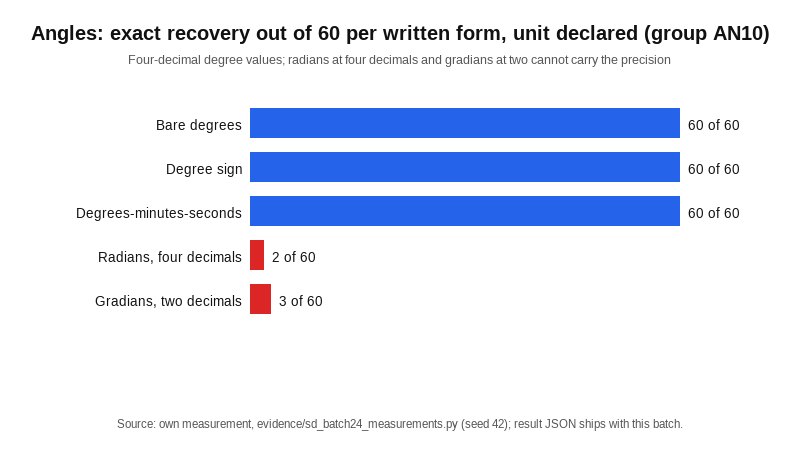
Pass criterion: the per-block recovery counts are known and recorded, not estimated. Convert degrees-minutes-seconds by the standard rule; convert radians by multiplying by 180/pi; convert gradians by multiplying by 9/10; round to four decimals and compare against ground truth where it exists. In the measured inventory, with units correctly declared, the blocks recover as follows: bare degrees 60 of 60, degree-sign rows 60 of 60, DMS rows 60 of 60 — and radians 2 of 60, gradians 3 of 60. The last two counts surprise everyone the first time: even with the unit known, the conversion cannot restore the original value, because four-decimal radians quantise angle in steps of 0.005730 degrees and two-decimal gradians in steps of 0.009 degrees, both far wider than the four-decimal degree grid. The worked row shows the mechanism: 101.9687 degrees written as "1.7797" radians converts back to 101.9693 degrees, off by 0.0006; written as "113.30" gradians it converts back to 101.9700 degrees, off by 0.0013. These rows are not misconverted. They are converted perfectly from spellings that never held the precision.
Step 3: Merge Only What Survived, and Quarantine the Rest with Its Reason
Pass criterion: the merged inventory's count plus the quarantine count equals the source count, and every quarantined row names its failure — unit unknown, or precision lost in the source spelling. From the measured blocks, the merge accepts the 180 degree-family rows at full precision. The 120 radians and gradians rows enter only if the merged inventory's purpose tolerates their demonstrated error — up to about half a radian-step, 0.0029 degrees, and half a gradian-step, 0.0045 degrees, respectively — and if it does, they must carry that tolerance as a stated property of the rows, not as a footnote nobody reads. A survey-grade inventory will refuse them; a coarse orientation log may accept them knowingly. What neither may do is accept them silently at four-decimal face value, because face value is precisely what their spellings cannot support.
Completion Check: The Three Counts That Prove the Merge
The merge is complete when three checks pass. Check one, the count identity: merged rows plus quarantined rows equal 300, the size of the source inventory — in the measured run, 180 rows merge at full precision and 120 are quarantined or tolerance-flagged. Check two, the checksum: the source inventory's angles, summed in ten-thousandths of a degree, total 532,252,088; the merged inventory's checksum over its full-precision rows will be a subset sum, and the difference must be exactly the quarantined rows' contribution — any other difference means a row was altered in transit. Check three, the false-merge scan: no two merged rows may share a value unless the sources did; the string-only parse of this same data produced 1 false merge, and the procedure exists to make that number zero by construction. If any check fails, the merge rolls back to the separated blocks of Step 1, which is why the blocks are kept until the checks pass.
Questions on The Silent Unit, answered
1. Why did the full string parse stop at 180 of 300? Because 120 rows — the radians and gradians blocks — are bare numbers with no unit mark. A string-only parser reads every unit-less number as degrees, so those blocks cannot be identified, let alone converted, from the strings alone.
2. If the unit is declared, do radians rows then recover? Almost never at four-decimal precision: 2 of 60 in the measurement. Four-decimal radians move in steps of 0.005730 degrees, so the original four-decimal degree value usually falls between two writable radian spellings. Gradians at two decimals recovered 3 of 60, for the same reason with a wider step.
In one sentence: an angle written without its unit is not a measurement but a riddle — recoverable only when the unit is declared outside the string and the source precision survives conversion, conditions that held for 180 of the 300 rows measured here.