
"03/04/2023": The Register Row That Reads Back as a Different Day
The row says 03/04/2023. In the register it was written as the fourth of March, in the American month-first convention. The parser that reads the merg...
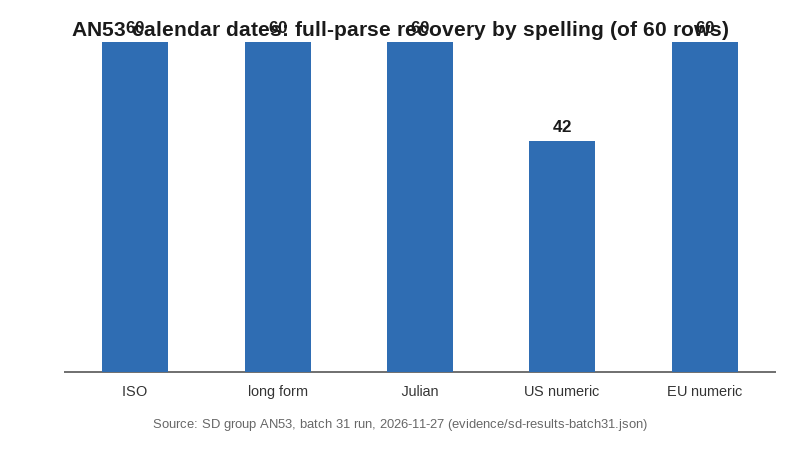
The row says 03/04/2023. In the register it was written as the fourth of March, in the American month-first convention. The parser that reads the merged register assumes day-first whenever both fields are twelve or below, and hands back the third of April — a valid date, thirty days away from the truth, with no error raised anywhere in the chain. This batch's calendar group drew 300 dates and spelled each five ways; under one fixed reading rule, the American numeric spelling returned 42 of its 60 dates correctly and returned the other 18 as different, valid dates, while the European spelling returned all 60 (Source: SD group AN53, batch 31 run, 2026-11-27). This article is the maintenance calendar for a date register: the checks, on a schedule, that keep the two conventions from silently exchanging days.
What The Swapped Fields means
The Swapped Fields is the failure of a numeric date spelling whose two field orders are both in use, so that a reader applying the other order obtains a different, valid value of the same quantity. In this group the canonical value is a calendar date drawn from 2023-01-01 to 2027-12-31. The full parser reads slash dates by one fixed rule: a first field above 12 must be a day; a second field above 12 makes the first a month; when both fields are 12 or below, it assumes day-first (Source: batch 31 SD run notes, AN53 section). Under that rule every European-spelled row returns correctly, including the ambiguous ones, because the assumption matches their convention. American-spelled rows return only where the day exceeds 12 or equals the month — 42 of 60 — and the remaining 18 come back swapped: not rejected, not flagged, but read as the date obtained by exchanging day and month (Source: SD group AN53, batch 31 run, 2026-11-27).
The Swapped Fields is a sharper relative of The False Friend, an earlier concept in this series, in which a spelling that looks familiar denotes a different quantity altogether, so a reader at least has the chance to notice the unit is wrong. A swapped date denotes the same quantity in the same format with the same punctuation; the reading is well-formed, the date exists, and downstream checks — range tests, format validation, even a calendar lookup — all pass. The only artefact that can catch it is the register's own maintenance: comparing conventions before they are merged, which is a calendar discipline, not a parsing one.
The register: five spellings of a date
Three of the five spellings are unambiguous and exact. The ISO form "2027-06-06", the long form "6 June 2027" and the Julian form "2027-157" — year plus day-of-year — each return all 60 of their rows (Source: SD group AN53, batch 31 run, 2026-11-27):
| Spelling | Example | Full-parse recovery |
|---|---|---|
| ISO | "2027-06-06" | 60 of 60 |
| Long form | "6 June 2027" | 60 of 60 |
| Julian day-of-year | "2027-157" | 60 of 60 |
| US numeric (month-first) | "06/06/2027" | 42 of 60 |
| EU numeric (day-first) | "06/06/2027" | 60 of 60 |
The stages follow: the exact-string stage reads ISO and recovers 60; the structural stage adds the long and Julian forms and reaches 180; the full parser adds the two numeric forms and reaches 282 of 300 (Source: SD group AN53, batch 31 run, 2026-11-27). The register's total loss is eighteen rows, and all eighteen are of one kind: American rows whose day and month are both twelve or below and unequal. Note the example row in the table: the drawn date, 2027-06-06, has day equal to month, so its two numeric spellings are the same string and both return it. Equality is the one ambiguous case that cannot swap. The Julian form deserves a note of its own: it is the only numeric spelling in the register that is both compact and unambiguous, and its obscurity to human readers is precisely why it survives parsing intact — no living convention reads it two ways, so no reader's habit can exchange its fields.
The eighteen swapped rows, and what they became
The swapped rows are ordinary dates, which is the point. The register's first five: 2023-03-04, spelled "03/04/2023", read back as 2023-04-03; 2027-03-09, spelled "03/09/2027", read back as 2027-09-03; 2025-02-09, spelled "02/09/2025", read back as 2025-09-02; 2025-05-09, spelled "05/09/2025", read back as 2025-09-05; and 2027-05-10, spelled "05/10/2027", read back as 2027-10-05 (Source: batch 31 SD run notes, AN53 section). The displacements are not small: the March-to-September swap moves a record by 178 days, and every swapped row lands inside the register's five-year window, so no range check downstream can see it. A swap is also asymmetric under a fixed rule. Had the parser assumed month-first instead, the European block would have supplied the eighteen swaps and the American block none; the count belongs to the pairing of rule and register, not to either convention. A merged register cannot average this away — under any single rule, one convention's ambiguous rows are the other's errors.
The maintenance calendar for a merged date register
Because the failure is silent, the defences are scheduled rather than reactive. On intake, monthly: count the register's slash-dated rows whose first field exceeds 12 and whose second exceeds 12; the ratio between the two counts estimates the convention mix, and a register that believes itself single-convention but shows both counts is already merged. On merge, at the event: freeze one reading rule, record it in the register's header, and restate every ambiguous row — both fields at twelve or below, fields unequal — from its source before the merge closes; in this group that population is eighteen rows in sixty, thirty percent of the American block. Quarterly: sample ten ambiguous rows and verify them against their sources, because swaps accumulate exactly where sampling is rarest. Annually: re-run the stage counts — a full parse that once returned 282 of 300 and now returns fewer is reporting new ambiguous intake, not parser decay. Each check is cheap because the vulnerable population is definable in one line: day and month both at twelve or below, and unequal.
FAQ
How many dates does the US numeric spelling lose? Eighteen of sixty come back as different, valid dates; 42 return correctly — those whose day exceeds 12, plus day-equal-to-month rows (Source: batch 31 SD run notes, AN53 section).
Why does the EU spelling lose none under the same rule? The parser's fixed rule assumes day-first for ambiguous rows, which is the EU convention; the EU block's ambiguous rows are therefore read as written (Source: batch 31 SD run notes, AN53 section).
Which date spellings are unambiguous? ISO, the long form with a month name, and the Julian year-and-day form; each recovered 60 of 60 (Source: SD group AN53, batch 31 run, 2026-11-27).
Can a swapped date be detected from the register alone? No. The swapped value is a valid date inside the register's range. Detection requires the source, or a convention census of unambiguous rows taken before merging.
The review node for this register is the next merge: before any new source is folded in, recount the ambiguous population — both fields at twelve or below, unequal — and confirm the reading rule in the header still matches the convention the new source actually writes.