
The Badge Says 2.0 Litres; the Engine Is 1,998 cc, and the Register Can Prove It
Two inscriptions describe the same engine. The badge on the car reads "2.0 L"; the build sheet reads 1,998 cc. Read back into a register whose canonic...
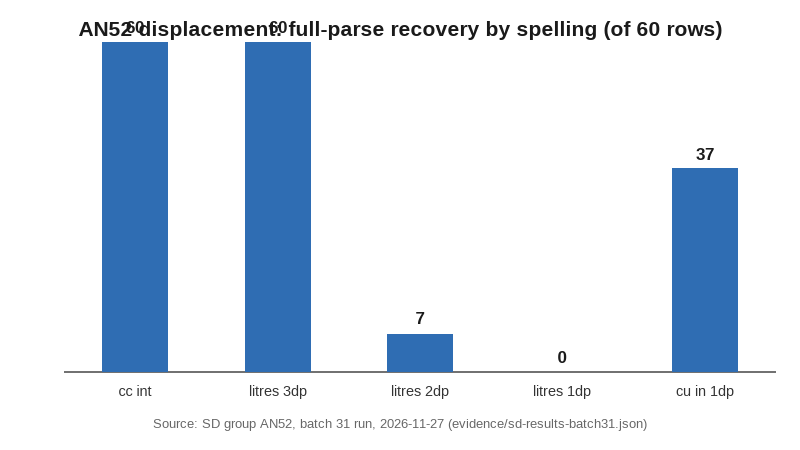
Two inscriptions describe the same engine. The badge on the car reads "2.0 L"; the build sheet reads 1,998 cc. Read back into a register whose canonical value is the cubic centimetre, the badge returns 2,000 and the build sheet returns 1,998 — a two-cubic-centimetre disagreement manufactured entirely by spelling. This batch's displacement group drew 300 engines and spelled each five ways; the one-decimal litre, the badge spelling, recovered 0 of its 60 values, while the cubic inch at one decimal — a foreign unit with an irrational-looking conversion — recovered 37 of 60 (Source: SD group AN52, batch 31 run, 2026-11-27). This article diagnoses where in the chain from measurement to badge the register's values are lost.
What The Rounded Litre means
The Rounded Litre is the one-decimal litre spelling of an engine's displacement: the marketing form, rounded to the nearest hundred cubic centimetres, under which engines are sold, taxed in some markets and compared by buyers. As a register spelling it is a step of 100 cc laid over a unit grid, and its measured recovery in this group is zero of sixty: a displacement returns from "2.0 L" only if it is an exact multiple of 100, and a register of real engines — 1,998, 1,496, 2,457 — holds almost none (Source: SD group AN52, batch 31 run, 2026-11-27).
The Rounded Litre is kin to The Lossy Decimal, an earlier concept in this series, in which a decimal spelling whose step is coarser than the register's grid surrenders most of its values. The displacement case adds a contrast the earlier group did not have: the same register carries the litre at three precisions side by side — three decimals exact, two decimals nearly lost, one decimal wholly lost — so the loss is visible as a function of a single choice, the number of decimals, on a single unit. And it carries one spelling, the cubic inch, whose losses obey a different law entirely, which the diagnosis below separates from the decimal ladder's.
The register: 300 displacements, five spellings
The canonical value is displacement in whole cubic centimetres, drawn from 500 to 7,000. Sixty rows are spelled in each form (Source: SD group AN52, batch 31 run, 2026-11-27):
| Spelling | Step | Full-parse recovery |
|---|---|---|
| Cubic centimetres, integer ("1998 cc") | 1 cc | 60 of 60 |
| Litres, three decimals ("1.998 L") | 1 cc | 60 of 60 |
| Litres, two decimals ("2.00 L") | 10 cc | 7 of 60 |
| Litres, one decimal ("2.0 L") | 100 cc | 0 of 60 |
| Cubic inches, one decimal ("121.9 cu in") | 1.6387 cc | 37 of 60 |
The stages accumulate the same picture: the exact-string stage reads the cc integer and recovers 60; the structural stage adds the three-decimal and two-decimal litres and reaches 127; the full parser adds the badge litre and the cubic inch and reaches 164 of 300 (Source: SD group AN52, batch 31 run, 2026-11-27). Note what the full parser's last 37 rows are made of: every one of them comes from the cubic inch block. The badge litre contributes nothing at any stage.
Diagnosis, first break: the decimal ladder inside one unit
The litre spellings are one unit at three precisions, and their recoveries — 60, 7, 0 — are the pure effect of step width against a unit grid. Three decimals of a litre is one cubic centimetre, the grid itself, so the spelling is the canonical value with its point moved and loses nothing. Two decimals steps by 10 cc and keeps only multiples of ten: 7 of this draw's 60. One decimal steps by 100 cc and keeps only multiples of 100: none of this draw's 60. The break is located precisely at the second decimal place: a register that stores two decimals has already surrendered 53 of every 60 values, and the third decimal is the whole of the information. This is the cheapest diagnosis in the series — no unit conversion is involved at all, only the number of digits a form chooses to print.
Diagnosis, second break: the cubic inch obeys a different law
One cubic inch is 16.387064 cubic centimetres, so one decimal of a cubic inch steps by 1.6387 cc — a step that never aligns with the unit grid. Its 37 recoveries are not lattice points; they are rounding survivals, draws whose true value happened to lie within half a cubic centimetre of the back-converted spelling (Source: batch 31 SD run notes, AN52 section). The distinction matters for repair. A lattice loss is systematic: the register can state exactly which values a spelling can hold (the multiples of its step) and reject the rest at intake. A survival loss is statistical: the cubic inch spelling can hold any value and guarantees none, returning roughly three draws in five with no pattern a validator can check in advance. The badge litre's zero is, paradoxically, the more honest failure — it is predictable — while the cubic inch's 37 is a coin the register flips row by row.
The worked rows: the badge engine and the drawn engine
The harness's constructed badge row is the 1,998 cc engine of the standfirst. Its spellings are "1998 cc" and "1.998 L", both exact; "2.00 L", which returns 2,000; "2.0 L", which also returns 2,000; and "121.9 cu in", which returns 1,998 exactly, one of the cubic inch's survivals (Source: batch 31 SD run notes, AN52 section). The register's drawn example row is a 625 cc engine: "625 cc" and "0.625 L" exact; "0.63 L" returns 630; "0.6 L" returns 600, twenty-five cubic centimetres discarded by a single dropped digit; "38.1 cu in" returns 624, one low (Source: batch 31 SD run notes, AN52 section). In both rows the badge spelling is the worst inscription on the page — worse than a foreign unit's approximation — because its step is the widest and its losses are total rather than partial.
FAQ
How many displacements does the one-decimal litre recover? None of sixty. Its step is 100 cc, so only exact multiples of 100 can return, and this draw's badge block held none (Source: SD group AN52, batch 31 run, 2026-11-27).
Why does the cubic inch recover more than the two-decimal litre? Its one-decimal step is 1.6387 cc, far narrower than the two-decimal litre's 10 cc, and its recoveries are rounding survivals — about three draws in five — rather than lattice points (Source: batch 31 SD run notes, AN52 section).
What litre precision must a register store to be exact? Three decimals. One litre at three decimals is one cubic centimetre, the register's own grid step; the three-decimal spelling recovered 60 of 60 (Source: SD group AN52, batch 31 run, 2026-11-27).
Is the badge wrong about the engine? No. "2.0 L" is a correct rounding of 1,998 cc to one decimal. The finding is about storage: a correct badge is a lossy register spelling, returning 2,000 when read back.
The next action for a displacement register is a digit audit: count the decimals on every litre spelling at intake, restate anything under three decimals from its cc source before storing, and mark cubic-inch rows as survivals — values to verify against a cc source, not values the register has confirmed.