
The Dose Spelling with the Finest-Looking Decimals Loses Every Value
Of the five spellings in this batch's radiation dose register, the one that looks most precise is the worst. "0.91 rem" carries two decimal places and...
Of the five spellings in this batch's radiation dose register, the one that looks most precise is the worst. "0.91 rem" carries two decimal places and an air of care; it returns not one of its sixty values exactly, because the rem is so large a unit that its second decimal still steps by 100 microsieverts (Source: SD group AN51, batch 31 run, 2026-11-27). The register's plainest spelling, the integer microsievert, loses nothing. This article is the quick fix: how to restate a dose register so that every row survives, in the order a practitioner should apply the changes.
What The Hundredfold Unit means
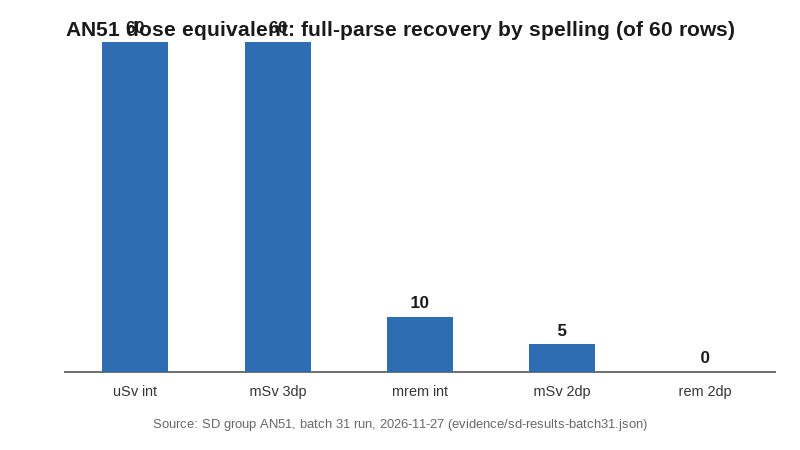
The Hundredfold Unit is the legacy unit in a family where one sievert holds a hundred of them: the rem, defined so that 100 rem make one sievert, and its thousandth, the millirem, at ten microsieverts each. A dose register kept in whole microsieverts meets this family unevenly. The sievert spellings at full precision are exact — three decimals of a millisievert is one microsievert — while every rem-family spelling steps by 10 or 100 microsieverts and keeps only the draws that sit on its lattice: the integer millirem recovered 10 of 60, the two-decimal rem recovered 0 of 60 (Source: SD group AN51, batch 31 run, 2026-11-27).
The Hundredfold Unit differs from The Write-Only Unit, an earlier concept in this series, in which a legacy unit family's spellings recovered none of their rows at all and could be written but never read back. The rem family is not write-only: the millirem returns a sixth of its rows, and the family's failure is concentrated at its most formal-looking spelling, the decimal rem. Nor is the mechanism a coarse instrument; the doses themselves are exact integers in the register. The loss is a unit-size artefact — a hundredfold unit asked to carry a unit-sized grid — and it is fixable by restatement alone, which is what makes this group a quick-fix case rather than a cautionary tale.
The register as drawn: five spellings of one dose
The group drew 300 doses in whole microsieverts, from 1 to 10,000, and spelled sixty in each form (Source: SD group AN51, batch 31 run, 2026-11-27):
| Spelling | Step in microsieverts | Full-parse recovery |
|---|---|---|
| Microsieverts, integer ("9107 µSv") | 1 | 60 of 60 |
| Millisieverts, three decimals ("9.107 mSv") | 1 | 60 of 60 |
| Millirem, integer ("911 mrem") | 10 | 10 of 60 |
| Millisieverts, two decimals ("9.11 mSv") | 10 | 5 of 60 |
| Rem, two decimals ("0.91 rem") | 100 | 0 of 60 |
Two spellings share each coarse step and divide its survivors between their different draws: at the 10-microsievert step the millirem kept 10 rows and the two-decimal millisievert 5, both keeping only values that are multiples of ten. At the 100-microsievert step the two-decimal rem kept nothing, since a multiple-of-100 dose is one draw in a hundred and the block of sixty happened to hold none that its rounding could return (Source: batch 31 SD run notes, AN51 section). The stages tell the same story in aggregate: the exact-string stage recovers 60, the structural stage, adding the millisievert spellings, reaches 125, and the full parser, adding the rem family, reaches 135 of 300 (Source: SD group AN51, batch 31 run, 2026-11-27). The rem family contributes ten rows to a register of three hundred.
The drawn row: 9,107 microsieverts in five spellings
The register's example dose is 9,107 microsieverts — a large occupational dose, chosen by the draw, not by the article. As "9107 µSv" it returns itself. As "9.107 mSv" it returns itself, the third decimal carrying the unit exactly. As "911 mrem" it returns 9,110, three microsieverts high, the millirem's ten-unit step rounding it up. As "9.11 mSv" it also returns 9,110, the same lattice reached from the sievert side. As "0.91 rem" it returns 9,100, seven low (Source: batch 31 SD run notes, AN51 section). The row shows the fix's target precisely: nothing is wrong with the dose, the instruments, or the parser. Three of the five inscriptions simply cannot hold the number they were given, and the two that cannot hold it best are the two that look most carefully written.
The quick fix, in order
First, restate the register's storage unit as the microsievert integer, or equivalently the three-decimal millisievert; both are exact, and every historical row already in those forms survives untouched. Second, convert the millirem and two-decimal millisievert rows on entry and tag them as converted-from a 10-microsievert step, so a reader knows those values are known only to the nearest ten. Third, refuse the two-decimal rem as a storage form: where a source document reports in rem, store the interval the spelling denotes — "0.91 rem" denotes 9,050 to 9,150 microsieverts, the lattice point plus and minus half its 100-unit step (derived: batch 31 SD run notes, AN51 section) — or obtain the underlying microsievert figure from the source. Fourth, in any report generated from the register, print doses in the unit the row was stored in, not in rem for formality: the register's own evidence is that formality, here, is the single largest source of loss. The four steps touch no instrument and no measurement; they are a restatement of records, and they move the register's recoverable count from 135 of 300 to every row whose source held an exact figure.
Why the rem persists, and why registers should not follow it
The rem survives in regulations, signage and older literature, particularly in the United States, and a dose register will keep meeting it at intake. The measured facts argue for treating it as a citation form rather than a data form: quote it where a regulation is being quoted, convert it where a value is being stored. The hundredfold size that makes the rem convenient for whole-body dose ranges — a few rem reads more calmly than tens of thousands of microsieverts — is exactly what makes its decimals useless at register precision: two decimals of the rem still step by 100 microsieverts, a hundred times the register's unit grid, and no care in writing can recover what the unit itself discards. Registers fail quietly in this direction because nothing looks wrong: "0.91 rem" is a well-formed, professional-looking inscription of a number it cannot hold.
FAQ
Which dose spellings are exact? The integer microsievert and the three-decimal millisievert, both at 60 of 60; one microsievert is the register's grid step, and three decimals of a millisievert is exactly one microsievert (Source: SD group AN51, batch 31 run, 2026-11-27).
How many values does the two-decimal rem recover? None of its sixty. Its step is 100 microsieverts, so only multiples of 100 can return, and this draw's rem block held none its rounding could return (Source: batch 31 SD run notes, AN51 section).
Why do the millirem and the two-decimal millisievert recover different counts at the same step? Both step by 10 microsieverts and keep only multiples of ten, but they were spelled on different draws of sixty; the millirem's block held ten multiples of ten, the millisievert's five (Source: batch 31 SD run notes, AN51 section).
What does "0.91 rem" actually denote, stored honestly? An interval, 9,050 to 9,150 microsieverts — the lattice point 9,100 plus or minus half of its 100-microsievert step (derived: batch 31 SD run notes, AN51 section).
The decision rule is one line: store dose in microsieverts or three-decimal millisieverts, convert every rem-family row on entry with its step recorded, and let the rem appear only inside quotations — never as the form a value is kept in.