
Zero of Sixty: The Karat Spelling That Returns No Fineness at All
A hallmark register that accepts karat spellings has a measurable acceptance problem: of sixty fineness values spelled as integer karats, the full par...
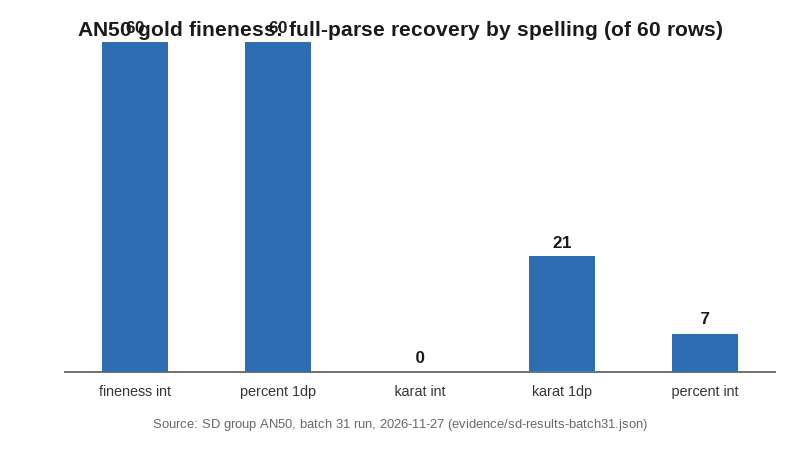
A hallmark register that accepts karat spellings has a measurable acceptance problem: of sixty fineness values spelled as integer karats, the full parser returns none — a recovery of 0 of 60, the emptiest form in this batch's gold group (Source: SD group AN50, batch 31 run, 2026-11-27). The same register's percent spellings lose nothing at all, because one decimal of a percent is exactly one part per thousand. This article sets the acceptance criteria a fineness register should be held to: which spellings may be accepted as exact, which only as bounds, and which — the integer karat — should be rejected as a storage form outright.
What The Twenty-Fourth Part means
The Twenty-Fourth Part is the unit of the karat scale: karat counts how many twenty-fourths of a piece of metal are gold, so 24K is pure, 18K is eighteen twenty-fourths, and one whole karat is 1000/24, or 41.667, parts per thousand of fineness. A register whose canonical value is fineness in whole parts per thousand, drawn from 0 to 1000, meets this scale badly: the integer karat's step of 41.667 is so coarse against the register's unit grid that no drawn value survives the round trip, and even the one-decimal karat, stepping by 4.167, keeps only 21 of 60 (Source: SD group AN50, batch 31 run, 2026-11-27).
The Twenty-Fourth Part differs from The Three Zeros, an earlier concept in this series, in which national scales for one quantity were anchored at different zero points, so their spellings disagreed by shifts as well as by steps. Karat has no shifted zero: 0K and 0 parts per thousand are the same metal, and 24K and 1000 coincide exactly. The scale is a pure ratio with a single shared zero, and its losses come from one cause only — a step built from twenty-fourths laid over a register built from thousandths, two denominators with no small common lattice. Where an affine scale can be repaired by recording its offset, a twenty-fourth scale can be repaired only by recording more decimals.
The register under test: five spellings of fineness
The group drew 300 fineness values and spelled sixty in each form (Source: SD group AN50, batch 31 run, 2026-11-27):
| Spelling | Example (fineness 750) | Full-parse recovery |
|---|---|---|
| Bare fineness integer | "750" | 60 of 60 |
| Percent, one decimal | "75.0%" | 60 of 60 |
| Karat, integer | "18K" | 0 of 60 |
| Karat, one decimal | "18.0K" | 21 of 60 |
| Percent, integer | "75%" | 7 of 60 |
The percent family is the fineness restated: since one percent is ten parts per thousand, one decimal of a percent is exactly one part per thousand, and the 1dp percent spelling is a decimal-point shift of the canonical value, lossless by construction. The integer percent steps by ten parts per thousand and keeps 7. The karat family is the register's problem. Its integer form's survivor set is empty — not small, empty (Source: batch 31 SD run notes, AN50 section) — and the reason is arithmetic, not sampling: a fineness returns from an integer karat only if it lies within half a part per thousand of a multiple of 41.667, and those multiples sit at 41.667, 83.333, 125.000, 166.667 and so on, so only about twenty-four integers in the whole 0-to-1000 range — 42, 83, 125, 167, 208, 250 and their successors — can ever return. A sixty-row block expects one or two of them; this draw contained none.
Acceptance criterion one: a spelling is exact only if its step divides the grid
The register's stages mark the boundary. The exact-string stage reads the bare fineness and recovers 60. The structural stage adds the two percent spellings and reaches 127. The full parser adds the karat spellings and reaches 148 of 300 (Source: SD group AN50, batch 31 run, 2026-11-27). Read as acceptance criteria, the stages say: accept the bare fineness and the one-decimal percent as exact storage forms, since their steps — one part per thousand — are the grid itself. Accept the integer percent and the one-decimal karat only as approximate forms, tagged with their steps of 10 and 4.167, since a reader can bound any value they carry to within half a step. The integer karat fails every criterion a storage form can be held to: its step is 41.667, its measured recovery is zero, and a value stored in it is recoverable only as an interval over forty parts per thousand wide. It is a display form — the language of shop windows — and a register that stores it has stored a label, not a measurement.
The drawn row and the hallmark row
The register's example row is a fineness of 25 parts per thousand, near the bottom of the scale. It spells as "25" and "2.5%", both exact; as "3%", which returns 30; as "0.6K", which returns 25 exactly, one of the one-decimal karat's 21 survivors; and as "1K", which returns 42 — the integer karat's nearest lattice point, seventeen parts per thousand away from the metal it names (Source: batch 31 SD run notes, AN50 section). Against that row stands the hallmark case, the commonest fineness in the trade: 750 spells as "750", "75.0%", "18K", "18.0K" and "75%", and all five round-trip exactly, because 750 is exactly eighteen twenty-fourths and sits precisely on the integer karat's lattice (Source: batch 31 SD run notes, AN50 section). The hallmark's exactness is the trap in the karat spelling: the one value everyone tests is the one value the form can hold, and a register validated against hallmark examples alone will pass a form that loses everything else.
What a fineness register should store
The criteria imply a storage rule with three clauses. Store fineness in parts per thousand, or in one-decimal percent, which is the same number with the point moved; both are exact and interconvertible without loss. Accept karat spellings at intake only with at least one decimal, and convert on entry, recording the original spelling beside the converted value so the 4.167 step's rounding is auditable. Refuse the integer karat as a value: where a source offers only "18K", store the interval it denotes — 729.2 to 770.8 parts per thousand for 18K, the lattice point plus and minus half a step (derived: 18 × 1000/24 = 750, half-step 20.833) (Source: batch 31 SD run notes, AN50 section) — rather than the point value 750, which the source did not measure. A register that stores intervals where its sources are coarse can still answer threshold questions honestly; one that stores points has fabricated the precision it reports.
FAQ
Why does the integer karat recover nothing? Its step is 41.667 parts per thousand against a unit grid, so a value returns only if it lies within half a unit of a multiple of 41.667 — about twenty-four integers in the whole range qualify — and this draw's karat block contained none of them (Source: batch 31 SD run notes, AN50 section).
Is 18K exactly 750? Yes. Eighteen twenty-fourths of 1000 is 750, and the hallmark fineness round-trips exactly in all five spellings tested (Source: batch 31 SD run notes, AN50 section).
Which spellings are safe to store? The bare fineness integer and the one-decimal percent, both exact at 60 of 60; the one-decimal karat (21 of 60) and integer percent (7 of 60) only as tagged approximations (Source: SD group AN50, batch 31 run, 2026-11-27).
What interval does an integer karat actually denote? The lattice point plus or minus half a step of 20.833 parts per thousand: "18K" denotes 729.2 to 770.8, not the point 750 (derived: batch 31 SD run notes, AN50 section).
The acceptance checklist for any fineness intake is four lines: store parts per thousand or one-decimal percent; convert one-decimal karat on entry and keep the original spelling; store integer karat only as the interval it denotes; and validate the intake against a non-hallmark value, such as 25, never against 750 alone.