
One Bottle, Two Proofs: Walking a Whisky Strength Through Five Spellings
A duty-free shelf holds a bottle labelled 40.0% ABV. The same liquid, bottled for the American market, is 80 proof; bottled under the older British co...
A duty-free shelf holds a bottle labelled 40.0% ABV. The same liquid, bottled for the American market, is 80 proof; bottled under the older British convention, it is 70 proof. Nothing about the whisky changes — the two proof scales are national rulers laid on the same quantity, one doubling the alcohol percentage, the other scaling it by a factor fixed in the nineteenth century — yet a register that mixes the spellings cannot read its own rows back. This batch's proof group drew 300 alcohol strengths and spelled each in five forms: the percentage at one decimal, the two national proof scales as integers, the percentage as an integer, and the American proof at one decimal. The full parser recovered 148 of 300 (Source: SD group AN49, batch 31 run, 2026-11-27). This article walks the case of the register's drawn rows, and of the 40.0% bottle, through all five spellings.
What The Two Proofs means
The Two Proofs is the condition of a quantity that carries two national scale spellings, each an exact multiple of the canonical value, whose integer forms nevertheless disagree with each other and lose most values. United States proof is exactly twice the alcohol by volume: a spirit at 40.0% ABV is 80 proof, with no rounding in the definition. United Kingdom proof sets 100 degrees at 57.15% ABV, so one UK degree carries 0.5715 of a percent, and the same 40.0% spirit is 70 UK proof (derived: 40.0 divided by 0.5715 rounds to 70) (Source: batch 31 SD run notes, AN49 section). Both scales are exact as definitions. Their integer spellings are not exact as registers: the American integer steps by 0.5 of a percent, the British by 0.5715, and a register kept on a 0.1 grid keeps only the draws whose round trip through each step lands home — 10 of 60 for the American integer, 11 of 60 for the British (Source: SD group AN49, batch 31 run, 2026-11-27).
The Two Proofs is a cousin of The Half-Lost Degree, an earlier concept in this series, in which national degree scales for one quantity each surrendered about half their values to a coarse step. The proof case is sharper in two ways. The two scales are not independent instruments but exact multiples of one canonical number, so every value has both spellings and the register's failure is purely the integer rounding of each. And the two integers for the same liquid differ by ten on the commonest bottle in the world, so a merged register does not merely lose rows — it holds two plausible numbers for one fact, 80 and 70, with nothing in either spelling to say they agree.
The case register: 300 strengths, five spellings each
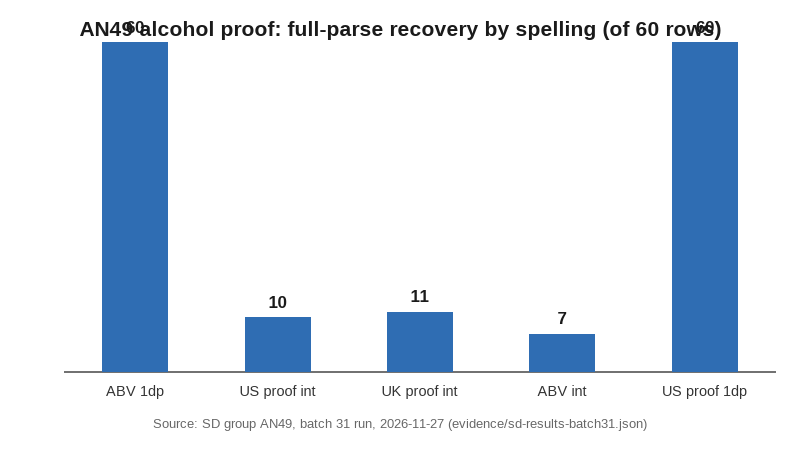
The register's canonical value is alcohol by volume in tenths of a percent, drawn from 0.0 to 96.0. Each block of sixty rows is spelled one way (Source: SD group AN49, batch 31 run, 2026-11-27):
| Spelling | Example | Full-parse recovery |
|---|---|---|
| ABV, one decimal | "29.2% ABV" | 60 of 60 |
| US proof, integer | "58 proof (US)" | 10 of 60 |
| UK proof, integer | "51 proof (UK)" | 11 of 60 |
| ABV, integer | "29% ABV" | 7 of 60 |
| US proof, one decimal | "58.4 proof (US)" | 60 of 60 |
The two decimal spellings are exact: one decimal of US proof steps by 0.05 of a percent, finer than the register's grid, so it returns every draw. The three integer spellings divide the losses among their steps — 0.5 of a percent for the American, 0.5715 for the British, a full percent for the integer ABV. The British survivors are eleven specific strengths whose round trip lands on the grid: 25.7, 78.9, 65.2, 11.4, 44.0, 91.4, 36.6, 84.6, 16.6, 18.3 and 75.4 percent (Source: batch 31 SD run notes, AN49 section). They are not the round numbers; they are the lattice points of a scale built on 57.15.
Stage by stage: what a reader of the register can recover
The exact-string stage reads the register's own one-decimal percentage and recovers 60. The structural stage adds the two American proof spellings, integer and decimal, and reaches 130. The full parser adds the British integer and the integer percentage and reaches 148 of 300 (Source: SD group AN49, batch 31 run, 2026-11-27). The stage shape is the case's quiet finding: nearly everything recoverable is recoverable inside one country's conventions. The British scale contributes eleven rows to the full parse and nothing to the structural stage, so a register merged from British sources reads, to an American parser, as 60 exact rows and 70 American-proof rows recovered, with 170 rows unrecovered — and the full parser's two added conventions rescue only 18 of those 170.
The drawn row: 29.2 percent in five spellings
The register's example row is a strength of 29.2% ABV. As a one-decimal percentage it reads "29.2% ABV" and returns itself. As an American integer proof it reads "58 proof (US)" and returns 29.0, the half-percent step costing two tenths. As a British integer proof it reads "51 proof (UK)" and returns 29.1, a tenth lost to the 0.5715 step. As an integer percentage it reads "29% ABV" and returns 29.0. As a one-decimal American proof it reads "58.4 proof (US)" and returns 29.2 exactly (Source: batch 31 SD run notes, AN49 section). One liquid, five inscriptions, three different values handed back by a correct parser. The parser is not wrong in any row; each spelling genuinely carries only the precision its step allows, and the two proof integers carry different wrong values because their steps differ.
The constructed bottle: 40.0 percent, where the scales show their disagreement
The register's draws are random, so the article adds the constructed case the harness spells exactly: a strength of 40.0% ABV, the standard whisky bottling strength. Its five spellings are "40.0% ABV", "80 proof (US)", "70 proof (UK)", "40% ABV" and "80.0 proof (US)", and every one of them round-trips exactly, because 40.0 sits on all three integer lattices at once (Source: batch 31 SD run notes, AN49 section). The bottle is the exception that displays the rule: the world's commonest strength is the rare row where the two proofs can be compared without loss, and the comparison is 80 against 70 — a ten-degree disagreement between two exact scales, printed on two labels of the same liquid. A register that stores the number without the scale's name holds a value that is wrong by ten degrees in one country or the other, with no error raised anywhere.
FAQ
How do US and UK proof differ? US proof is exactly twice the alcohol percentage. UK proof sets 100 degrees at 57.15% ABV, so a UK degree carries 0.5715 of a percent; 40.0% ABV is 80 US proof and 70 UK proof (Source: batch 31 SD run notes, AN49 section).
Which proof spelling loses the most values? The integer percentage loses most, 53 of 60. Of the two proof integers, the American loses 50 of 60 and the British 49 of 60; both decimal spellings lose none (Source: SD group AN49, batch 31 run, 2026-11-27).
Why does the British integer recover slightly more than the American? Its step, 0.5715 of a percent, is incommensurate with the register's 0.1 grid in a way that scatters its lattice points across the grid rather than along it; the measured counts are 11 against 10 on this draw (Source: batch 31 SD run notes, AN49 section).
Is 40.0% ABV exactly representable in both proof scales? Yes — 80 US proof and 70 UK proof, both exact, which is why the standard bottle is the cleanest place to see the two scales disagree by ten degrees.
The case reduces to one line with its condition attached: a proof number is meaningless without its country's name, because the two exact scales for the same liquid differ by ten degrees on the commonest bottle — so store the scale with the number, or store the percentage and derive the rest.