
What Does a Wind Register Do with a Spelling That Cannot Hold a Value?
Every register template has a field for the value, and the value's unit. A wind register kept for a coastal facility has five spellings in use — metre...
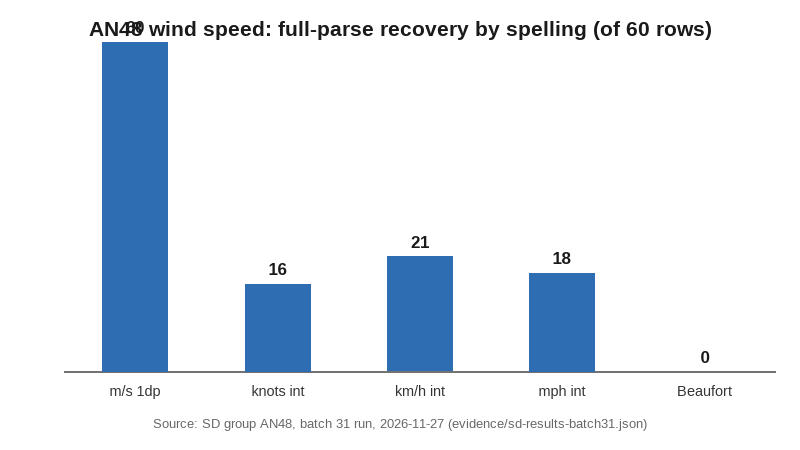
Every register template has a field for the value, and the value's unit. A wind register kept for a coastal facility has five spellings in use — metres per second at one decimal, whole knots, whole kilometres per hour, whole miles per hour, and the Beaufort number a watchkeeper reports over the radio. Four of the five are units. The fifth is a band: "Beaufort 6" says the wind lay somewhere between 10.8 and 13.8 metres per second, and no reading of it returns the register's number. This batch's wind-speed group measured all five spellings against a 300-item register: the band form recovered 0 of its 60 values exactly, while containing all 60 inside its named band (Source: SD group AN48, batch 31 run, 2026-11-27). This article is the filled template: how each field of the register should be completed, and what the parser at each stage can and cannot hand back.
What The Band Number means
The Band Number is a spelling that names an interval of a quantity instead of a value of it, so that a register written in that spelling bounds every entry and returns none of them. In the wind group, the register's canonical value is a wind speed in tenths of a metre per second, drawn from 0.5 to 60.0. The Beaufort spelling maps each value to the band whose standard range contains it — band 5 ends at 10.7 metres per second, band 6 runs to 13.8, band 12 is everything from 32.7 up — and the full parser, which can read all five spellings, returns no value at all for a band row: exact recovery 0 of 60, against band containment of 60 of 60 (Source: SD group AN48, batch 31 run, 2026-11-27).
The Band Number differs from The Mismatched Ruler, the concept of an earlier speed group in this series, in which five numeric unit spellings of one speed register recovered at rates ordered by each unit's written step width — every spelling was a unit, and every spelling returned some values exactly. The wind register's fifth spelling is not a unit with a wide step; it is a category with no step at all, because adjacent values inside one band share a spelling while values a tenth apart across a band edge do not. A mismatched ruler loses values at its rounding edges. A band number loses them everywhere except the edges, which are the only places it says anything precise.
The wind register template, field by field
The register draws 300 items and spells each in one of five forms, sixty rows each (Source: SD group AN48, batch 31 run, 2026-11-27). The template's fields, with the completion rule for each:
| Register field | How it is filled | What the full parser returns |
|---|---|---|
| Value, canonical | Tenths of a metre per second, 0.5 to 60.0 | The register's own number |
| Spelling: m/s, one decimal | "11.9 m/s" | Exact, 60 of 60 |
| Spelling: knots, integer | "23 kt" | Exact where the round trip lands on the grid, 16 of 60 |
| Spelling: km/h, integer | "43 km/h" | Exact on the same condition, 21 of 60 |
| Spelling: mph, integer | "27 mph" | Exact on the same condition, 18 of 60 |
| Spelling: Beaufort number | "Beaufort 6" | No value; the band only, 0 of 60 |
The three integer unit spellings lose values by the familiar mechanism: one knot is exactly 463/900 of a metre per second, one kilometre per hour exactly 5/18, one mile per hour exactly 0.44704, and an integer spelling keeps only the draws whose round trip through its step lands back on the register's tenth-of-a-metre grid (Source: batch 31 SD run notes, AN48 section). The first ten knot survivors — 27.8, 18.0, 59.7, 47.8, 6.2, 7.2, 22.1, 47.3, 33.4 and 38.6 metres per second — are the draws that happen to sit on the knot lattice (Source: batch 31 SD run notes, AN48 section). The Beaufort field is filled by a different rule entirely: not rounding to a step, but membership in a range.
What the three parser stages hand back
The exact-string stage reads only the register's own spelling, the one-decimal metre-per-second form, and recovers 60 of 300. The structural stage adds the knot spelling and reaches 76. The full parser reads all five forms and recovers 115 of 300: the exact form whole, the three integer unit forms at 16, 21 and 18, and the band form at zero (Source: SD group AN48, batch 31 run, 2026-11-27). The stage totals conceal the group's real shape, which is that 125 of the 240 unit-spelled rows are lost to step rounding while all 60 band rows are lost to category. A register audit that reports only the full-parse total, 115, cannot distinguish a register whose losses are rounding from one whose losses are structural; the per-form row of the table above can, and it is the row the template should carry into every report.
A worked row: 11.9 metres per second in all five spellings
The register's example row is a wind of 11.9 metres per second. Spelled in metres per second it reads "11.9 m/s" and the full parser returns 11.9. Spelled in knots it reads "23 kt" and returns 11.8, a tenth low. Spelled in kilometres per hour it reads "43 km/h" and returns 11.9 exactly. Spelled in miles per hour it reads "27 mph" and returns 12.1, two tenths high. Spelled as a Beaufort number it reads "Beaufort 6" and returns nothing, although 11.9 does lie inside band 6, which spans 10.8 to 13.8 metres per second (Source: batch 31 SD run notes, AN48 section). One row, five fates: two exact, two rounded away, one bounded but unreadable. A template that stores only the spelling a watchkeeper happened to use preserves, for the band rows, the weather's character and none of its measurement.
How a register should carry a band spelling
The template fix is a field, not a conversion. A band row should be stored with its band's edges — "Beaufort 6 (10.8–13.8 m/s)" — so that downstream code can treat the entry as the interval it is: usable for threshold questions (did the wind exceed 10.8?), unusable for averages, and visibly different from a rounded unit row, whose error is at most half a step. Averaging band midpoints into a mean wind fabricates precision the register never held; the containment result, 60 of 60, certifies the bands as honest bounds, not as estimates. Registers that mix the two kinds of row should also report them separately, because their failure modes differ: unit rows fail by tenths, band rows fail by the width of a band, up to 3.0 metres per second in band 6 and without limit in band 12.
FAQ
How many wind values does the Beaufort spelling recover? None of the sixty exactly. It contains all sixty inside their named bands, which is a bound, not a recovery (Source: SD group AN48, batch 31 run, 2026-11-27).
Which unit spelling recovers the most wind values? Kilometres per hour, 21 of 60, ahead of miles per hour at 18 and knots at 16; the register's own one-decimal spelling recovers all 60 (Source: SD group AN48, batch 31 run, 2026-11-27).
Why do the integer unit spellings lose so many values? Their steps — 0.5144, 0.2778 and 0.44704 metres per second — are wider than the register's 0.1 grid, so only draws sitting near each unit's lattice survive the round trip (Source: batch 31 SD run notes, AN48 section).
Can a band row be converted back to a value with a midpoint rule? A midpoint can be computed, but it is an estimate the register never recorded; the measured result is that the spelling itself returns no value, and reports should keep the two kinds of row separate.
The next action for any register holding Beaufort rows is mechanical: add the band-edge field, restate each band row as the interval it names, and re-report the register's recoverable count with band rows excluded from the value total and included in a separate bounded total.