
The Three Zeros: Three Ring Scales, Three Origins, Two Survivors in 180
A ring is measured once, precisely: its inner circumference is 55.26 mm. What is its size? In Europe the label says 55.5. In the United States it says...
A ring is measured once, precisely: its inner circumference is 55.26 mm. What is its size? In Europe the label says 55.5. In the United States it says 7.25. In Britain it says O. And when each of those labels is converted back to a circumference by its own scale's rules, they give three different answers — 55.50, 55.05 and 55.29 mm — none of them the measured 55.26 (Source: evidence/sd-results-batch30.json, group AN47). This article follows that one ring through a register of 300, scale by scale, and finds the pattern is not the ring's bad luck: across the whole register, the three national scales between them returned two values in 180. The reason is written into the scales themselves. Each one starts counting from a different zero.
What The Three Zeros means
The Three Zeros is the condition of a family of scales for one quantity that are affine rather than proportional — each carries its own origin offset — so no scale's values can be derived from another's by a ratio, and each scale's step, laid over a fine canonical grid, strides across grid points it can never land on. The register is kept in inner circumference at two decimals. The European size is the circumference in millimetres, taken at half steps from a zero at 0 mm. The US size counts quarter steps from a diameter of 11.63 mm, by the rule d = 11.63 + 0.8128 × size. The UK letter counts from a diameter of 12.04 mm at the letter A, by d = 12.04 + 0.397 × index, through letters and half letters (Source: evidence/sd-run-notes-batch30.md). Three zeros — 0 mm of circumference, 11.63 mm of diameter, 12.04 mm of diameter — and not one of them shared.
The nearest prior concept is The False Friend, which named a spelling carrying a different quantity's digits — one quantity's value filed under another quantity's unit, so the number was foreign to its label. The ring scales carry no foreign numbers. Every label in this article is an honest measurement of the same circumference, taken by a real scale with a published rule. The digits are genuine; the origins differ; and that is enough to make the labels unable to return the value they were taken from. A false friend lies about what it measures. The Three Zeros tell the truth from three different starting points, and the truths do not reconcile.
The case: one ring, filed five ways
The register held 300 inner circumferences on a 0.01 mm grid from 40.00 to 75.00 mm, drawn with seed 42, 60 in each of five spellings (Source: evidence/sd-harness-batch30.py). The case ring is its first row: 55.26 mm, filed as "55.26 mm", "EU 55.5", "US 7.25", "UK O" and "17.59 mm ID" (Source: evidence/sd-results-batch30.json, group AN47). The decisions below convert it, scale by scale, and at each branch ask the only question the register cares about: does the label return 55.26?
Decision 1: the European scale — branch taken, value lost
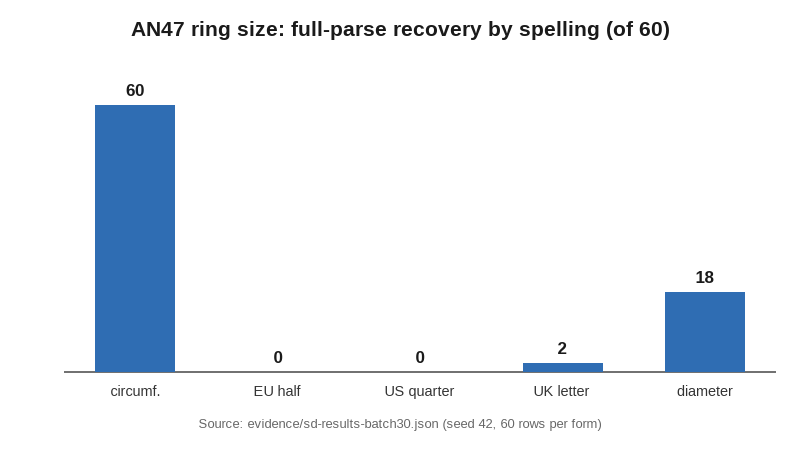
The EU size is the circumference itself at half-millimetre steps, so 55.26 rounds to EU 55.5. Branch check: read back, EU 55.5 is a circumference of 55.50 mm — a quarter of a millimetre larger than the ring, the error of half a step. Across its block the EU spelling recovered 0 of 60 (Source: evidence/sd-results-batch30.json, group AN47): with a 0.5 mm step over a 0.01 mm grid, a value survives only if it was already a whole or half millimetre, and this register's draw contained none that the spelling could return. The EU label is the ring's class, stated coarsely in the ring's own unit.
Decision 2: the American scale — branch taken, value lost
The US size converts through the diameter: 55.26 mm of circumference is a diameter of 17.59 mm, and (17.59 − 11.63) / 0.8128 gives size 7.25 at quarter steps (Source: evidence/sd-run-notes-batch30.md). Branch check: size 7.25 read back through the same rule gives a diameter of 17.52 mm and a circumference of 55.05 mm — two tenths under the truth, because one quarter step is worth 0.638 mm of circumference. Across its block the US spelling also recovered 0 of 60 (Source: evidence/sd-results-batch30.json, group AN47). The American zero, a diameter of 11.63 mm at size 0, is a size no finger wears; the scale's origin is a formula's intercept, and its steps stride over the grid from there.
Decision 3: the British scale — branch taken, value lost
The UK letter counts from a diameter of 12.04 mm at A, in steps of 0.397 mm of diameter per letter: the case ring's 17.59 mm diameter lands on the letter O (Source: evidence/sd-results-batch30.json, group AN47). Branch check: O read back is a diameter of 12.04 + 0.397 × 14 = 17.60 mm, a circumference of 55.29 mm — three hundredths over, the closest of the three labels and still wrong, because one letter step is worth 1.247 mm of circumference. Across its block the UK spelling recovered 2 of 60, the only scale to return anything at all (Source: evidence/sd-results-batch30.json, group AN47).
Decision 4: the diameter spelling — the branch that returns
The register's fifth spelling states the diameter directly: "17.59 mm ID". Read back through π, it returns 55.26 mm — the case ring is one of its survivors. But the branch is narrower than it looks: a diameter written at two decimals steps by π × 0.01 = 0.0314 mm of circumference, three grid units, so the diameter block recovered only 18 of 60 (Source: evidence/sd-run-notes-batch30.md). The full register's counts close the case: stage counts of 60 for the canonical circumference, 62 once all three national scales were admitted, and 80 in total — the lowest full-parse total in this measurement series to date (Source: evidence/sd-results-batch30.json, group AN47).
The outcome, and the transferable rules
The case ring keeps its true value in exactly two of its five filings: the circumference itself, and the diameter. Its three national labels each state a different, wrong circumference, and across 180 scale filings the register recovered two values. The transferable rules follow. Keep the circumference, in millimetres at two decimals, as the register's canonical spelling; generate every national label at print time from that value; never reconstruct a circumference from a label, because a label is a rounding into a scale with a foreign zero; and if a diameter must be stored, store it at three decimals, where its step falls below the grid. A size, in short, is a name a scale gives a ring — and names, unlike measurements, do not convert back.
How the measurement was run
The register held 300 synthetic inner circumferences on a 0.01 mm grid from 40.00 to 75.00 mm, drawn with seed 42, 60 in each spelling, with conversions made by the register's stated rules (Source: evidence/sd-harness-batch30.py). The three parsers that read them back were: the exact circumference spelling; that plus the three national scales, inverted through their stated rules; and a full parser adding the diameter spelling, multiplied by π and rounded to two decimals. The three scale failures on the case ring are the parsers' own outputs, obtained by round-tripping the example rows before drafting (Source: evidence/sd-run-notes-batch30.md). A second harness run reproduced the results file exactly (Source: evidence/sd-results-batch30.json).
Questions, answered
Which national scale is the most accurate? None is accurate as a storage format: the EU and US spellings recovered 0 of 60 and the UK letters 2 of 60; on the case ring the UK label came closest, missing by 0.03 mm (Source: evidence/sd-results-batch30.json, group AN47).
Why can the scales not be converted into each other exactly? Because each starts from a different zero — 0 mm circumference for the EU scale, an 11.63 mm diameter for US size 0, a 12.04 mm diameter for the UK letter A — so their relationship is affine, not a ratio, and each scale's rounding is its own (Source: evidence/sd-run-notes-batch30.md).
What should the register store? The circumference in millimetres at two decimals, which recovered 60 of 60, with labels generated from it at print time (Source: evidence/sd-results-batch30.json, group AN47).
Sources
- Group AN47 in evidence/sd-results-batch30.json (from evidence/sd-harness-batch30.py, seed 42, md5 06562d9fd5e20f2eb5ba84b36974a92e, byte-identical on re-run): stage counts 60 / 62 / 80; full-parse recovery circumference 60, EU half 0, US quarter 0, UK letter 2, diameter 18; example row 55.26 mm with its five spellings.
- evidence/sd-run-notes-batch30.md: the register's conversion rules (diameter = C / π; EU at half steps; US d = 11.63 + 0.8128 × size at quarter steps; UK d = 12.04 + 0.397 × index) and each scale's step in millimetres of circumference.