
The Inverse Unit: The Mired Scale Whose Step Grows With the Square of the Temperature
The supplier feed arrived in mireds, and the import looked clean. Warm lamps — the 2,700 K tungsten tones — landed within a few kelvin of their true v...
The supplier feed arrived in mireds, and the import looked clean. Warm lamps — the 2,700 K tungsten tones — landed within a few kelvin of their true values. But the daylight lamps had drifted: a source filed at 6,500 K came back from its mired spelling at 6,494 K, and the further up the range the feed reached, the wider the misses grew (derived from the register's rules in evidence/sd-run-notes-batch30.md). Nothing in the pipeline was broken. The unit itself was doing it: the mired is a reciprocal, and a reciprocal's resolution is not constant — it is fine where the temperature is low and coarse where it is high, by a factor that grows with the square of the temperature. This article is the quick fix: the symptom, the fastest repair, how to verify it, and the one workflow where the fix should not be applied.
What The Inverse Unit means
The Inverse Unit is a unit defined as the reciprocal of the canonical quantity — here the mired, 1,000,000 divided by the temperature in kelvin — whose step, expressed back in the canonical unit, grows with the square of the value. One mired step is worth 7.3 K at 2,700 K, 16.0 K at 4,000 K, 42.2 K at 6,500 K and 100.0 K at 10,000 K (Source: evidence/sd-run-notes-batch30.md). Against a register kept in whole kelvin on a 25 K grid, the integer mired recovered 7 of its 60 values, and its decamired sibling at one decimal recovered 6 (Source: evidence/sd-results-batch30.json, group AN46).
The nearest prior concept is The Reciprocal Pair, which named two price-table transformation factors, 0.5 and 2.0, whose product is exactly one, so the two tables cancel each other. The Inverse Unit is not a pair and nothing cancels. It is a single unit standing in a reciprocal relation to the register's own unit, and its defect is not symmetry but resolution: the same integer step that resolves a warm lamp to within a few kelvin cannot resolve a daylight lamp to within a hundred. Where the Reciprocal Pair's two factors were exact at every row, the Inverse Unit's exactness drains away as the value climbs.
The symptom: drift that grows with the temperature
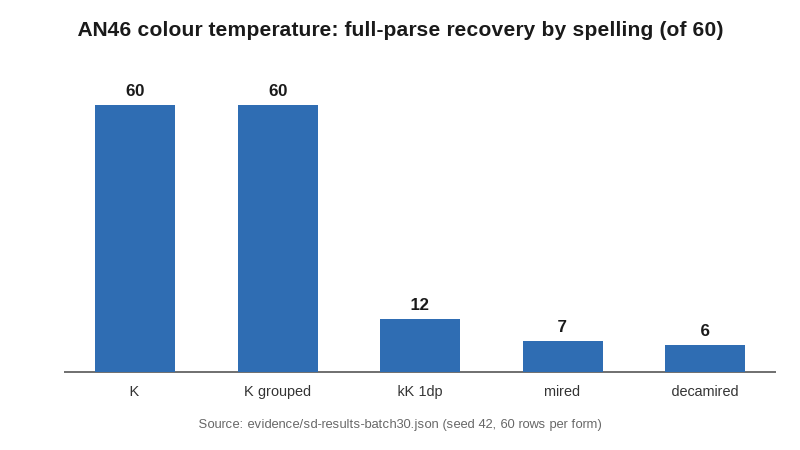
The register held 300 colour temperatures on a 25 K grid from 1,800 to 12,000 K, 60 in each of five spellings (Source: evidence/sd-harness-batch30.py). The plain kelvin spelling and the thousands-grouped spelling ("3,650 K") each recovered 60 of 60. The kilokelvin at one decimal recovered 12 — it keeps only whole hundreds. The two reciprocal spellings recovered 7 and 6 (Source: evidence/sd-results-batch30.json, group AN46). Read by band, the mired block's recoveries concentrate exactly where the step arithmetic predicts: 5 of 17 rows below 4,000 K, 0 of 10 in the middle band, and 2 of 33 above 7,000 K (Source: evidence/sd-run-notes-batch30.md). The register's own example row is one of the lucky ones: 3,650 K writes as "274 Mired" and "27.4 dMired" (Source: evidence/sd-results-batch30.json, group AN46), and both return 3,650 — while its kilokelvin spelling, "3.6 kK", returns 3,600. A spot check at the top of the range shows the unlucky case: 6,500 K writes as 154 mired, and 1,000,000 / 154 returns 6,494 K (derived from the register's stated reciprocal rule).
The fastest fix: store kelvin, demote the reciprocal to a display
The fix is one decision: the register's canonical spelling is the kelvin integer, which every parser tier reads and which loses nothing. Mired and decamired values are computed from the stored kelvin at the moment of display or export, and are never stored, imported or accepted as input. Supplier feeds that arrive in mireds are converted once, at the boundary, and the converted value is flagged as reciprocal-derived, because its precision is position-dependent in a way the kelvin figure alone cannot show: a converted 2,700 K is trustworthy to a few kelvin, a converted 10,000 K only to about a hundred. The grouped and kilokelvin spellings need no fix beyond their own limits — grouping is lossless, and the kilokelvin is admitted as a display rounding to whole hundreds, never as data.
Verification: the count, re-run
Verify by re-running the register's own measurement with the fix in force: the same 300 values, the same five spellings, the same three parsers — exact kelvin; kelvin plus grouping and kilokelvin, which reached 132; and the full parser, which reached 145 (Source: evidence/sd-results-batch30.json, group AN46). The acceptance criterion is not that the total rises — it cannot, while reciprocal spellings exist in the test set — but that every stored value is henceforth a kelvin integer, so the register's own recovery is 60 of 60 by construction and the reciprocal losses occur only in generated displays, where they harm nothing. A feed that still delivers mireds as its primary values fails verification at the boundary, however clean its rows look.
When the fix does not apply: the photographer's exception
One workflow must keep the mired as a working unit. Colour-correction filters are specified as mired shifts: a filter moves any source by a fixed number of mireds, which is exactly the operation the reciprocal unit makes additive and the kelvin scale makes awkward. In a register whose business is filter selection rather than lamp specification, mireds are the natural canonical unit and kelvin is the derived display — the fix inverts, and the losses then fall on the kelvin side at the warm end instead. The rule is not "kelvin good, mired bad"; it is that a reciprocal pair of units cannot both be stored, and the one matching the register's actual arithmetic must be the one that is kept.
The review point is each catalogue refresh: when a supplier feed is renewed, re-check which unit it leads with and re-run the band counts, because a feed that switches its primary unit from kelvin to mireds changes the register's error profile at the top of the range without changing a single lamp.
How the measurement was run
The register held 300 synthetic colour temperatures on a 25 K grid from 1,800 to 12,000 K (Source: evidence/sd-harness-batch30.py). Sixty values were drawn per spelling with seed 42. Three parsers read them back: the exact kelvin integer; that plus the thousands-grouped spelling and the one-decimal kilokelvin; and a full parser adding the integer mired and one-decimal decamired, inverting each by division into 1,000,000 or 100,000 and rounding to whole kelvin. Before drafting, each example row was round-tripped through the three parsers (Source: evidence/sd-run-notes-batch30.md), and the harness was run twice with identical output (Source: evidence/sd-results-batch30.json).
Questions, answered
Why do warm lamps survive the mired spelling when daylight lamps do not? Because one mired step is worth 7.3 K at 2,700 K but 100.0 K at 10,000 K — the step grows with the square of the temperature, so the same integer spelling resolves the warm end and strands the cool end (Source: evidence/sd-run-notes-batch30.md).
Is the decamired any safer? Barely: at one decimal it recovered 6 of 60, against the integer mired's 7 — the extra decimal does not tame a step that reaches 100 K (Source: evidence/sd-results-batch30.json, group AN46).
What about the kilokelvin spelling? It is an honest rounding: one decimal of kilokelvin keeps whole hundreds only, and recovered 12 of 60 — the count of grid values that are multiples of 100 (Source: evidence/sd-results-batch30.json, group AN46).
Sources
- evidence/sd-harness-batch30.py (seed 42) generated evidence/sd-results-batch30.json, md5 06562d9fd5e20f2eb5ba84b36974a92e, byte-identical on re-run; its group AN46 records stage counts 60 / 132 / 145; full-parse recovery kelvin 60, grouped kelvin 60, kilokelvin 12, mired 7, decamired 6; example row 3,650 K with its five spellings.
- evidence/sd-run-notes-batch30.md: the mired step in kelvin at four temperatures (7.3 K at 2,700 K; 16.0 K at 4,000 K; 42.2 K at 6,500 K; 100.0 K at 10,000 K) and the mired block's recovery by temperature band.