
The Coarse Label: The Integer R-Value That Keeps 2 of 60 Insulation Ratings
The biggest number on the insulation pack is the least accurate spelling in the register. Written as an integer — R-18, the form printed largest on pa...
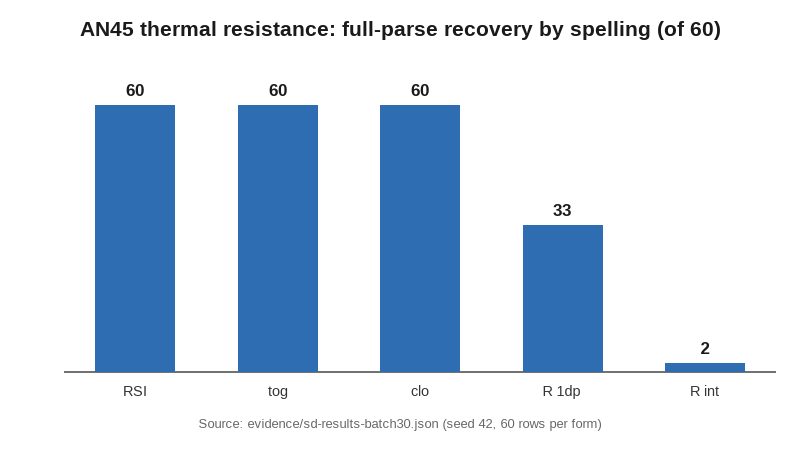
The biggest number on the insulation pack is the least accurate spelling in the register. Written as an integer — R-18, the form printed largest on packaging across North America — the imperial R-value recovered 2 of its 60 values. Written with one decimal it recovered 33. And the two spellings nobody prints on a pack, the tog of the duvet trade and the clo of the clothing trade, recovered all 60 each, because both are exact or near-exact decimals of the metric value the register is kept in (Source: evidence/sd-results-batch30.json, group AN45). A buyer comparing packs is comparing the coarsest surviving spelling of a number that exists, precisely, in three other systems. This article lists the register's five spellings as resources — what each one is, where it comes from, and what it costs in lost values.
What The Coarse Label means
The Coarse Label is a consumer-facing integer label whose step, converted back into the canonical unit, is so much wider than the register's grid that almost no value survives the round trip — the label is a name for a neighbourhood, not a measurement. The register is kept in RSI, thermal resistance in m²K/W at two decimals. The imperial R is RSI × 5.678263 (Source: evidence/sd-run-notes-batch30.md), so one integer step of R is worth 0.1761 RSI — nearly eighteen grid steps — and the integer block recovered 2 of 60 under the full parser (Source: evidence/sd-results-batch30.json, group AN45). Even the one-decimal R, stepping 0.01761 RSI, recovered only 33.
The nearest prior concept is The Sixth Step, which named an integer spelling — degrees per second, carrying the friendly exact factor of six — made coarse purely by being written as whole numbers. The Coarse Label shares the integer mechanism but adds two turns. Its factor is not a friendly integer but 5.678263, so its steps do not even align with the grid periodically; and its integer is not a back-office spelling but the public label itself, the one number a buyer is expected to compare. The Sixth Step's coarseness hid in a derived column. This one is printed on the front of the pack.
The need: a register of insulation values that survives export
The register holds 300 thermal resistances from 0.10 to 6.00 RSI on a 0.01 grid, drawn with seed 42, 60 in each spelling (Source: evidence/sd-harness-batch30.py). Its readers recovered 60 of 300 from the canonical spelling alone, 180 once the two decimal systems were admitted, and 215 in total (Source: evidence/sd-results-batch30.json, group AN45). The need is a spelling set that can leave the register — to a supplier, a marketplace, a building-code filing — and come back unchanged. Each spelling below is listed as a resource with its source and its cost, where cost is measured in the only currency this register has: values lost out of 60.
Resource group 1: the metric spellings — RSI and its two decimal cousins
RSI at two decimals is the canonical resource: cost zero, recovery 60 of 60, source the register itself. The tog, defined as exactly 0.1 RSI (Source: evidence/sd-run-notes-batch30.md), written at one decimal, steps by exactly one grid unit and also costs zero: 60 of 60. The clo, at 0.155 RSI per unit (Source: evidence/sd-run-notes-batch30.md), written at two decimals, steps by 0.00155 RSI — finer than the grid — and costs zero: 60 of 60 (Source: evidence/sd-results-batch30.json, group AN45). Between them, the three decimal systems are interchangeable without loss; a register could be re-based in togs tomorrow and lose nothing, which is more than the headline unit can say.
Resource group 2: the imperial label, at two precisions
The R-value at one decimal is a half-resource: recovery 33 of 60, cost 27 values, source the imperial conversion R = RSI × 5.678263 (Source: evidence/sd-results-batch30.json, group AN45). The R-value as an integer is barely a resource at all: recovery 2 of 60, cost 58. The register's example row shows both failures on one value: 3.09 RSI is written "R-17.5" and "R-18" (Source: evidence/sd-results-batch30.json, group AN45), and round-tripped before drafting, the first returns 3.08 and the second returns 3.17 — the integer label overshoots the true resistance by eight grid steps, enough to move a product into a different performance class in any comparison built from labels. As a resource, the integer R is fit for one purpose: naming the approximate class on a shelf edge, in the knowledge that the number cannot be taken back.
The gaps: what no spelling in this register provides
Two gaps remain after all five resources are listed. First, no spelling carries both the public label and the precision: the register can have R-18's recognisability or the tog's exactness, not both in one string, so every export must choose which audience it serves. Second, no spelling records which system a value arrived in; once an integer R has been converted and stored as RSI, the coarseness of its origin is invisible, and the register cannot later distinguish a measured 3.17 from a label-derived 3.17 that was really 3.09. Provenance — the spelling of arrival — is the missing sixth field, and until the register carries it, label-derived values should be quarantined from measured ones.
The next action is a single afternoon's work: add the provenance field, mark every existing value that entered through an integer R label as label-derived, and re-issue the register with RSI as the only stored spelling and the R label generated at print time, at one decimal, with its step printed beside it.
How the measurement was run
The register held 300 synthetic thermal resistances on a 0.01 RSI grid from 0.10 to 6.00, drawn with seed 42, 60 in each spelling, converted with the register's stated rules (Source: evidence/sd-harness-batch30.py). Three parsers read them back: the exact RSI spelling; that plus the tog and clo decimal systems; and a full parser adding both R precisions, dividing by 5.678263 and rounding to two decimals. Every example row cited here was fed back through the three parsers before drafting (Source: evidence/sd-run-notes-batch30.md). The harness's results file is reproduced byte for byte on re-run (Source: evidence/sd-results-batch30.json).
Questions, answered
Why does the tog lose nothing when the R-value loses so much? One tog is exactly 0.1 RSI, so its one-decimal spelling steps by exactly the register's grid; one integer R steps by 0.1761 RSI, nearly eighteen grids (Source: evidence/sd-run-notes-batch30.md).
Is the one-decimal R-value safe to store? No. It recovered 33 of 60 — better than the integer's 2, but still a display spelling, not a storage format (Source: evidence/sd-results-batch30.json, group AN45).
What should a buyer do with the R number on a pack? Treat it as a class name, not a measurement: two products labelled R-18 can differ by most of 0.18 RSI, and a comparison that matters should be made in RSI or togs from the manufacturer's data sheet (Source: evidence/sd-results-batch30.json, group AN45).
Sources
- For group AN45, evidence/sd-results-batch30.json — generated by evidence/sd-harness-batch30.py at seed 42 and reproduced byte-identically on re-run (md5 06562d9fd5e20f2eb5ba84b36974a92e) — records stage counts 60 / 180 / 215; full-parse recovery RSI 60, tog 60, clo 60, R at one decimal 33, R integer 2; example row 3.09 RSI with its five spellings.
- evidence/sd-run-notes-batch30.md: the register's rules (R = RSI × 5.678263; 1 clo = 0.155 RSI; 1 tog = 0.1 RSI) and the step size of each spelling in RSI.