
The Thin-End Gauge: The AWG Number That Only Returns Thin Wires
The least informative spelling in the register is the only one that knows where it is. A bare integer — the American wire gauge number — recovered jus...
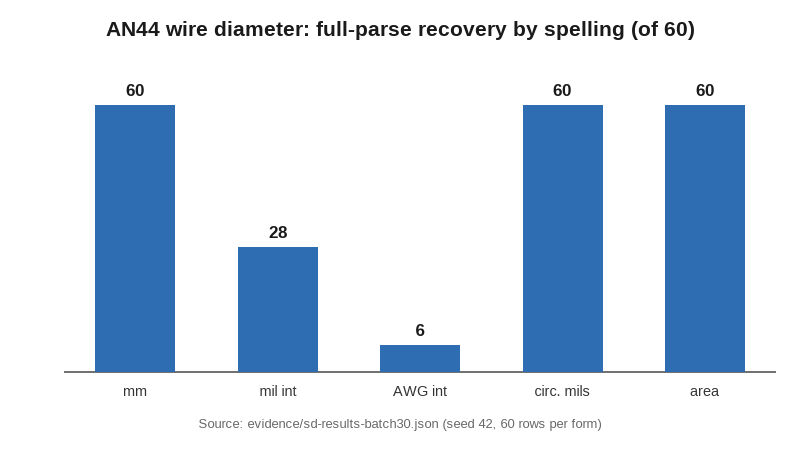
The least informative spelling in the register is the only one that knows where it is. A bare integer — the American wire gauge number — recovered just 6 of its 60 diameters, and every one of the six is a thin wire, 1.29 mm or under; at the thick end of the register it recovered nothing at all (Source: evidence/sd-results-batch30.json, group AN44). Meanwhile two spellings that do not state a diameter at all — they state an area, in circular mils and in square millimetres — recovered every value they were given, once the reader agreed to take a square root. A gauge number is a position on an exponential scale, and its precision is not a property of the spelling but of the place: fine where the wire is thin, coarse where it is thick. This guide walks the register's five spellings in order, with the step each one must pass.
What The Thin-End Gauge means
The Thin-End Gauge is a gauge scale whose step, expressed in the canonical unit, grows exponentially along the register, so the same integer spelling is finer than the grid at one end and far coarser at the other. The register's rule is the standard AWG relation, diameter d = 0.127 × 92^((36−n)/39) millimetres for gauge n (Source: evidence/sd-run-notes-batch30.md). One gauge step is worth 0.012 mm near 0.10 mm, 0.126 mm near 1.00 mm and 0.638 mm near 5.00 mm (Source: evidence/sd-run-notes-batch30.md), against a register grid of 0.01 mm. The gauge block's six recoveries — 0.14, 0.20, 0.25, 0.40, 0.57 and 1.29 mm — all sit where the step is at or below the grid's neighbourhood (Source: evidence/sd-run-notes-batch30.md).
The nearest prior concept is The Thousandth Inch, which named a familiar unit — the inch written to three decimals in a type register — whose smallest digit was coarser than the grid everywhere, so the spelling lost uniformly across its range. The Thin-End Gauge loses non-uniformly, and that is the distinction: its step is not a fixed size but a function of the value itself, multiplying by about 12% per gauge number, so a recovery table for the gauge is meaningless unless it is read by position. The inch was a blunt instrument. The gauge is a sharp one that dulls as it goes.
Step 1: Inventory the spellings, with the inversion each one demands
Goal: a complete list of the register's five spellings and the operation that returns each to millimetres. The register holds: diameter in mm at two decimals (the canonical spelling, no inversion); diameter in whole mils, thousandths of an inch, inverted by multiplying by 0.0254; the AWG integer, inverted through the exponential above; circular mils, the square of the diameter in mils, inverted by a square root and the mil factor; and cross-section area in mm² at three decimals, inverted by the square root of 4A/π (Source: evidence/sd-run-notes-batch30.md). Pass criterion: every spelling has its inversion written beside it, including the two square roots — a spelling whose inversion is "look it up" is not yet inventoried.
Step 2: Compute each spelling's step at both ends of the range
Goal: the step of every spelling, in millimetres, at the register's thin end and thick end. The mm spelling steps by 0.01 everywhere. The mil integer steps by 0.0254 everywhere — two and a half grids — which predicts its partial recovery before any counting is done. The circular-mil integer and the three-decimal area both step far below the grid across the range, because their written precision grows with the value. The gauge alone changes character: 0.012 mm per step near 0.10 mm, 0.638 mm near 5.00 mm (Source: evidence/sd-run-notes-batch30.md). Pass criterion: the prediction is written down before the count — gauge partial and position-dependent, mil partial and uniform, both area spellings complete.
Step 3: Run the round-trip count and read it by position
Goal: recovery counts per spelling, with the gauge's count broken down by where its survivors sit. The full parser recovered: mm 60 of 60, mil integer 28 of 60, AWG integer 6 of 60, circular mils 60 of 60, area 60 of 60; the stage counts were 60 for the exact mm spelling, 88 once the mil integer was admitted, and 214 in total (Source: evidence/sd-results-batch30.json, group AN44). The register's example row shows the split in one wire: 2.38 mm is written "2.38 mm", "94 mil", "AWG 11", "8780 cmil" and "4.449 mm2" (Source: evidence/sd-results-batch30.json, group AN44). Round-tripped before drafting, the mil spelling returns 2.39 and the gauge returns 2.31 — both wrong, the gauge by seven hundredths — while the two area spellings return 2.38 exactly. Pass criterion: the counts match the Step 2 predictions, and the gauge's six survivors are listed by diameter, not just counted.
Step 4: File by diameter, keep the areas, demote the gauge to a label
Goal: a filing rule the register can enforce. Diameter in mm at two decimals is the canonical spelling. The two area spellings are acceptable copies, since both round-trip completely at their written precisions, provided the reader implements the square root. The mil integer is a display spelling: it loses 32 of 60 uniformly, so it may be printed but never stored. The gauge is a label, not a measurement: it may ride along as a name for the wire, the way it does on packaging, but no value may ever be reconstructed from it above the thin end — and the register now knows where the thin end stops, at about 1.29 mm in this draw. Pass criterion: the rule names, for each spelling, whether it may be stored, printed or merely attached.
In one sentence: keep the diameter, trust the areas, print the mils, and never let a gauge number pretend to be a measurement anywhere except the thin end where its step is finer than your grid.
How the measurement was run
The register held 300 synthetic diameters on a 0.01 mm grid from 0.05 to 5.00 mm, drawn with seed 42, 60 in each spelling (Source: evidence/sd-harness-batch30.py). Three parsers read them back: the exact mm spelling; that plus the mil integer; and a full parser adding the gauge exponential and both square-root inversions, rounding to two decimals. The failures quoted above are the parsers' own verdicts on the example rows, which were round-tripped before drafting began (Source: evidence/sd-run-notes-batch30.md); the results file was reproduced exactly when the harness ran a second time (Source: evidence/sd-results-batch30.json).
Questions, answered
Why does the gauge recover anything at all? At the thin end one gauge step is worth about 0.012 mm, close to the 0.01 mm grid, so a few diameters land on gauge values and return exactly; all six survivors are 1.29 mm or thinner (Source: evidence/sd-run-notes-batch30.md).
The area spellings state the wrong quantity. Why do they win? Because their written precision, inverted through the square root, steps below the grid everywhere in the range: circular mils and three-decimal mm² both recovered 60 of 60 (Source: evidence/sd-results-batch30.json, group AN44).
Is the mil integer at least uniformly reliable? It is uniformly unreliable: a 0.0254 mm step against a 0.01 mm grid recovered 28 of 60, spread across the range rather than concentrated at one end (Source: evidence/sd-results-batch30.json, group AN44).
Sources
- evidence/sd-results-batch30.json (seed 42; md5 06562d9fd5e20f2eb5ba84b36974a92e; byte-identical on re-run), group AN44: stage counts 60 / 88 / 214; full-parse recovery mm 60, mil integer 28, AWG integer 6, circular mils 60, area 60; example row 2.38 mm with its five spellings. Generated by evidence/sd-harness-batch30.py.
- evidence/sd-run-notes-batch30.md: the register's rules (1 mil = 0.0254 mm; AWG d = 0.127 × 92^((36−n)/39) mm; circular mils and A = π d² / 4), the gauge step at three diameters, and the six recovered diameters (0.14, 0.20, 0.25, 0.40, 0.57, 1.29 mm).