
The Half-Lost Degree: The German Hardness Degree That Loses 30 of 60 Values
Thirty of sixty. That is the survival count of the German hardness degree in a register of water hardness values: written at the precision German prac...
Thirty of sixty. That is the survival count of the German hardness degree in a register of water hardness values: written at the precision German practice uses, one decimal place, exactly half of its values come back changed, while the French degree beside it — written at the same one decimal place — loses none at all (Source: evidence/sd-results-batch30.json, group AN43). Same quantity, same decimal count, opposite outcomes. The difference is not care or convention; it is the size of each degree in the register's canonical unit, and whether that size divides the grid the register is kept on. This article is an audit of the five spellings, item by item, with the fix each failed item needs.
What The Half-Lost Degree means
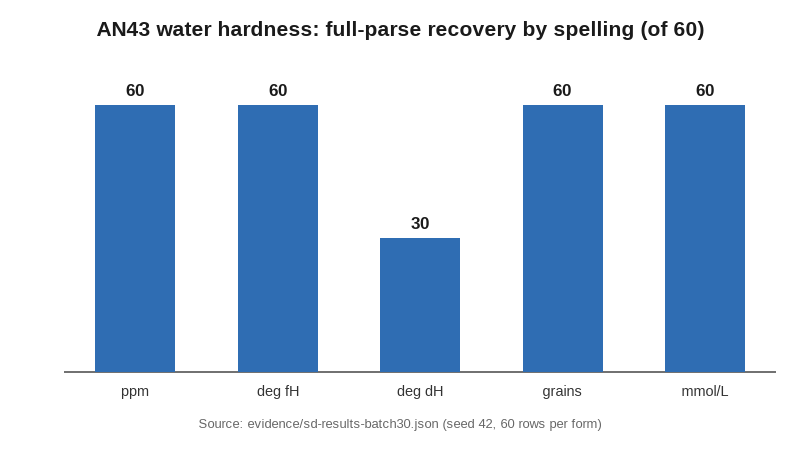
The Half-Lost Degree is a unit whose size, at the precision it is conventionally written, steps across the canonical grid at an interval that lands between grid points, so roughly half its values fall mid-step and are moved when read back. Water hardness is one quantity with five national spellings: the register's canonical parts per million as CaCO3, the German degree at 17.848 ppm per degree, the French degree at exactly 10 ppm, the US grain per gallon at 17.118 ppm, and the millimole per litre at 100.09 ppm (Source: evidence/sd-run-notes-batch30.md). Written at one decimal, the German degree steps by 1.7848 ppm against a one-ppm grid, and recovered 30 of 60 values under the full parser (Source: evidence/sd-results-batch30.json, group AN43).
The nearest prior concept is The Written Degrees, and the shared word is a trap to be disarmed. The Written Degrees named a coordinate column mixing two notations of a single system — decimal degrees and degree-minute-second strings — where every value was sound and only the presentation varied. The Half-Lost Degree is not a notation mix. Each hardness degree is a separately calibrated national scale with its own exact size in ppm, the values are written exactly as each scale prescribes, and the loss is arithmetic: a step of 1.7848 ppm cannot represent a grid of 1 ppm, no matter how carefully it is written.
The audit object: one register, five spellings, three readers
The register held 300 hardness values as whole ppm from 5 to 600, 60 in each spelling (Source: evidence/sd-harness-batch30.py). Three readers were audited against it: an exact-string reader for the ppm spelling, which recovered 60 of 300; a reader that also accepts the French degree, which reached 120; and a full reader accepting all five spellings, which reached 270 (Source: evidence/sd-results-batch30.json, group AN43). Each spelling below is checked on three items: is its size in ppm stated, is its written step computed, and does its recovery count match the step's prediction?
Item 1: the French degree — pass
Check: size stated, 10 ppm exactly. Step computed: at one decimal, 1 ppm — exactly the grid. Recovery: 60 of 60 (Source: evidence/sd-results-batch30.json, group AN43). Verdict: pass on all three items. The French degree is a perfect ladder because its size is a round decimal of the canonical unit; one decimal of French degrees is one ppm, neither finer nor coarser than the register itself. A register could be kept in French degrees at one decimal and lose nothing, which no other degree in this audit can claim at its conventional precision.
Item 2: the German degree — fail, with a worked failure
Check: size stated, 17.848 ppm. Step computed: at one decimal, 1.7848 ppm — coarser than the grid and not a divisor of it. Recovery: 30 of 60 (Source: evidence/sd-results-batch30.json, group AN43). Verdict: fail. The register's example row shows the degree at its luckiest: 64 ppm writes as "3.6 °dH" and returns 64, because 3.6 × 17.848 = 64.25 rounds home. The next value over shows the truth: 101 ppm writes as "5.7 °dH", and 5.7 × 17.848 = 101.73, which returns 102 (derived from the register's stated factor of 17.848 ppm per degree). Whether a German-degree value survives is decided by where it falls inside the 1.7848 ppm step, and across the block that coin lands heads exactly half the time.
Items 3 and 4: the grain and the millimole — pass
Check, grain: size stated, 17.118 ppm per grain per US gallon. Step computed: at two decimals, 0.17118 ppm — finer than the grid. Recovery: 60 of 60 (Source: evidence/sd-results-batch30.json, group AN43). Check, millimole: size stated, 100.09 ppm per mmol/L. Step computed: at three decimals, 0.10009 ppm — finer than the grid. Recovery: 60 of 60 (Source: evidence/sd-results-batch30.json, group AN43). Verdict: pass for both. Their sizes in ppm are no rounder than the German degree's; what saves them is the decimal count each is conventionally written with, which pushes the written step below the grid. Precision, not nationality, is the variable.
The fix, and the re-audit
The fix follows from the items. The register's canonical spelling stays ppm, the only spelling every reader tier accepts. The German degree is reclassified as display-only: it may be printed for a German reader, computed from the stored ppm at the moment of printing, and never stored, exported or accepted as input — at two decimals its step would be 0.17848 ppm and it would pass, but one decimal is its convention and the convention is what arrives. The re-audit is the audit itself, re-run after the fix: the same 300 values, the same three readers, with the German block now generated at print time from canonical values, and the acceptance criterion that no stored spelling steps coarser than one ppm.
The decision rule for any future degree, scale or unit proposed for this register: compute its written step in ppm before admitting it — if the step exceeds one ppm, or fails to divide the values it must carry, the unit is a display, not a storage format, whatever its country's practice says.
How the measurement was run
The register held 300 synthetic hardness values as whole ppm from 5 to 600, drawn with seed 42, 60 in each spelling, converted with the register's stated factors (Source: evidence/sd-harness-batch30.py). Three parsers read them back: exact ppm only; ppm plus the French degree; and a full parser for all five spellings, converting each by its factor and rounding to the nearest whole ppm. Before any drafting, the example rows were passed back through these same parsers (Source: evidence/sd-run-notes-batch30.md), and a second run of the harness returned the identical results file (Source: evidence/sd-results-batch30.json).
Questions, answered
Why does the French degree survive at one decimal when the German does not? Because one French degree is exactly 10 ppm, so one decimal of it steps by exactly one ppm, the grid itself; one German degree is 17.848 ppm, so one decimal steps by 1.7848 ppm and strands half the values mid-step (Source: evidence/sd-results-batch30.json, group AN43).
Would two decimals save the German degree? Yes — its step would fall to 0.17848 ppm, finer than the grid — but the audit judges the spelling as conventionally written, at one decimal, which is what registers actually receive (Source: evidence/sd-run-notes-batch30.md).
Which spellings can the register safely store? ppm itself, and any spelling whose written step is at or below one ppm: the French degree at one decimal, the grain at two, the millimole at three (Source: evidence/sd-results-batch30.json, group AN43).
Sources
- The harness is evidence/sd-harness-batch30.py; its output, evidence/sd-results-batch30.json (seed 42, md5 06562d9fd5e20f2eb5ba84b36974a92e, reproduced exactly on re-run), records for group AN43: stage counts 60 / 120 / 270; full-parse recovery ppm 60, French degree 60, German degree 30, grain 60, millimole 60; example row 64 ppm with its five spellings.
- evidence/sd-run-notes-batch30.md: the register's conversion factors (1 °dH = 17.848 ppm; 1 °fH = 10 ppm; 1 grain per US gallon = 17.118 ppm; 1 mmol/L = 100.09 ppm) and the step arithmetic for each spelling.